
 The Department of War announced September 14, 2026, that it has issued a targeted legal waiver allowing current and former military personnel, civilian employees and contractors to provide protected information concerning Unidentified Anomalous Phenomena (UAP) directly to designated representatives of the government’s PURSUE effort.
According to the Department, the waiver establishes an “authorized, legally protected disclosure mechanism” for individuals possessing UAP-related National Defense Information, or NDI.
“This waiver establishes an authorized, legally protected disclosure mechanism for current and former personnel to provide UAP-related National Defense Information (NDI) to designated representatives of the PURSUE effort,” the Department said.
The announcement is significant, particularly because the Department expressly references Special Access Program Indoctrination Agreements alongside conventional nondisclosure agreements.
But the underlying concept, allowing government personnel to provide otherwise protected UAP information to specifically authorized government investigators without violating their NDAs, is not new.
Documents previously obtained and published by The Black Vault show that similar protections were already established for disclosures to the All-domain Anomaly Resolution Office (AARO). Those protections became a central issue during AARO’s unsuccessful attempts to interview former intelligence official David Grusch in 2023.
The new announcement therefore raises an important question: What does the PURSUE waiver provide that the government did not already provide through AARO?
The public announcement does not fully answer that question.
What the New Waiver Says
According to the Department of War, the new directive covers “all current and former DOW service members, civilian personnel, and contractors holding or previously granted access to UAP-related National Defense Information.”
Those individuals are now authorized to provide that information directly to official PURSUE representatives.
The Department specifically states:
“The waiver supersedes civil and administrative enforcement provisions contained within Non-Disclosure Agreements (NDAs) and Special Access Program Indoctrination Agreements (SAPIAs) previously executed within the United States, strictly for communications directed to the PURSUE team.”
That final limitation is important.
The announcement does not provide blanket authorization for personnel to disclose protected information publicly. It does not state that classified information may be provided to journalists or released independently by the individual possessing it. Nor does the announcement itself declassify information.
The authorization described by the Department applies specifically to disclosures made to PURSUE.
According to the Department, information entering that channel would undergo “systematic review, security evaluation, and potential declassification.”
The use of “potential declassification” establishes another distinction: information disclosed to PURSUE does not automatically become unclassified and/or publicly releasable.
Department Says the Waiver Removes Fear of Penalties
The Department characterized the waiver as addressing concerns from individuals who might otherwise hesitate to provide information because of agreements they previously signed.
“Historically, individuals with direct knowledge of UAP-related programs cited concerns regarding potential legal liability, loss of clearances, or administrative prosecution stemming from standard NDAs and SAP indoctrination terms,” the announcement states.
It continued:
“This waiver removes those barriers by explicitly authorizing covered disclosures to PURSUE representatives without triggering breach-of-agreement penalties or standard NDA violations.”
The Department did not identify the individuals who reportedly raised those concerns, identify specific programs associated with them, or provide examples of information that had previously been withheld from PURSUE because of an NDA or SAP agreement.
The announcement also does not establish that any alleged undisclosed UAP program exists.
It establishes a mechanism through which information about such matters can be provided to the government for evaluation.
Similar UAP Disclosure Protections Already Existed
Although the September 14 announcement establishes a new channel through PURSUE, the federal government had already created an authorized mechanism for individuals to provide highly classified and otherwise protected UAP information to AARO.
That authority dates to legislation enacted years before PURSUE.
Section 1673 of the James M. Inhofe National Defense Authorization Act for Fiscal Year 2023 established a mechanism for authorized UAP disclosures and gave AARO authority to receive UAP-related information regardless of classification and notwithstanding nondisclosure agreements.
AARO’s current reporting guidance continues to state that an authorized disclosure “shall not be subject to a nondisclosure agreement entered into by the individual who makes the disclosure.” AARO also states that it is authorized to receive UAP information subject to restrictive access controls, including Special Access Programs and compartmented access programs.
The practical implementation of that authority was subsequently revealed through Freedom of Information Act records obtained by The Black Vault.
Those records centered on David Grusch.
The Government Told Grusch He Could Disclose Classified UAP Information
In November 2023, The Black Vault filed FOIA case 24-F-0266 seeking records concerning AARO’s attempts to contact and interview Grusch.
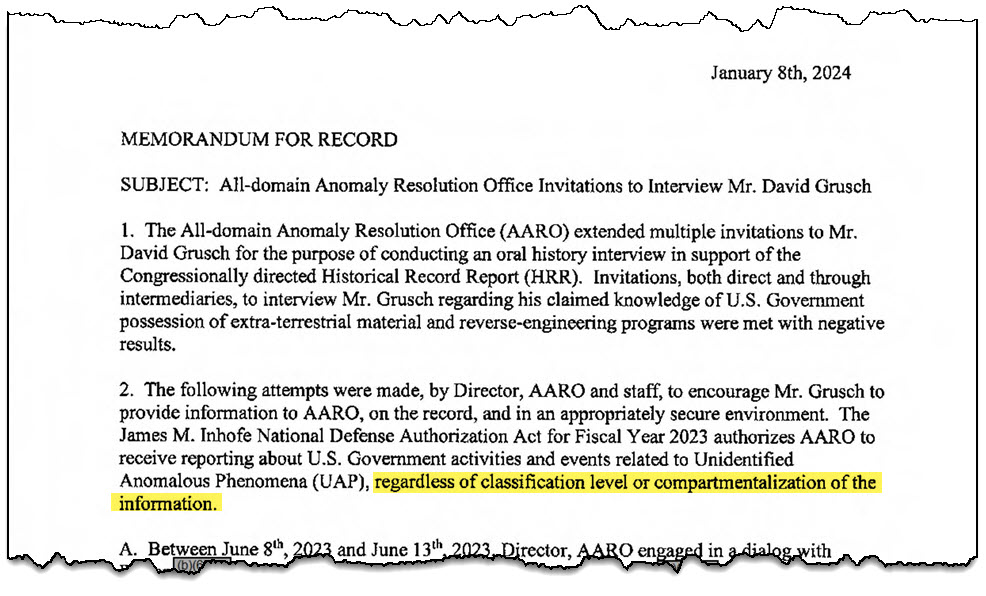
The resulting 28-page release documented repeated communications between AARO and Grusch and included government memoranda addressing exactly the type of disclosure protections now being highlighted under PURSUE.
In a November 19, 2023, communication released through the case, AARO told Grusch:
“In accordance with the James M. Inhofe National Defense Authorization Act for Fiscal Year 2023, AARO is authorized to receive any information related to UAP regardless of classification, and notwithstanding any nondisclosure agreement you may have signed.”
AARO offered to meet Grusch inside a Sensitive Compartmented Information Facility, or SCIF, so he could provide the information.
The records also contained formal government guidance concerning individuals holding protected UAP information.
One memorandum stated:
“Individuals with current or previous access to Unidentified Aerial Phenomena (UAP)-related or presumed relevant information which is subject to a USG Nondisclosure Agreement are authorized to provide this otherwise protected information to AARO representatives.”
The memorandum further stated:
“The provision of UAP-related information which is subject to a Nondisclosure Agreement to AARO personnel constitutes an authorized disclosure if the information is provided and received for the limited purpose of conducting AARO’s assigned mission.”
The documentation was not limited to ordinary classified information.
The procedures contemplated information potentially classified at TOP SECRET//SCI or involving Special Access Programs, with AARO instructed to initially handle information at the classification level asserted by the individual until its actual status could be determined.
Those records were published by The Black Vault in April 2024 as part of its reporting on AARO’s attempts to interview Grusch.
The Exact Legal Advisement Was Later Released
Questions remained about precisely what AARO intended to tell Grusch and other witnesses immediately before they provided protected information.
The Black Vault subsequently filed FOIA case 24-F-1138 in April 2024 seeking the complete wording of AARO’s “Verbal Legal Advisement.”
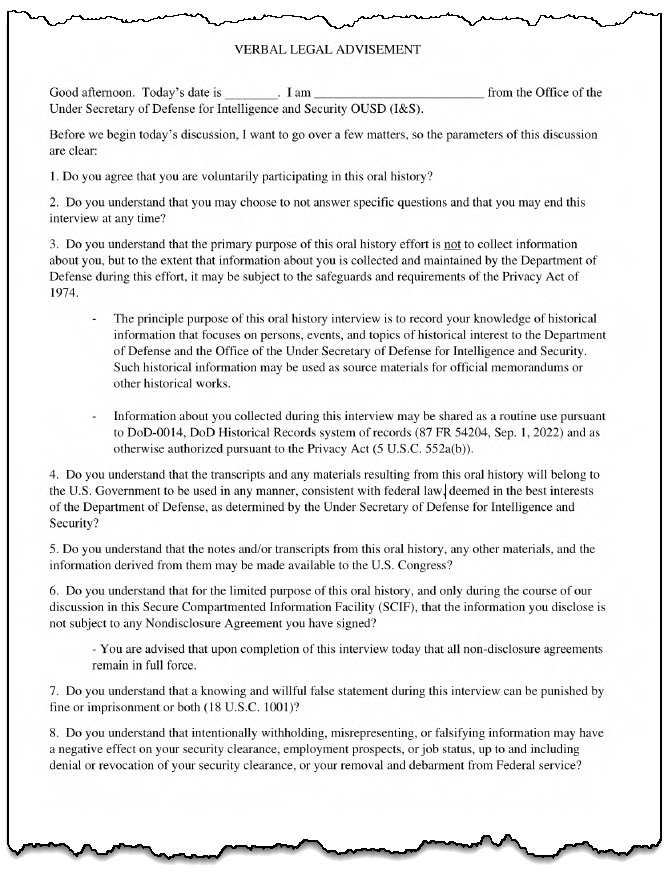
The Department of Defense released that document in full in 2025.
It provided unusually explicit instructions.
Before an interview, a witness was to be asked:
“Do you understand that for the limited purpose of this oral history, and only during the course of our discussion in this Secure Compartmented Information Facility (SCIF), that the information you disclose is not subject to any Nondisclosure Agreement you have signed?”
The witness was also told:
“Upon completion of this interview today all non-disclosure agreements remain in full force.”
The language illustrates the limited nature of the protection.
A witness was not being released permanently from secrecy obligations. Rather, the government was creating an authorized environment in which protected UAP information could be communicated to officials legally entitled to receive it.
That basic structure closely resembles what the Department of War is now describing for PURSUE.
Grusch Raised a More Complicated Question
The earlier records are also relevant because Grusch disputed whether the protections offered by AARO were sufficient for the information he said he needed to discuss.
His documented concern went beyond whether an NDA covering UAP information could be overridden.
In a November 13, 2023, email released through FOIA, Grusch wrote:
“The key issue here is that many of these activities have conventional classified and compartmented Security Classification Guides that also cover non-UAP activities as well.”
He continued:
“To discuss the UAP-related activities would also expose these conventional SAP mission areas.”
Grusch argued that an individual participating in an oral-history interview would need protection from those obligations as well, including information he described as potentially involving “bigoted or WAIVED” programs.
The records show that Grusch continued requesting additional assurances and documentation concerning AARO’s authority and ultimately did not participate in the planned November 14, 2023, meeting.
AARO, meanwhile, maintained that it possessed the necessary statutory authority to receive his UAP-related information and continued attempting to arrange an interview.
The distinction between those two positions is important.
The government maintained that Grusch was legally authorized to provide AARO with UAP-related information regardless of classification or applicable NDA restrictions. Grusch’s concern was that providing that information could necessarily reveal additional classified or compartmented information governed by other restrictions.
The FOIA records document the disagreement. They do not establish which interpretation would have prevailed if the issue had been litigated or otherwise formally adjudicated.
Does the PURSUE Waiver Address Grusch’s Concern?
That history makes one phrase in the September 14 announcement particularly noteworthy.
Unlike some earlier public descriptions of the AARO disclosure mechanism, the Department now expressly states that the PURSUE waiver supersedes applicable civil and administrative enforcement provisions contained in both “Non-Disclosure Agreements (NDAs) and Special Access Program Indoctrination Agreements (SAPIAs).”
That is more specific language.
Whether it actually provides broader protection than the AARO framework is not yet clear.
The earlier AARO authority already contemplated classified information, Special Access Programs, compartmented access programs and information covered by NDAs. The newly announced PURSUE waiver explicitly identifies SAPIAs and UAP-related National Defense Information.
But the Department has not publicly released, at least as of this writing, the underlying directive or complete waiver language accompanying its announcement.
That makes a direct legal comparison impossible.
It also remains unclear whether the PURSUE waiver addresses the precise scenario Grusch raised: UAP information that cannot be discussed without simultaneously revealing conventional classified or compartmented information that is not itself UAP-related.
The Department’s announcement says the authorization covers “UAP-related National Defense Information.” It does not explain how collateral classified information would be treated when disclosure of that information is necessary to describe the UAP-related material.
The Black Vault Seeks the Actual Directive and Guidance
The Black Vault contacted the Department of War following the September 14 announcement seeking additional information about the waiver.
Among the information sought was the actual language of the directive or waiver underlying the public announcement, along with any implementation instructions, legal advisements, procedures or other guidance being provided to current or former personnel considering making a disclosure to PURSUE.
That documentation would permit a direct comparison between the new PURSUE process and the statutory authorities, memoranda and verbal legal advisement previously used by AARO.
As of the publication of this article, the Department of War had not responded.
Without those underlying records, it cannot yet be determined whether the September 14 waiver materially expands the legal protections previously available to UAP witnesses or primarily establishes a new authorized recipient — PURSUE — operating under protections similar to those already available through AARO.
PURSUE’s Broader Disclosure Effort
The new waiver comes approximately four months after the Department launched the Presidential Unsealing and Reporting System for UAP Encounters (PURSUE).
On May 8, 2026, the Department announced the first PURSUE release, describing the initiative as an interagency effort involving the White House, Office of the Director of National Intelligence, Department of Energy, AARO, NASA, FBI and additional elements of the Intelligence Community.
The Department said the effort followed President Donald Trump’s direction to identify and begin releasing government records concerning UAP, UFOs and related subjects.
Five tranches had been published through August 7, 2026.
The government’s PURSUE portal contains historical documents alongside more recent UAP material from multiple agencies. The Department has said additional material will be released on a rolling basis.
The September 14 action adds another component to that process: instead of relying exclusively on records already residing within government repositories, PURSUE now has an expressly authorized channel through which individuals possessing protected information can provide it for review.
New Channel, Existing Precedent
The Department of War’s September 14 waiver therefore contains both a new development and substantial precedent.
The new development is the establishment of a PURSUE-specific disclosure channel and the Department’s explicit statement that civil and administrative enforcement provisions contained in NDAs and Special Access Program Indoctrination Agreements are superseded for authorized communications with the PURSUE team.
What is not new is the broader proposition that a person possessing highly classified UAP information can be authorized to provide it to designated government investigators without violating an NDA.
Congress established such an avenue through AARO years earlier.
The Black Vault’s subsequent FOIA releases documented how the government attempted to put that authority into practice with one of the most prominent UAP whistleblowers, David Grusch. Those records included written government authorization, procedures for handling highly classified and SAP information, repeated assurances to Grusch and, eventually, the exact legal advisement AARO intended to provide before receiving his information.
The PURSUE announcement does not invalidate or contradict that history. Instead, it establishes another authorized pathway.
Whether the new waiver goes materially further, particularly concerning the overlapping conventional SAP information that Grusch said prevented him from speaking freely to AARO, remains unanswered by the public announcement.
The underlying directive, legal guidance and instructions being provided to potential PURSUE sources will be necessary to determine exactly what has changed.
###
Follow The Black Vault on Social Media:


