
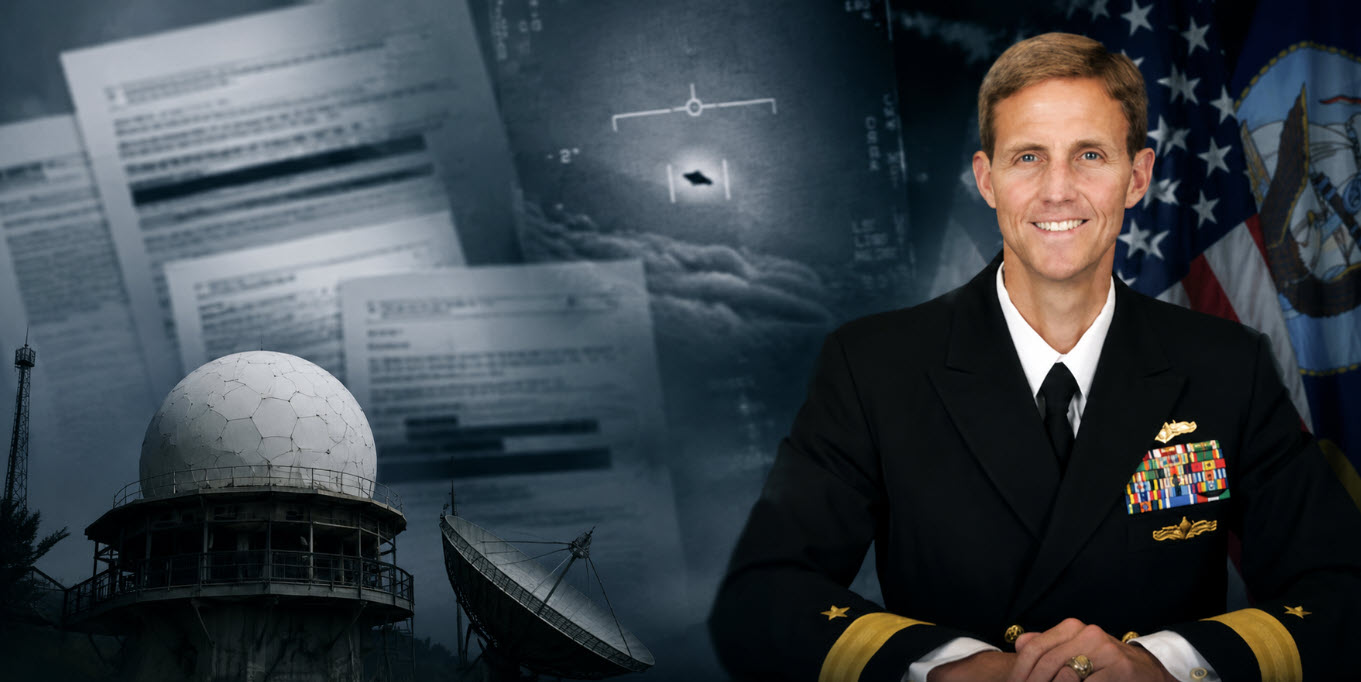

A newly released Freedom of Information Act response from the National Oceanic and Atmospheric Administration offers a limited but useful look at UAP-related keyword hits found in the email records of Dr. Timothy Gallaudet, the former Assistant Secretary of Commerce for Oceans and Atmosphere, Acting Under Secretary of Commerce for Oceans and Atmosphere, Acting NOAA Administrator, and Deputy NOAA Administrator.
The request, filed July 10, 2023, sought all emails sent to, from, or copied to Gallaudet between October 25, 2017, and January 20, 2021, that contained a series of UFO- and UAP-related terms. Those terms included “UNIDENTIFIED AERIAL,” “UNIDENTIFIED ANOMALOUS,” “AARO” (included even though AARO pre-dated date range), “UAP,” “UAPTF,” “UFO,” “UNIDENTIFIED FLYING,” “AOIMSG,” “ELIZONDO,” and “GRUSCH.” Those dates were chosen as they coincided with his time at NOAA. A second FOIA request was filed with the Navy, which is still open.
NOAA’s final response, dated May 6, 2026, stated that the agency located 51 responsive records totaling 245 pages. According to the agency, 167 pages were released in full, while 78 pages were released with redactions under FOIA exemption (b)(6), which protects personal privacy. NOAA stated the request was complete.
While the release does not reveal extensive government discussions about UAP programs, it does provide a glimpse into the information ecosystem surrounding the issue and the material that was reaching Gallaudet during his time at NOAA.
Among the more notable records are emails connected to the Unidentified Aerial Phenomena Task Force (UAPTF).
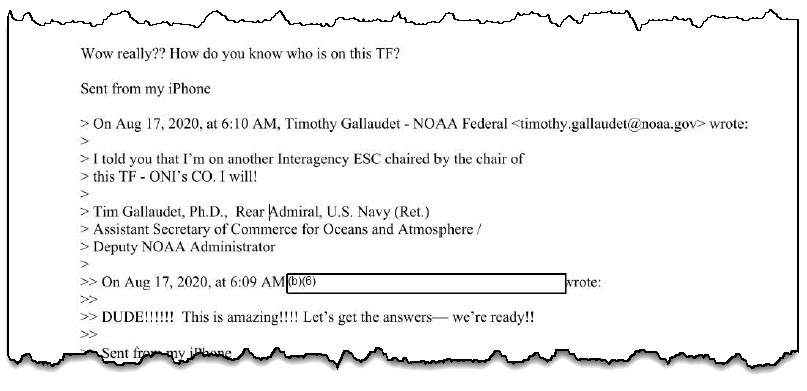 In an August 17, 2020 email, Gallaudet wrote, “I told you that I’m on another Interagency ESC chaired by the chair of this TF – ONI’s CO. I will!” The reference appears to indicate that Gallaudet was serving on a separate interagency Executive Steering Committee (ESC) chaired by the same Office of Naval Intelligence official who was leading the UAP Task Force at the time. While the email does not suggest that Gallaudet himself was a member of the UAPTF, it does show an awareness of the task force and a professional connection to its leadership through another government coordination mechanism. His email stated that he “will” get answers to the UAP issue, given his connections to its top leadership.
During the period in question, the UAP Task Force was at the Office of Naval Intelligence, then led by Rear Adm. Kelly Aeschbach.
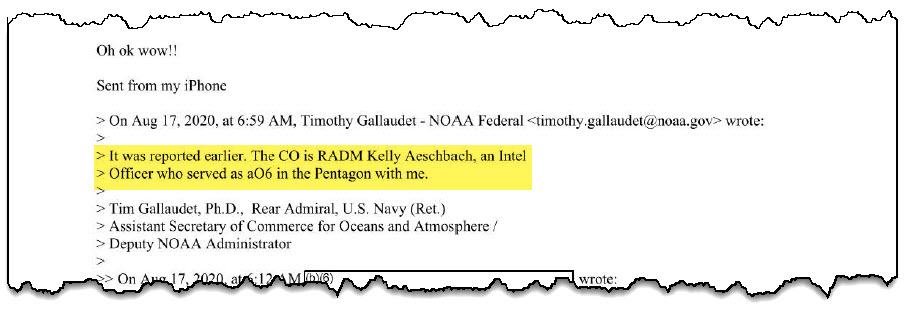 Aeschbach and Gallaudet were not strangers to one another. Both had previously served in senior Navy leadership positions, according to Gallaudet’s email.
While the released records do not indicate that Gallaudet participated in the UAP Task Force itself, his August 2020 email suggests he was clearly familiar with its leadership and had professional access to the same senior official overseeing the effort through a separate interagency Executive Steering Committee (ESC). That connection provides additional context for Gallaudet’s later public statements about UAP issues and demonstrates that his awareness of the government’s UAP activities extended beyond media reporting alone.
The exchange provides rare contemporaneous documentation placing Gallaudet within a network of officials discussing the UAPTF while it was still operating largely outside public view. At the same time, the records stop short of showing direct involvement in the task force’s activities, investigations, or decision-making processes.
Another email circulated an article from The Intercept examining former Pentagon official Luis Elizondo and the controversy surrounding his role in the government’s UAP efforts.
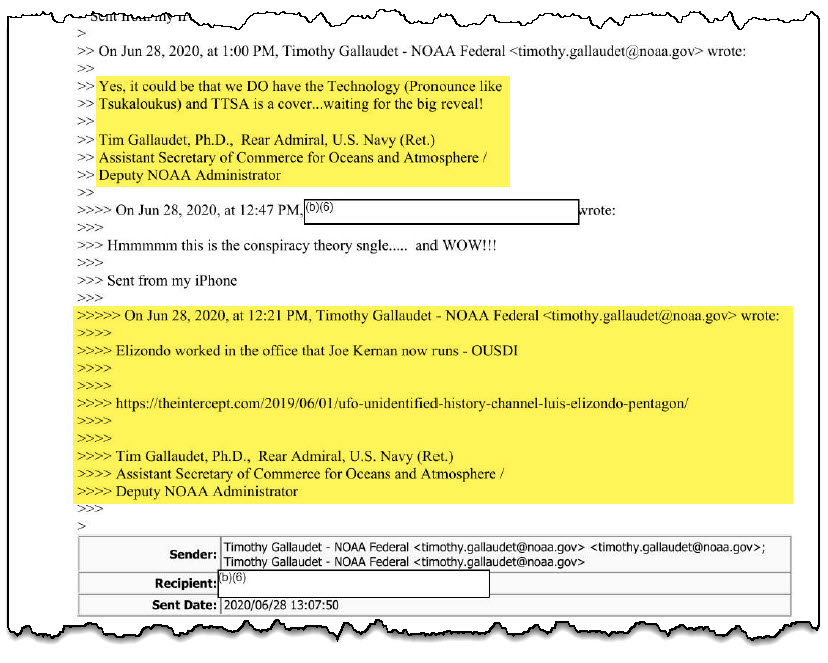 The article was critical of aspects of Elizondo’s public narrative and highlighted questions surrounding his involvement with the Advanced Aerospace Threat Identification Program (AATIP). The appearance of the article in the records is surprising, because it shows that critical reporting, not simply supportive coverage, was being shared within the network of individuals discussing the UAP issue that Gallaudet was communicating with.
The records also show Gallaudet forwarding a New York Magazine article featuring retired Navy Commander Chad Underwood, the aviator who captured the now-famous “FLIR1” video. In forwarding the piece, Gallaudet added a brief endorsement: “Gottaread this!” (sic). The article provided Underwood’s perspective on the encounter and helped shape public understanding of one of the most discussed military UAP incidents on record.
Other records show the circulation of mainstream reporting that became central to public awareness of the issue. Included among them was a 2020 New York Times article focused on former Senate Majority Leader Harry Reid and his longstanding interest in government investigations of unidentified aerial phenomena.
The correspondence also references Giorgio A. Tsoukalos, best known for the television series Ancient Aliens.
Another UFO-related hit in the release records appears in a December 2017 Yahoo Daily newsletter sent to Gallaudet’s NOAA account.
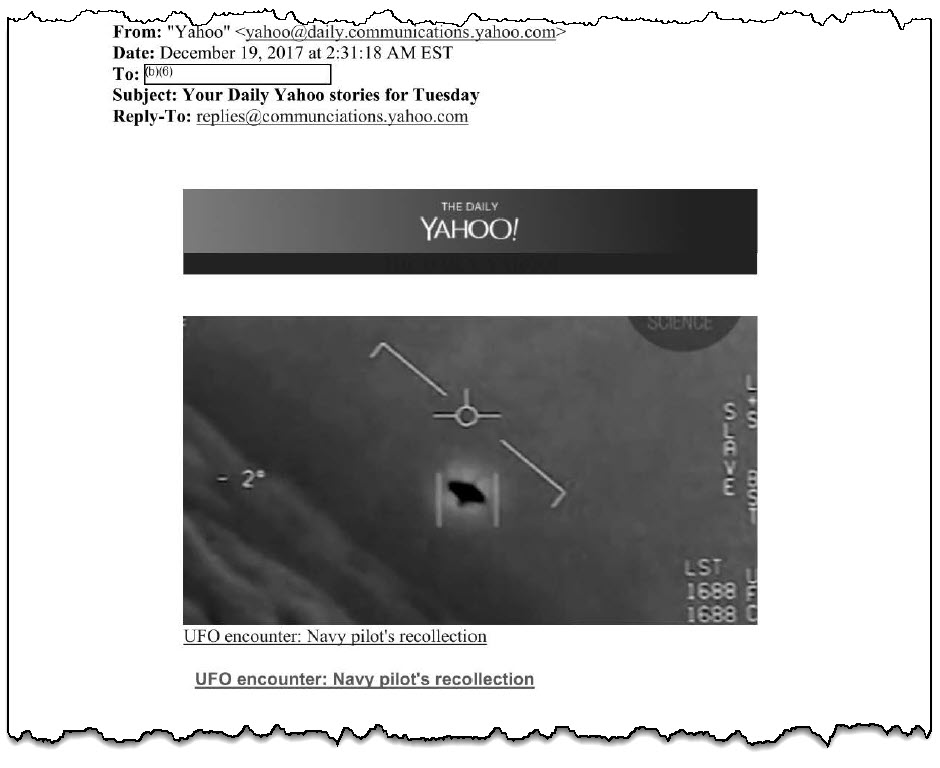 The newsletter included a story titled “UFO encounter: Navy pilot’s recollection,” accompanied by the image of the now infamous “Gimbal” UFO. Gallaudet later forwarded the newsletter from his iPad, but the release does not show any substantive comment from him about the UFO article, the Navy encounter, or the broader UAP issue.
Taken together, these emails portray Gallaudet less as a passive recipient of UFO-related news and more as an active consumer and occasional distributor of information related to the emerging UAP conversation. At the same time, the records stop well short of demonstrating direct participation in UAPTF operations, NOAA-led investigations, or other formal government UAP activities. Instead, they document an official who was following developments closely as the issue moved from the fringes of public discussion into mainstream political and media attention, but nothing more than that.
Other responsive material is even further removed from the subject of UAP. Several emails involve the National Fish and Wildlife Foundation, including board communications, holiday messages, meeting notes, and foundation updates. Another email contains a link to an article titled “The 101 Best EDM Songs of All Time,” which appears to have been captured by the keyword search despite having no clear connection to UFOs or UAP.
One email exchange does contain a passing reference to an unexplained light phenomenon, though not in the context of UAP policy or government investigations.
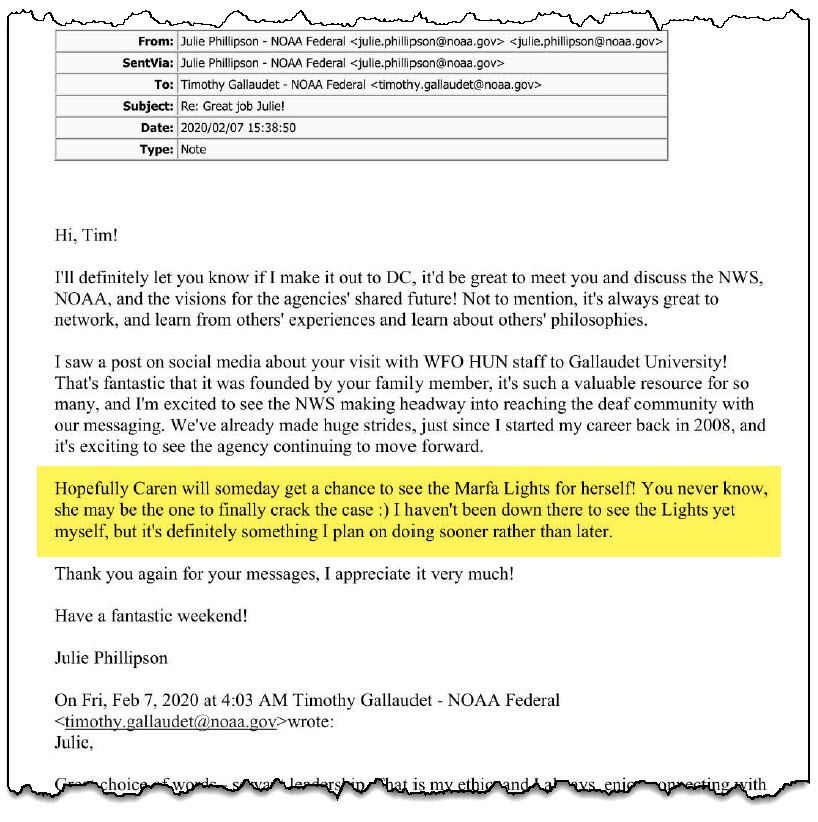 In February 2020, NOAA employee Julie Phillipson wrote to Gallaudet about possibly visiting Washington, D.C., and mentioned the Marfa Lights in Texas. She wrote, “You know, nobody’s totally sure what causes the Marfa lights! There are some speculations that they’re best viewed in certain atmospheric conditions due to strong low-level temperature inversions, and the headlights of vehicles on the highway down there.” The exchange was casual and did not involve official UAP reporting, military encounters, or internal NOAA deliberations.
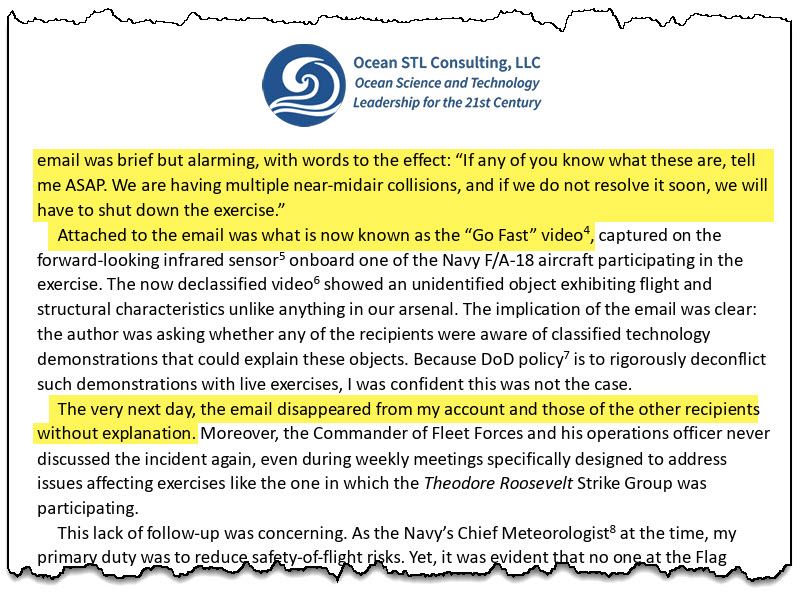
In November 2024, Gallaudet submitted written testimony for the House Oversight Committee hearing titled “Unidentified Anomalous Phenomena: Exposing the Truth.” In that testimony, he described a January 2015 incident from his time as Commander of the Naval Meteorology and Oceanography Command, when he said he received an email on the Navy’s secure network with the subject line “URGENT SAFETY OF FLIGHT ISSUE.”
According to Gallaudet’s testimony, the email was sent by the operations officer of Fleet Forces Command during a pre-deployment naval exercise involving the USS Theodore Roosevelt Carrier Strike Group. He wrote that the message included words to the effect of, “If any of you know what these are, tell me ASAP. We are having multiple near-midair collisions, and if we do not resolve it soon, we will have to shut down the exercise.”
Gallaudet testified that the email included what is now known as the “Go Fast” video, which he described as showing “an unidentified object exhibiting flight and structural characteristics unlike anything in our arsenal.” He further stated that “the very next day, the email disappeared from my account and those of the other recipients without explanation.”
In the same testimony, Gallaudet said the matter continued to concern him during the rest of his government service, including his time as an Under Secretary of Commerce and NOAA Administrator. He wrote that the incident “highlighted a dangerous culture of over-classification, where even pressing safety-of-flight issues could be swept aside under the pretense of secrecy.”
The newly released NOAA emails unsurprisingly do not contain that 2015 Navy email, which would fall outside the date range of the FOIA request. But more notably, they do not contain apparent follow-up discussions about the “Go Fast” video, the Roosevelt encounters, safety-of-flight concerns, the UAP Task Force, or the claims Gallaudet later raised publicly. That absence does not disprove his testimony, but it is relevant that if there was any time for him to mention this to his close confidants he was communicating with as shown in these emails, it would be assumed that might be a time to do bring it up as he brought up other articles and recommended reading material.
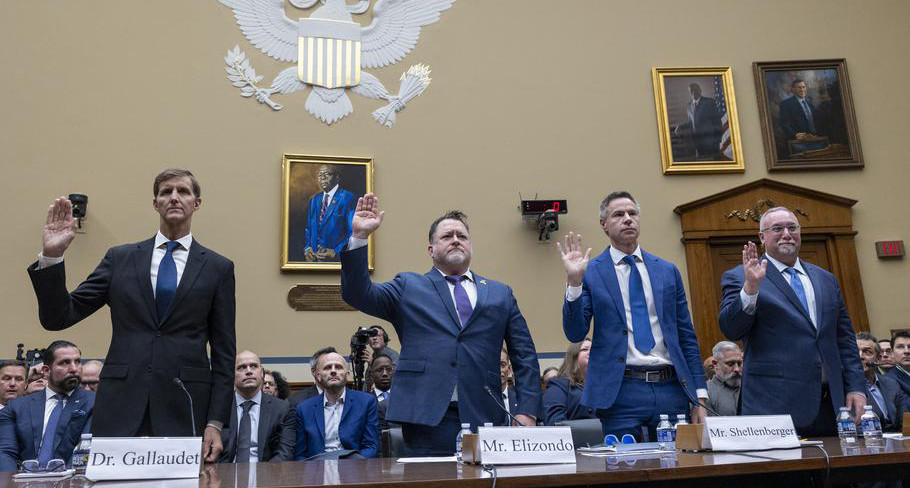
Gallaudet’s Congressional testimony placed him among the more prominent former government officials advocating for greater UAP transparency. He told Congress that “the continued excessive secrecy surrounding UAPs has not only hindered our ability to effectively address these phenomena but has also eroded trust in our institutions and compromised the safety of both military and civilian aviators.” He also urged Congress to pursue stronger oversight of executive branch UAP programs, information, and materials.
The result of this FOIA case is not a major disclosure, but it is a useful archival marker. Based on this release, Gallaudet’s public UAP advocacy is not reflected in any significant way in the NOAA email records produced under this request.
There is a Navy FOIA request still open, which has proven to be problematic during the processing of the case. Updates on that will be posted in the future.
###
Document Archive
 DOC-NOAA-2024-000220 Release Package [80 Pages, 8MB]
 Loading...
 Reload document
 Open in new tab
 Follow The Black Vault on Social Media:


