


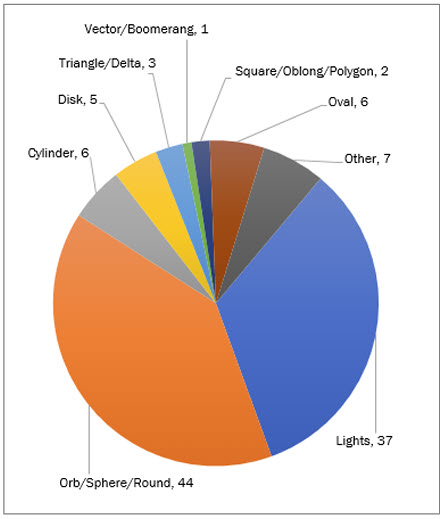
 The Department of Defense’s All-domain Anomaly Resolution Office (AARO) has released its Fiscal Year 2025 Consolidated Annual Report on Unidentified Anomalous Phenomena, documenting 319 newly received UAP reports while emphasizing that every resolved case was ultimately attributed to conventional causes.
The report arrives well after the timeline established by Congress. Under 50 U.S.C. § 3373(k)(1)(A), the AARO Director is required to submit an annual UAP report to the appropriate congressional committees “not later than 180 days after December 23, 2022, and annually thereafter for four years.”
The FY2025 report covers incidents from June 2, 2024, through May 30, 2025. Although Congress did not prescribe a specific public release date, previous reports have generally been delivered and publicly released in the fall. The FY2024 report, for example, was published in November 2024. This year’s report was not released until July 2026, several months later than the statutory annual reporting cycle contemplated by Congress.
According to AARO, it received 319 UAP reports, consisting of 284 incidents occurring during the reporting period and 35 older incidents that had not been included in previous reports. The office resolved 114 of those reports, while also resolving 256 previously reported cases, for a total of 370 resolved investigations during the reporting period.
AARO states that every resolved case was attributed to ordinary explanations.

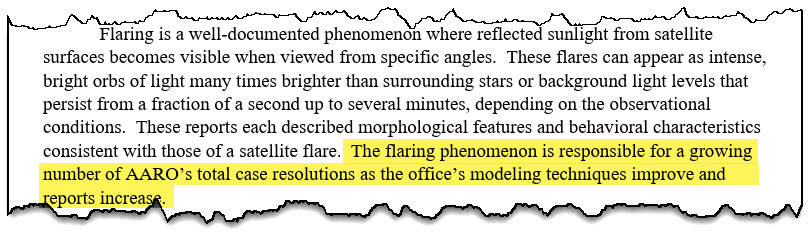
One of the most notable developments described in the report is the office’s expanded ability to identify satellite flares.

The report explains that none of the 44 space-domain reports originated from space-based sensors. Instead, 42 originated from FAA civilian pilot reports and two from U.S. Space Command ground-based sensors. Using three-dimensional modeling and all-source analysis, AARO concluded these observations were consistent with reflected sunlight from satellites.
The overall reporting volume represents a significant decrease from the FY2024 report, which documented 757 reports, including a large backlog of historical FAA submissions dating back to 2021.
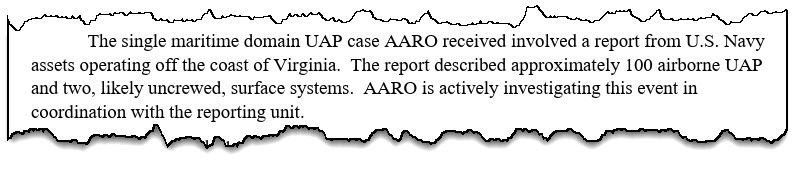
One of the more unusual incidents described in the FY2025 report involves a Navy observation off the Virginia coast.
While most unresolved reports were moved into AARO’s “active archive” because of insufficient data, the office stated that nine reports continue to warrant additional analysis by intelligence and scientific partners. At the same time, AARO reiterated that it has found no evidence of advanced foreign technology.

The report also contains language that will likely draw attention from those following national security aspects of the UAP issue. Regarding reports near sensitive facilities, AARO states:
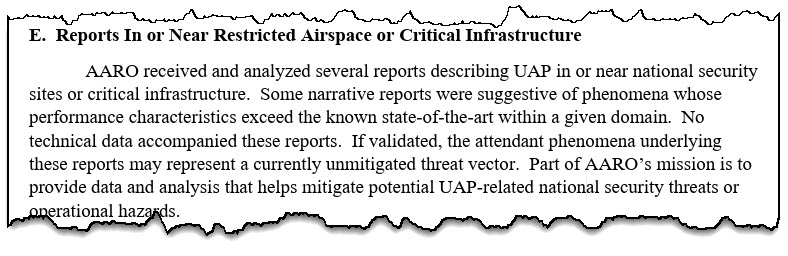
Two reports also described electronic or avionic interference involving operational aircraft, though AARO says it has not determined whether those effects were actually attributable to UAP.
The office reports receiving 50 notifications involving unmanned aerial systems near U.S. nuclear infrastructure, weapons, and launch sites, a substantial increase over the 18 incidents discussed in the FY2024 report. However, AARO states that none of those incidents were classified as UAP.
The report again rejects longstanding claims that the U.S. government possesses recovered UAP material.
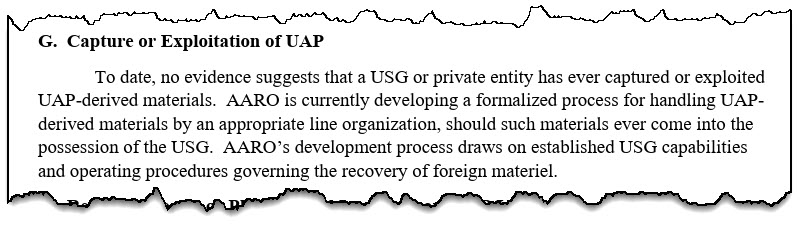
AARO adds that it is nevertheless developing procedures for handling such material “should such materials ever come into the possession of the USG.”
The office also reports receiving 262 submissions through its secure reporting mechanism from individuals claiming first-hand knowledge of government UAP programs. Of those, 255 were determined to be out of scope, while seven individuals were identified for follow-up interviews.
The report concludes by highlighting several organizational initiatives, including expanded sensor prototyping, additional public outreach, publication of case resolutions such as the “Go Fast” and Aguadilla cases, and the launch of AARO’s electronic FOIA Reading Room.
###
Document Archive
 FY 2025 AARO Report [14 Pages, 1.2MB]
 Loading...
 Reload document
 Open in new tab


