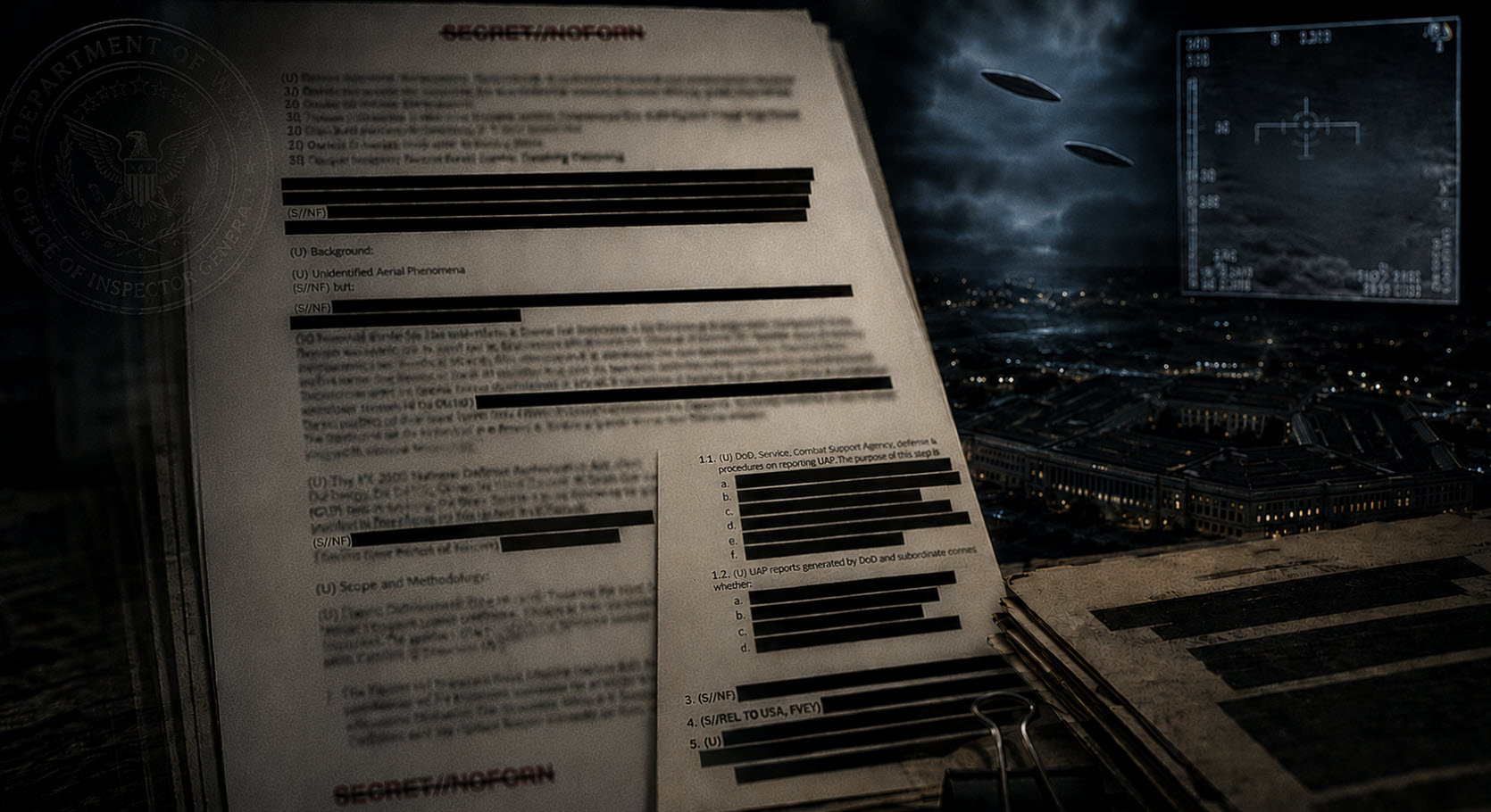

The Department of War Office of Inspector General (DoW OIG), formerly known as the Department of Defense Inspector General, has issued the fourth interim release of documents regarding its evaluation of the military’s handling of Unidentified Aerial Phenomena (UAP). The release is part of an ongoing Freedom of Information Act (FOIA) case, designated as case number DODOIG-2021-000806.
While the unclassified verbiage in this five-page release aligns with what the public already knows about UAP evaluation, the newly disclosed document highlights a stark contradiction. Despite frequent public assertions of “transparency” and the high-profile release of official UAP videos in previous years, the core mechanisms of how the U.S. government views, tracks, and analyzes the UAP issue remain heavily guarded, classified, and blacked out from public view.
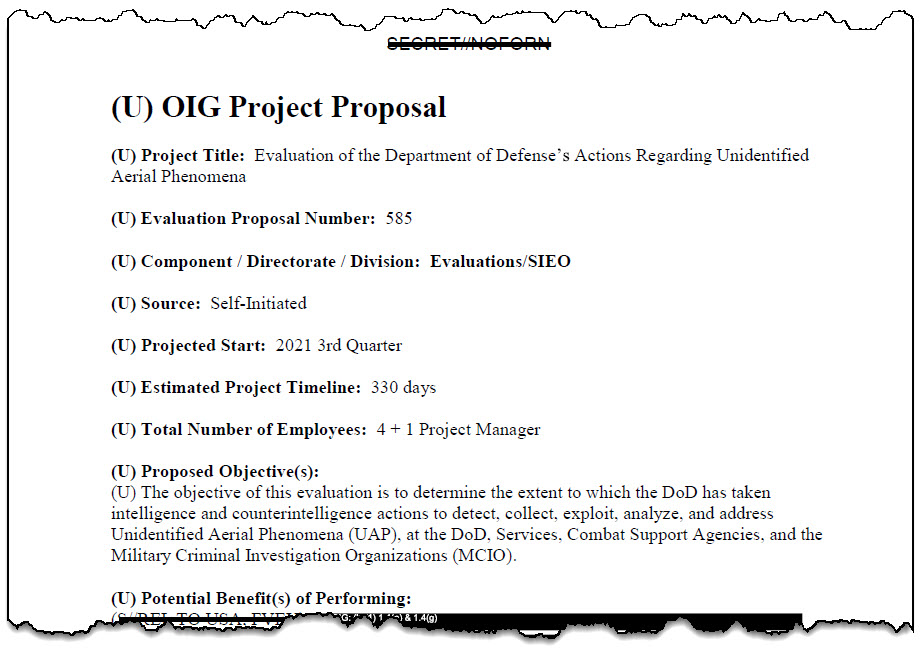
The released document is the official, self-initiated project proposal for Project Title: Evaluation of the Department of Defense’s Actions Regarding Unidentified Aerial Phenomena (Evaluation Proposal Number: 585).
“(U) The objective of this evaluation is to determine the extent to which the DoD has taken intelligence and counterintelligence actions to detect, collect, exploit, analyze, and address Unidentified Aerial Phenomena (UAP), at the DoD, Services, Combat Support Agencies, and the Military Criminal Investigation Organizations (MCIO).”
Yet, exactly why this evaluation matters and how the military evaluates threats is entirely hidden.
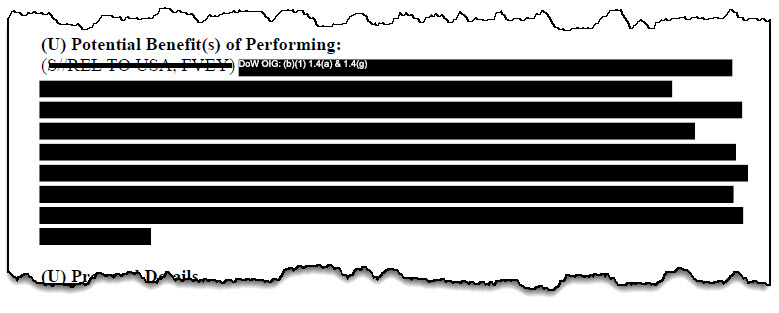
The section titled “Potential Benefit(s) of Performing” is completely redacted, citing FOIA exemptions (b)(1) 1.4(a) and 1.4(g). According to the DoW OIG’s response letter, these exemptions apply directly to “military plans, weapons systems, or operations” and “vulnerabilities or capabilities of systems, installations, infrastructures, projects, plans, or protection services relating to national security.”
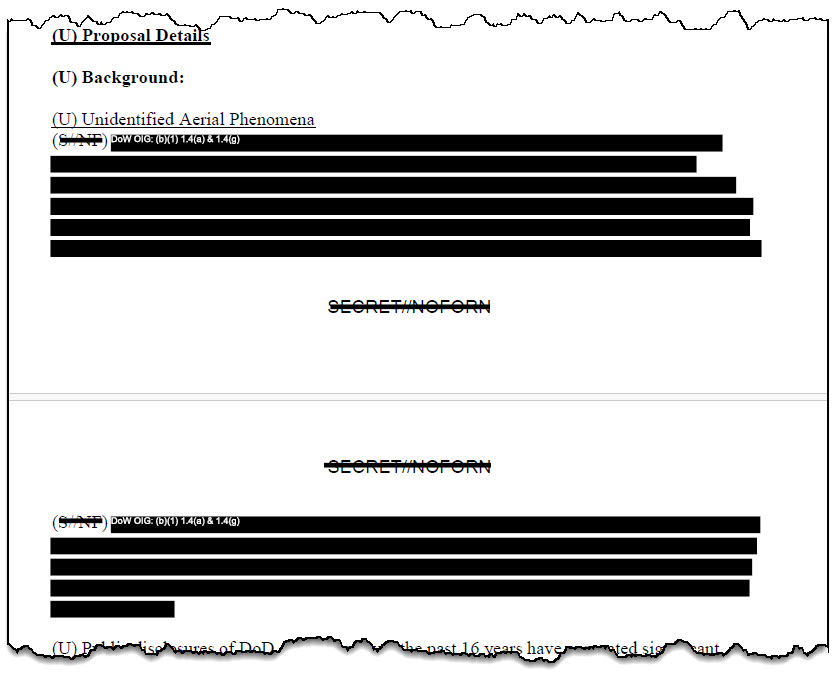
Furthermore, the entire first two sections of the UAP background information are heavily redacted. Every single one of these blacked-out paragraphs is preceded by an “(S)” or “(S//NF)”, indicating that the contents are classified as SECRET // NOFORN (Not Releasable to Foreign Nationals).
The unclassified portions of the background text validate the deep internal friction that has plagued the Pentagon regarding UAP research. The proposal openly documents the public speculation fueled by the lack of official explanations for encounters spanning 16 years, as well as the political fallout that led to the 2017 resignation of the Director of the National Programs Special Management Staff within the Office of the Undersecretary of Defense for Intelligence, Luis “Lue” Elizondo.
The proposal quotes his resignation memo to the Secretary of Defense verbatim:
“Despite overwhelming evidence at both the unclassified and classified levels, certain individuals in the Department remain staunchly opposed to further research on what could be a tactical threat to our pilots, sailors, and soldiers, and perhaps even an existential threat to our national security.”
There has been immense controversy over the official role, if any, of Elizondo when it came to UAP research during his tenure working within the Pentagon. This newly released document, which refers to Elizondo by title and having “researched UAP”, does not mention AATIP or any official program in which he did so. This reference will likely invigorate his supporters, while his detractors will state that the document, in which the author is unknown, could simply be conveying what they read in media articles, but not basing it on fact.
Either way, the mystery remains when it not only comes to Elizondo, but to the true nature of the UAP that the U.S. government has yet to adequately explain away.
Following the Congressional mandates in the FY 2020 National Defense Authorization Act, the UAP Task Force was officially established in August 2020.
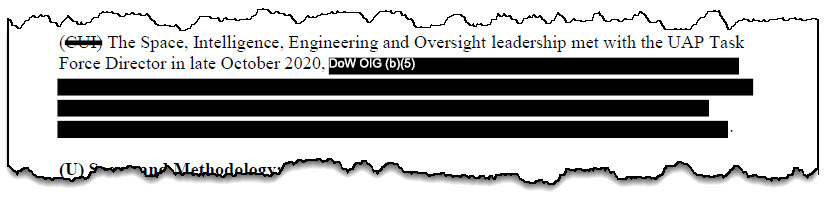
However, when the Space, Intelligence, Engineering and Oversight leadership finally met with the UAP Task Force Director in October 2020, the details and outcomes of that meeting were entirely withheld under exemption (b)(5), which protects internal deliberative processes.
The scope of this evaluation was massive, spanning across the Office of the Secretary of Defense, U.S. Special Operations Command, U.S. Central Command, DIA, NSA, NGA, NRO, DARPA, and the military branch criminal investigation divisions.
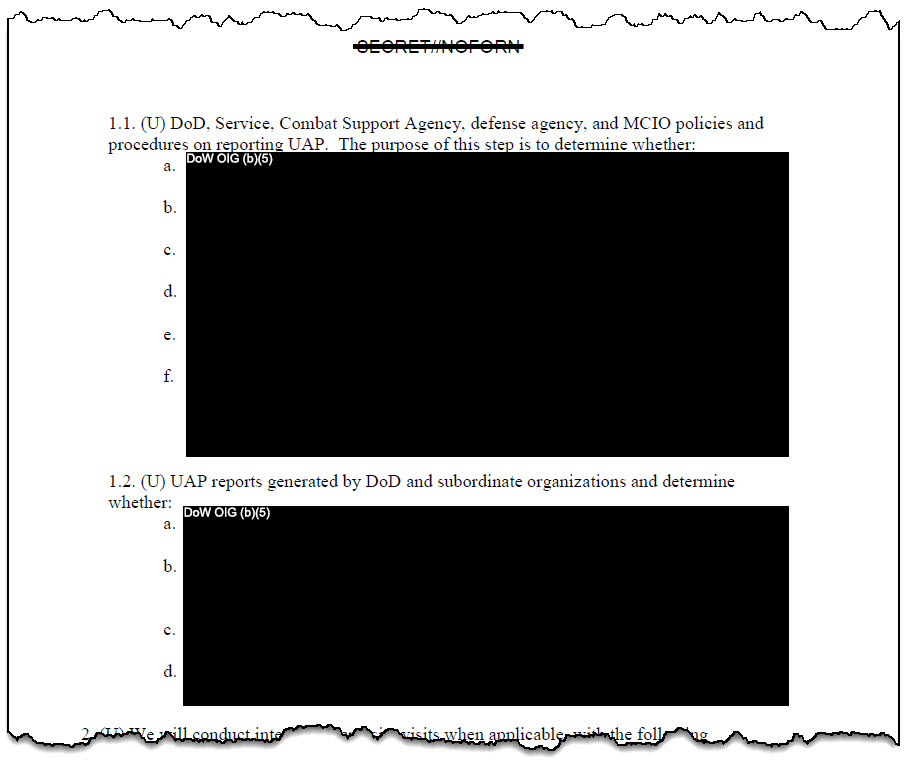
However, the specific questions the IG intended to answer are missing. Under the methodology section, the document outlines requests for information regarding agency policies and generated UAP reports, but every single specific metric is entirely redacted.
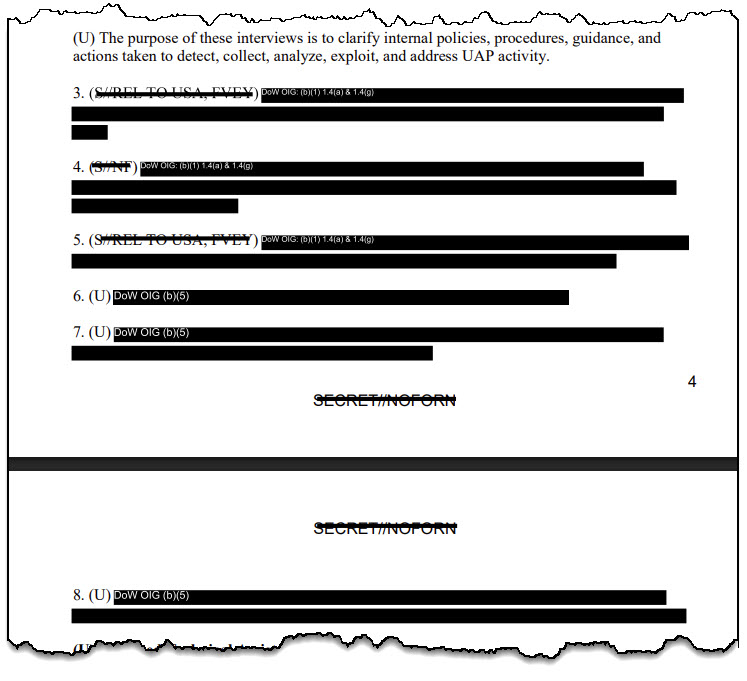
Additionally, methodology steps 3, 4, and 5, which are classified Secret and restricted to U.S. and Five Eyes (FVEY) intelligence sharing, are completely withheld from the public, while steps 6, 7, and 8 are also entirely redacted citing the “deliberative process privilege.”
The Black Vault has always advocated for government transparency while maintaining a realistic understanding that occasional, legitimate national security secrets must be kept. However, the sheer volume of redactions in this release paints a troubling picture.
If there truly is “nothing to hide”, as various public relations campaigns and limited document drops by the military try to suggest, then the foundational policies, potential benefits, and historical background of UAP tracking would not require blanket censorship.
While the Department of War publicly promotes its transparency efforts by highlighting declassified videos, the core documents that dig into the meat of the UAP issue, like how the U.S. military views, reports, and handles these phenomena, all remain completely hidden in the shadows.
This FOIA case remains open with an estimated 245 pages of potentially responsive records still awaiting future processing and review, which will be published on The Black Vault, if released.
Document Archive
 DODOIG-2021-000806 Interim Release 4 Package [7 Pages, 1.2MB]
 Loading...
 Reload document
 Open in new tab


