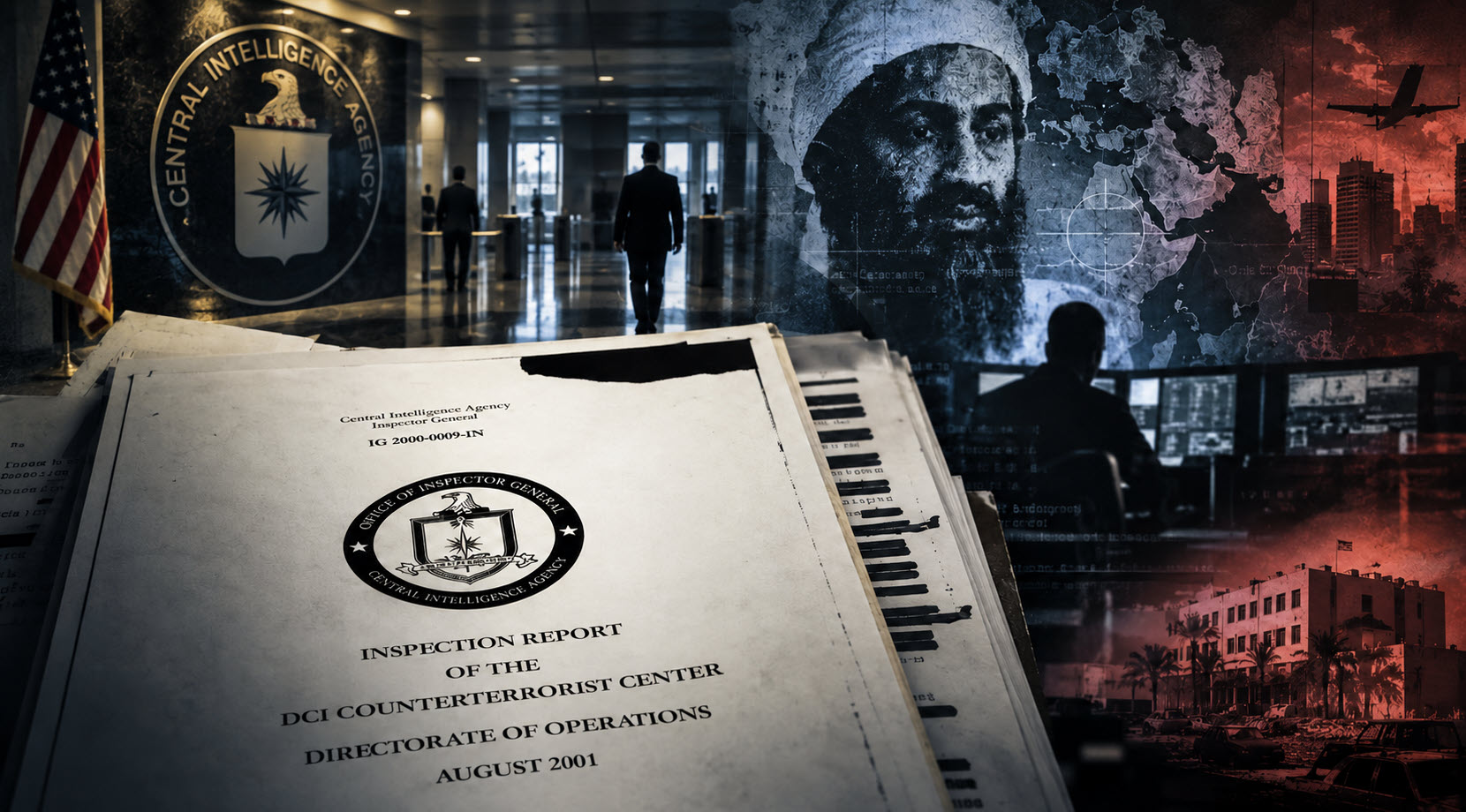

A new CIA release obtained by The Black Vault has restored significant portions of an August 2001 Inspector General review of the agency’s Counterterrorist Center, adding details that had remained classified when the report was publicly released more than 15 years ago.
The document, titled Inspection Report of the DCI Counterterrorist Center, Directorate of Operations, was completed in August 2001. An earlier version was approved for release to the public on July 26, 2010.
The Black Vault requested a new Mandatory Declassification Review of the report on January 8, 2019. In a July 6, 2026 final response, the CIA said it had completed that re-review and “determined that additional information can be released.” The agency said remaining deletions were being maintained under Executive Order 13526 and statutory protections incorporated through FOIA Exemption (b)(3).
A comparison of the two versions confirms that the new release does contain additional information. Much of it consists of statistics, organizational details and fuller passages that were only partially visible, or completely removed, in the 2010 copy. Numerous operational details, program names, personnel figures and other information remain classified.
New Details on the Center’s Growth
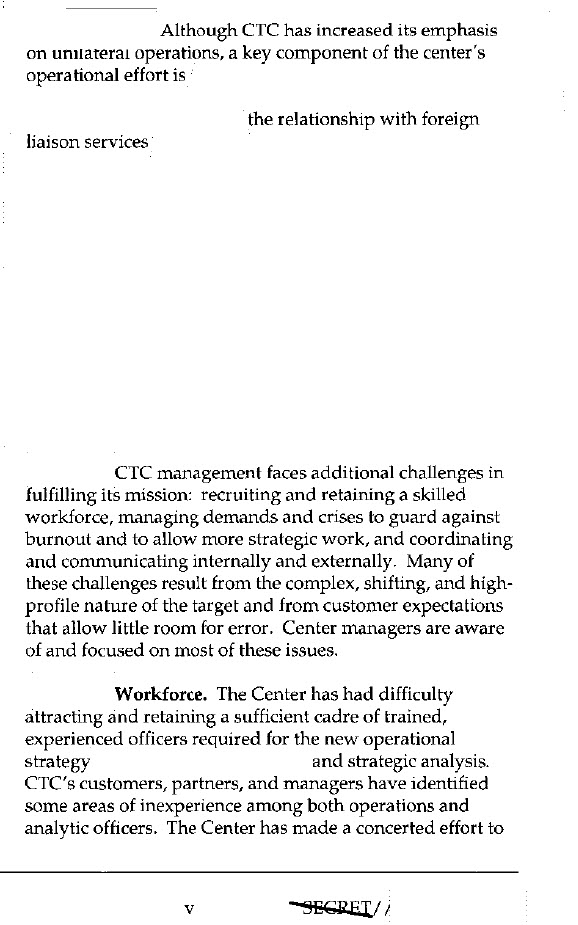
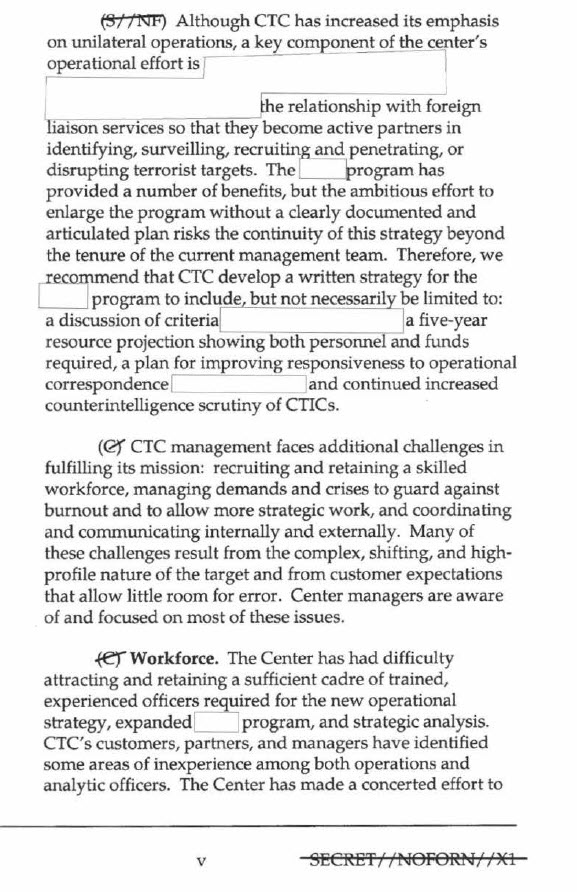
One of the clearest additions appears in the report’s executive summary.
The 2010 version stated that Counterterrorist Center resources had increased over five years, but the actual personnel and budget figures were removed. It also withheld part of the description of the operations that those resources supported.
The newly released version fills in those figures:
“CTC’s resources have steadily increased over the last five years, with personnel growing by 74 percent during that period and the budget more than doubling.”
The report adds that the Center’s resources permitted it to support “operations against terrorists and liaison relationships that DO area divisions otherwise could not fund.”
Those figures provide additional context for the CIA’s counterterrorism buildup before the September 11 attacks.
More of the Pre-9/11 Analytic Problems Are Now Public
Some of the more notable newly released material concerns the pressures facing CIA analysts responsible for terrorism intelligence.
The earlier version disclosed that analysts were concerned about the constant state of crisis and lacked sufficient time for warning and predictive analysis. But a substantial passage immediately following that discussion was withheld. The 2010 copy moved almost directly from the discussion of analysts trying to “get ahead of the target” to a Directorate of Operations response.
The 2026 release now fills in much of that missing section.
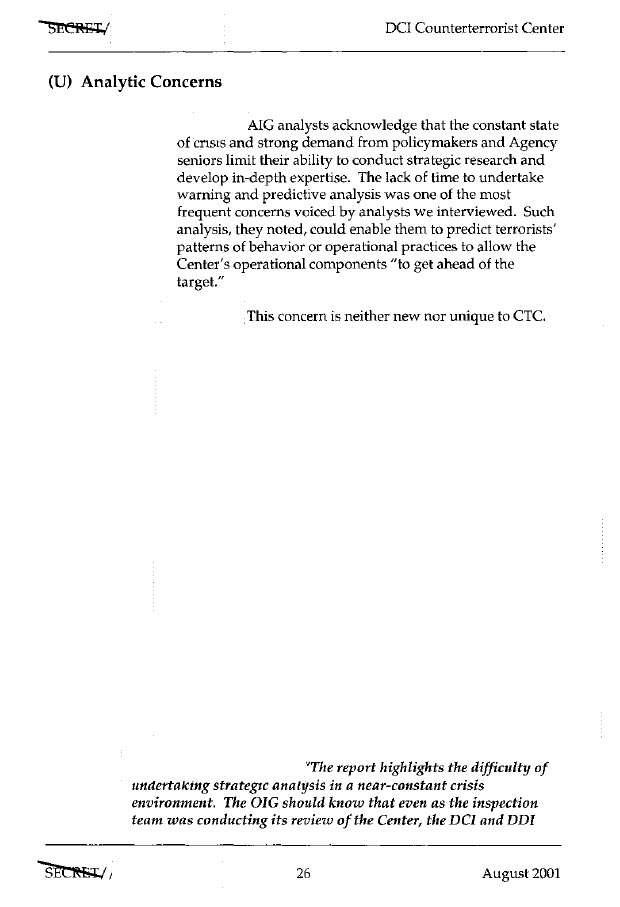
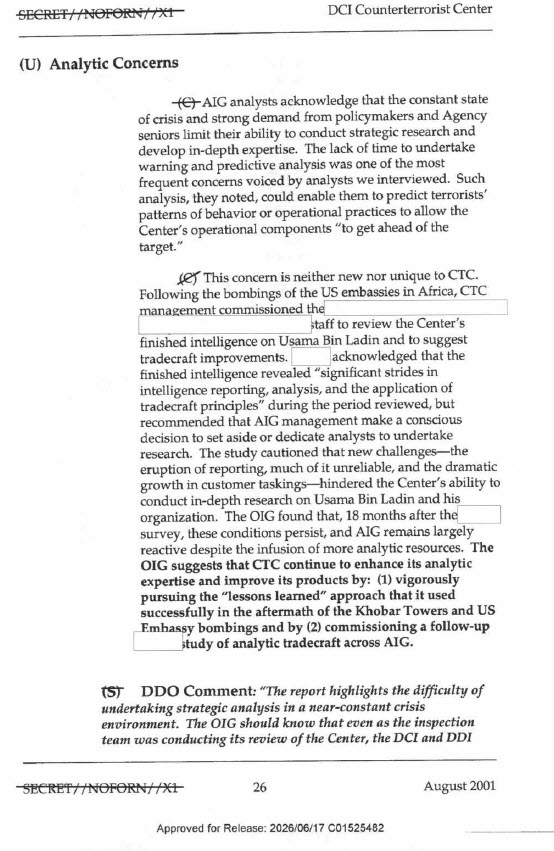
According to the newly disclosed text, following the bombings of the U.S. embassies in Africa, CTC management commissioned a review of the Center’s finished intelligence concerning Usama Bin Ladin and possible improvements in analytic tradecraft.
The report states that the earlier study found:
“significant strides in intelligence reporting, analysis, and the application of tradecraft principles”
but nevertheless recommended that management deliberately set aside analysts for research. It also found that an “eruption of reporting, much of it unreliable,” combined with a “dramatic growth in customer taskings,” hindered CTC’s ability to conduct in-depth research on Bin Ladin and his organization.
The Inspector General reported that 18 months later, those conditions persisted and the analytic group remained “largely reactive despite the infusion of more analytic resources.”
Analysts Were Spending Large Amounts of Time Supporting Operations
Other newly available figures provide a clearer picture of how CTC’s analytic resources were being used.
The 2010 version disclosed that the Center’s Assessments and Information Group, or AIG, provided terrorism analysis, but removed several organizational and staffing details.
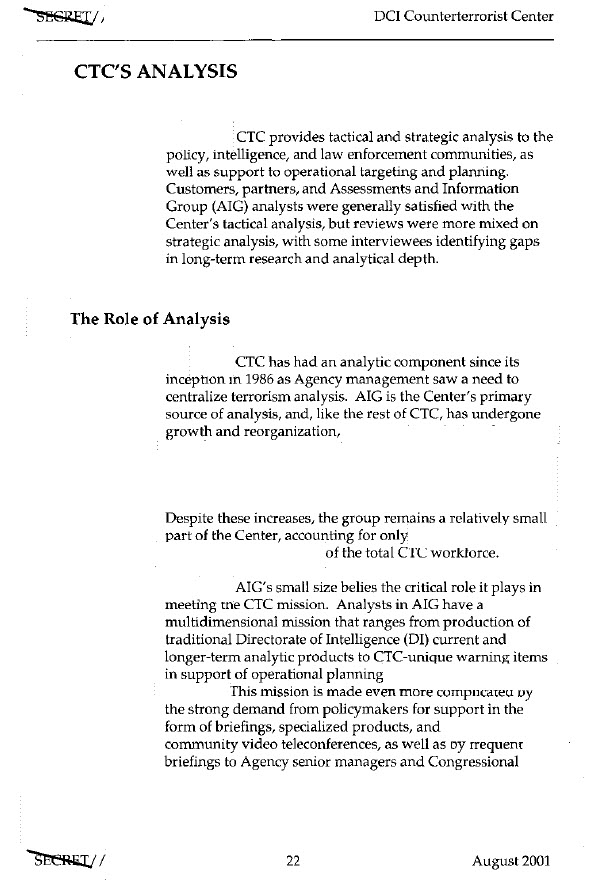
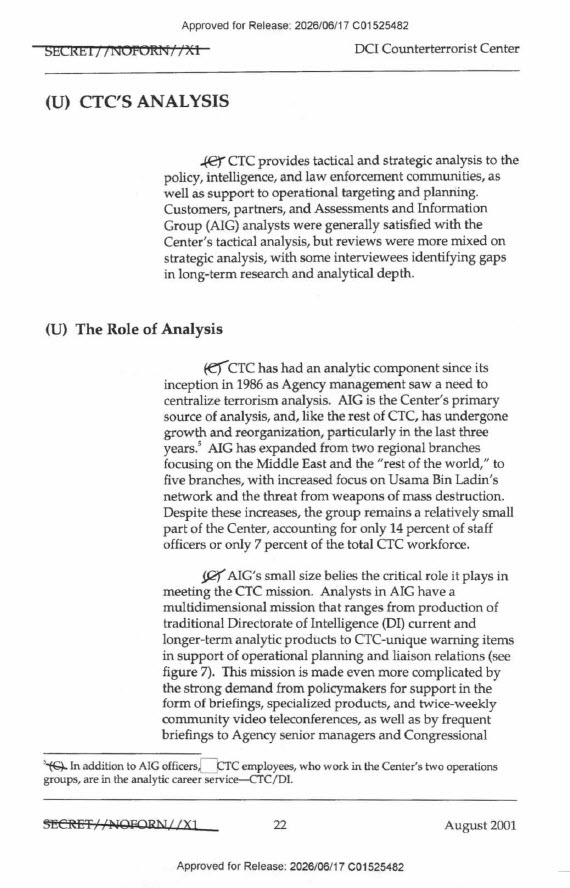
The new release states that AIG had expanded from two regional branches, one covering the Middle East and another covering the “rest of the world”, to five branches, with increased attention to Bin Ladin’s network and weapons of mass destruction.
Even after that expansion, however, AIG accounted for only “14 percent of staff officers or only 7 percent of the total CTC workforce.”
Another previously withheld figure shows that analysts estimated they devoted between 30 and 50 percent of their time to counterterrorism operations support, including targeting and planning connected with “penetrations, recruitments, renditions, and disruptions.”
Information Overload and Translation Backlogs
The new release also restores substantially more information about a problem that runs through the report: the volume of intelligence coming into the Center.
The newly disclosed executive-summary language says CTC had to cope with “information overload,” sometimes generated by successful operations against terrorist cells. Officers said they attempted to scan and prioritize material for immediate action, but the report noted that operational demands did not allow the Center to exploit everything it collected.
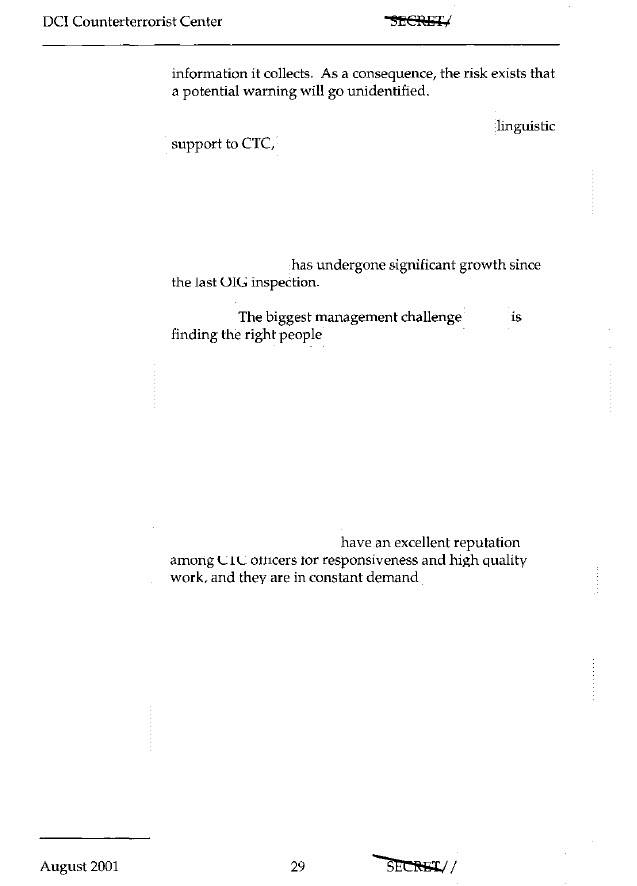
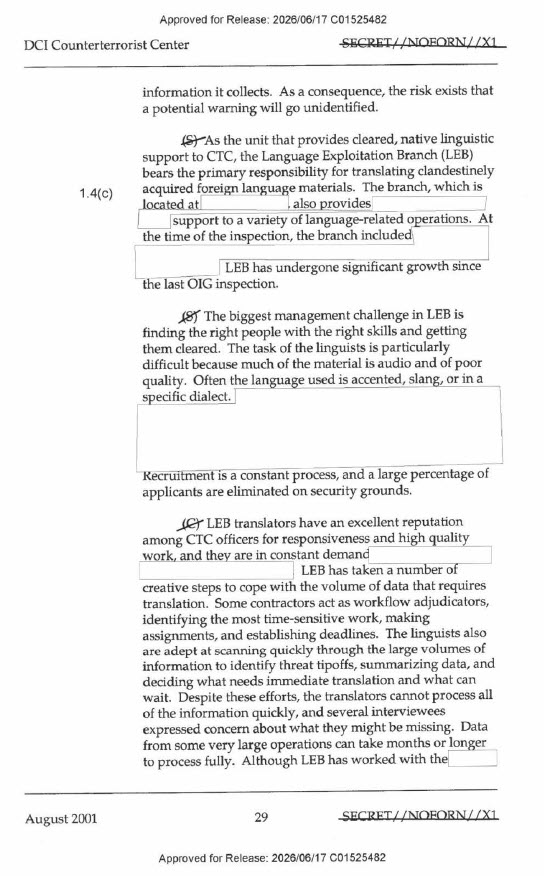
A later section now identifies the CIA’s Language Exploitation Branch as the unit principally responsible for translating clandestinely acquired foreign-language material.
The 2010 release left most of that page blank or reduced it to isolated fragments.
The 2026 version provides considerably more detail. It states that much of the material was poor-quality audio and could contain accented speech, slang or particular dialects. Translators triaged large quantities of information looking for threat indicators, but:
“the translators cannot process all of the information quickly, and several interviewees expressed concern about what they might be missing.”
The report adds that material from some large operations could take “months or longer to process fully.”
New Numbers on Reporting, Staffing and Funding
Several smaller redactions were also removed.
The new version says the percentage of disseminated CTC reports rated “good” or better increased from 44 percent in 1998 to 48 percent in 1999. Those figures were absent from the earlier release.
It also reveals that threat reporting accounted for 12 percent of all CTC reports disseminated in 2000. Senior officials described the rapid dissemination of all threat information as a “zero threshold” approach, while customers sought additional context and analysis.
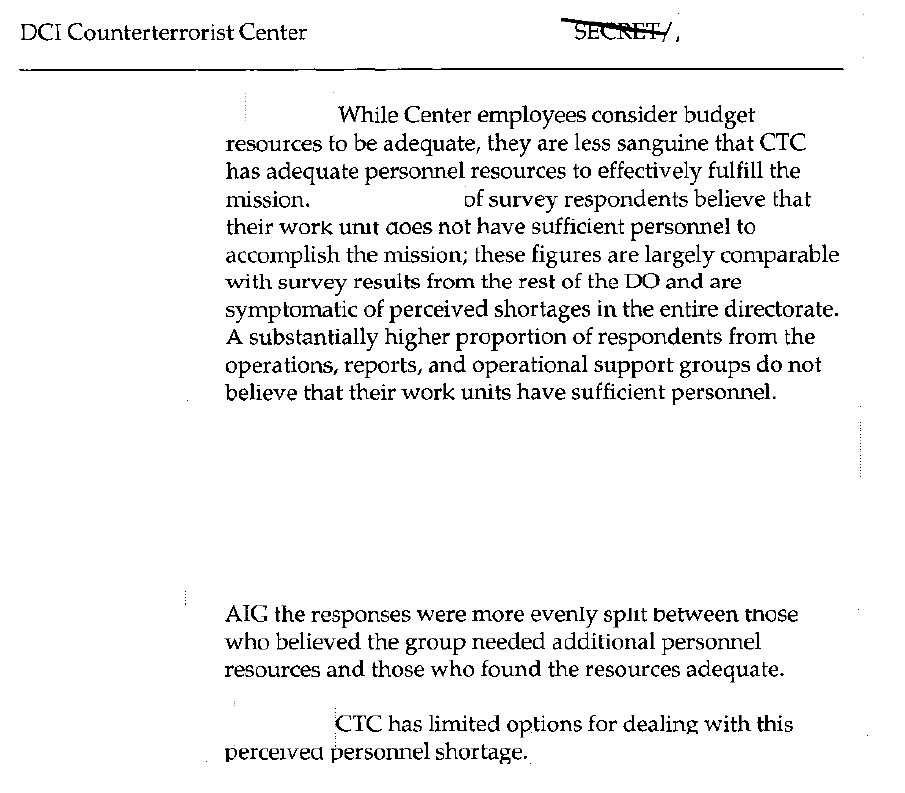
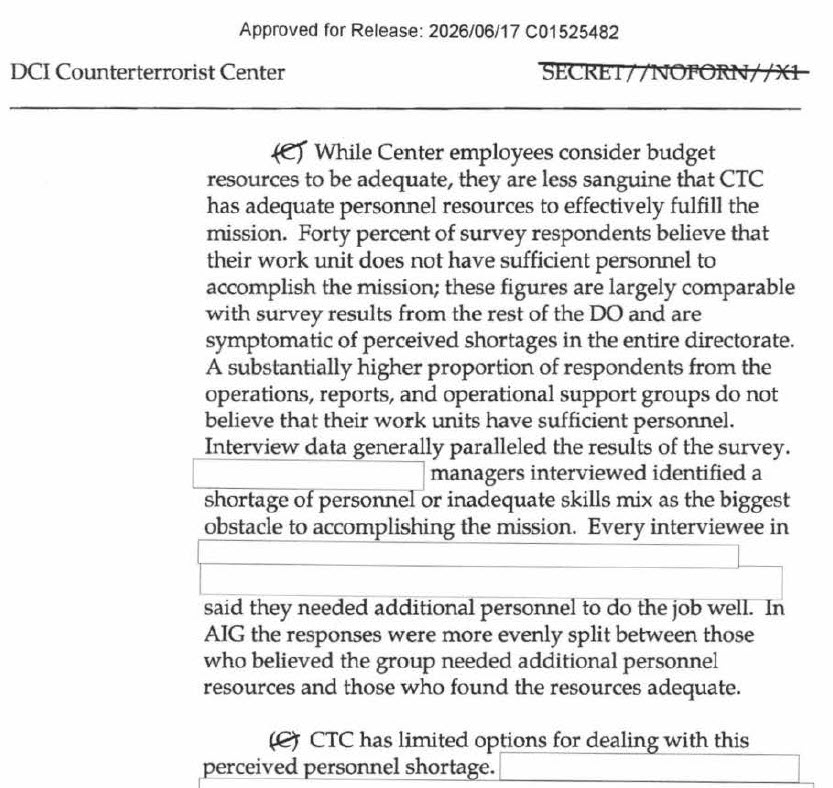
On personnel, the newly released report says 40 percent of survey respondents believed their work unit lacked sufficient personnel to accomplish its mission.
And in a discussion of funding, the CIA Inspector General reported that the additional costs associated with the millennium counterterrorism surge consumed an estimated 15 percent of CTC’s fiscal year 2000 budget. The extra expenditures occurred during the first quarter, while reserve funds did not arrive until May and supplemental funding followed in August. Interviewees characterized the period as a “rollercoaster” year.
A Fuller Document, But Significant Redactions Remain
The new release does not fundamentally rewrite what was already known from the 2010 document. Large portions of sensitive operational material remain withheld, including program names, specific overseas activities, personnel numbers, operational locations and sections concerning particular counterterrorism programs.
But the comparison shows that the Mandatory Declassification Review did produce meaningful additional disclosure, as the new version provides a more complete contemporary account of the pressures inside the CIA’s Counterterrorist Center immediately before September 11: rapidly expanding resources, analysts pulled heavily into operational support, difficulties conducting long-term research on Bin Ladin, information overload, translation backlogs and staffing concerns.
###
Document Archive
 EOM-2019-00272 Release Package [82 Pages, 9.13MB]
 Loading...
 Reload document
 Open in new tab
 Follow The Black Vault on Social Media:


