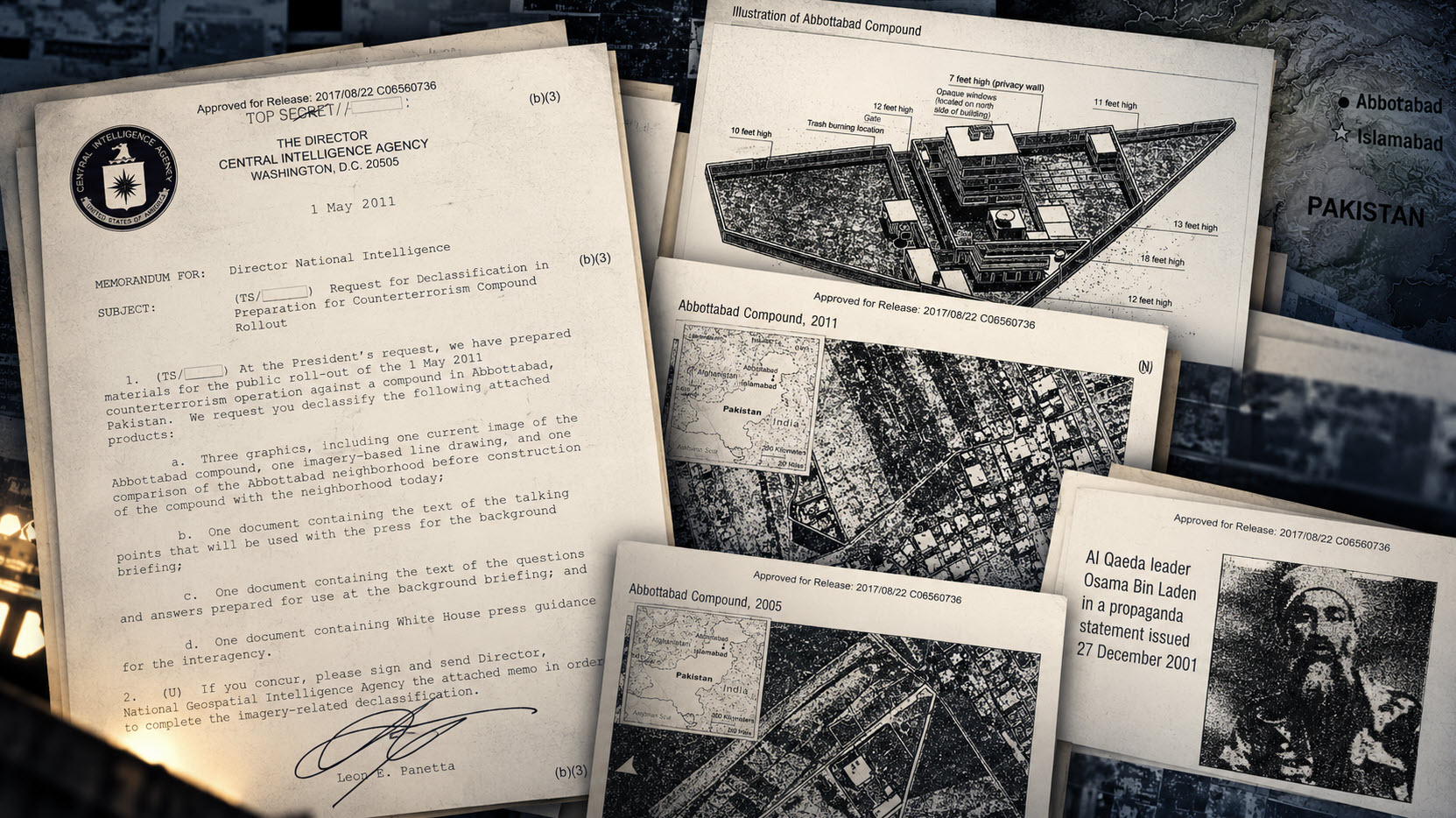

A newly obtained Central Intelligence Agency release provides a detailed look at the material prepared inside the U.S. government for the public rollout following the May 2011 raid that killed Osama bin Laden, including internal talking points, an extensive question-and-answer package, public-affairs guidance and records documenting the expedited declassification of intelligence imagery.
The 35-page responsive record was provided by the CIA in response to a Freedom of Information Act request filed by The Black Vault with the agency in August 2013. In its July 6, 2026, final response, the CIA said it had located the document in its “database of previously-released records” after determining that an earlier FOIA request had sought records on the same subject.
Searches conducted for this article, however, did not locate the complete document in the CIA’s online Electronic Reading Room or elsewhere through conventional web searches. Some portions may therefore be newly accessible online through this release, although that cannot be fully established. What can be established is that this newly obtained package brings together internal records showing how that information was prepared, cleared and organized for public disclosure.
CIA Withholds Records About What Happened to Bin Laden’s Body
The FOIA request contained two separate items. While the CIA released a previously processed record (at least, in part) responsive to the second, it refused to release records responsive to the first.
Item 1 sought:
“All documents pertaining to the capture of Osama Bin Laden’s body, and all documents pertaining to what happened with Bin Laden’s body after his capture — up to the point of his burial into the ocean.”
The request separately sought records concerning meetings about whether the media should be told of bin Laden’s death.
In its July 6, 2026, final response, the CIA said it conducted a review concerning Item 1 and determined that responsive records existed, but that they would not be released:
“With regard to Item 1, after a thorough review of your request, we determined that responsive records, should any exist, would be contained in operational files.”
The CIA cited the CIA Information Act, 50 U.S.C. § 3141, which exempts certain CIA operational files from the search, review, publication and disclosure requirements of FOIA. The agency therefore stated:
“This determination is not subject to an administrative appeal.”
It should be noted that the CIA did not confirm that responsive records concerning the handling of bin Laden’s body exist. Instead, it said that “should any exist,” they would be contained within operational files exempted from ordinary FOIA processing.
As a result, the newly released package does not provide the records specifically requested concerning the handling of bin Laden’s remains through his burial at sea. The CIA instead declined to search or process that portion of the request under the CIA Information Act.
Panetta Sought Rapid Declassification for the Public Rollout
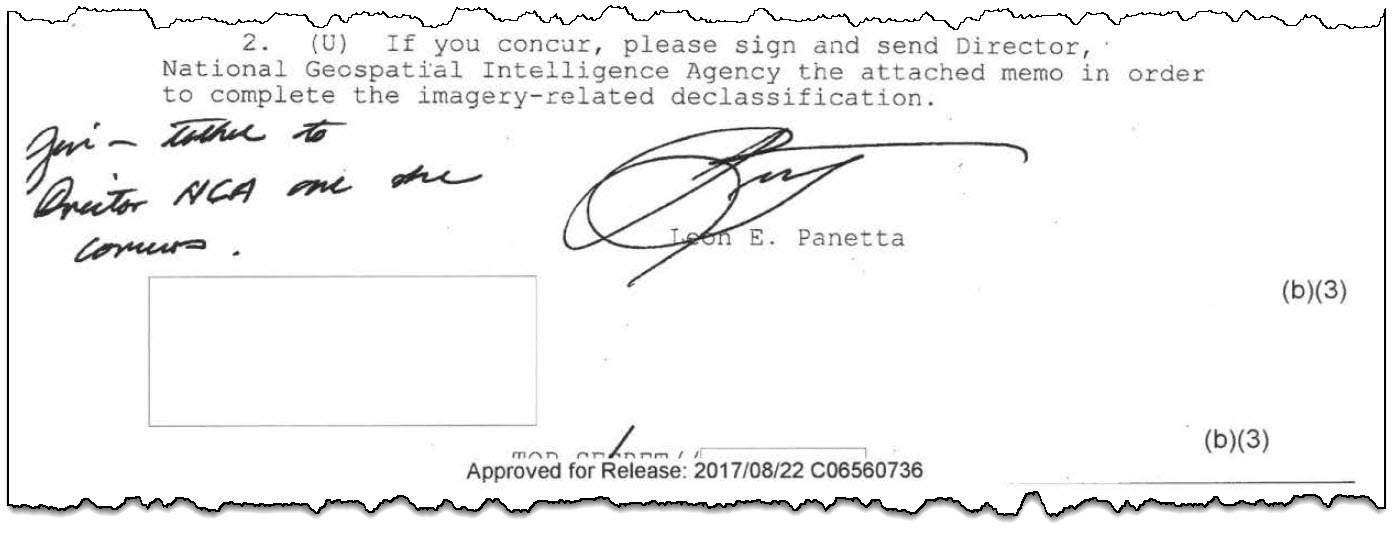
The package begins with a May 1, 2011, memorandum from CIA Director Leon Panetta concerning a request for declassification “in preparation for Counterterrorism Compound Rollout.”
Panetta wrote that materials had been assembled at the president’s request:
“At the President’s request, we have prepared materials for the public roll-out of the 1 May 2011 counterterrorism operation against a compound in Abbottabad, Pakistan.”
The memorandum identifies the material prepared for release as three graphics, a document containing talking points for a background briefing, and another containing questions and answers for use during that briefing.
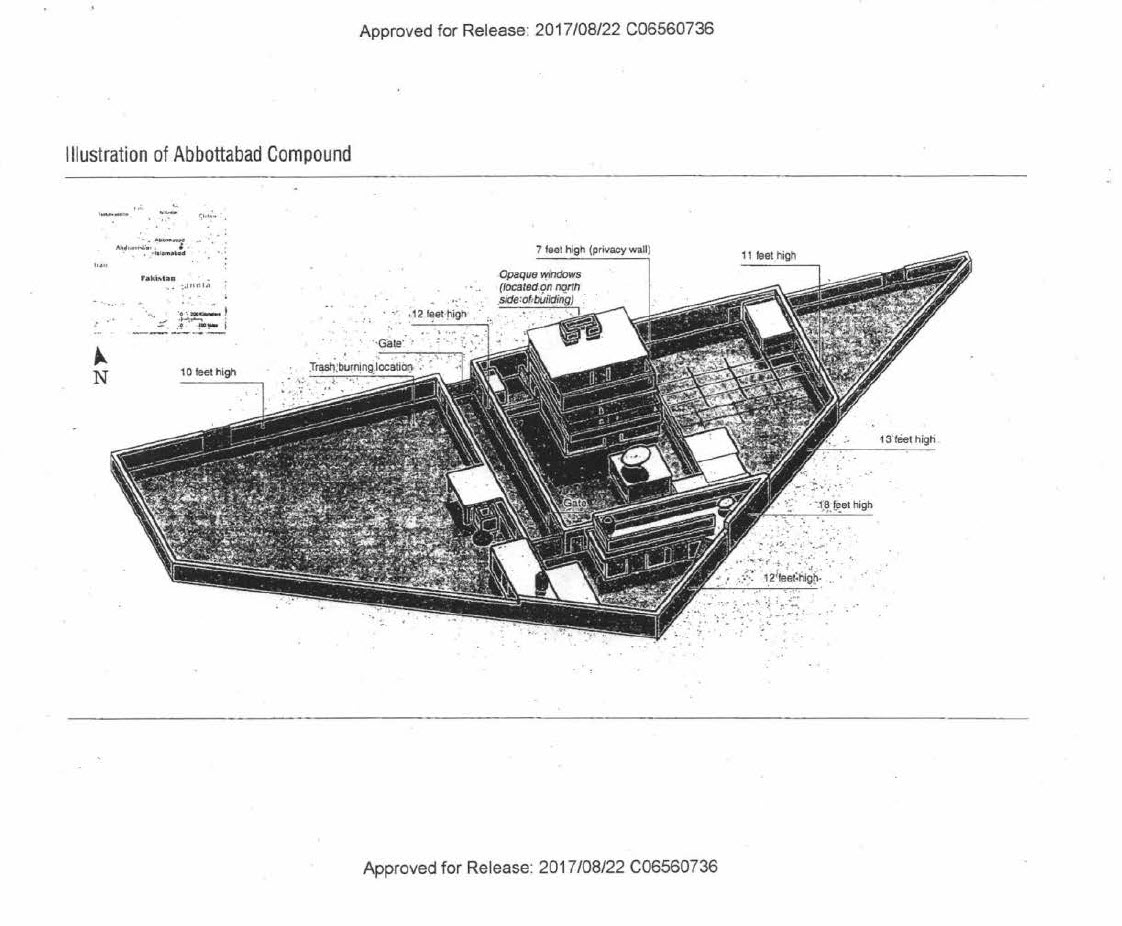 The three graphics were described as a current image of the Abbottabad compound, an imagery-based line drawing, and a comparison showing the compound neighborhood before construction and after it had been built.
Panetta’s memorandum also makes clear that the government was working on an extremely compressed schedule. He requested that the documents be declassified “on an expedited basis” for use by the interagency.
Clapper Authorized Use of Intelligence Imagery
 The next record documents another part of that process.
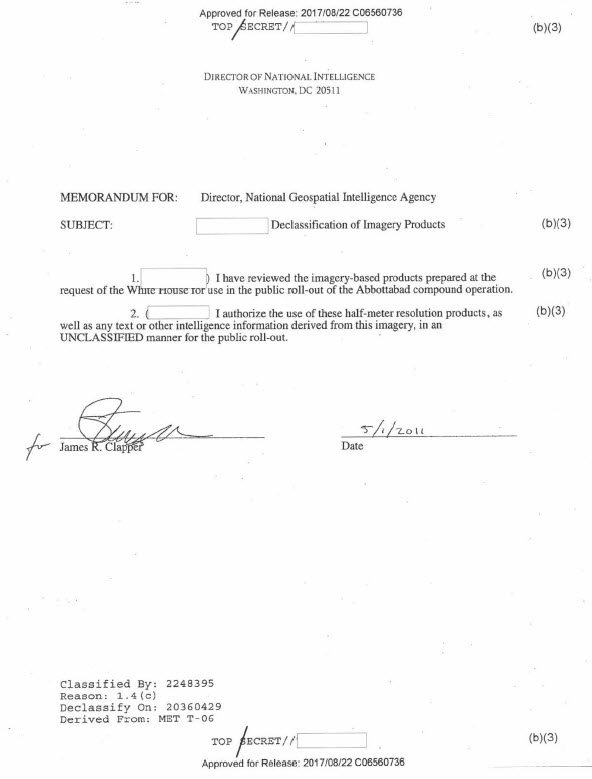
A memorandum to the Director of the National Geospatial-Intelligence Agency concerns the “Declassification of Imagery Products.” It bears the signature of then-Director of National Intelligence James Clapper and is dated May 1, 2011.
Clapper authorized:
“the use of these half-meter resolution products, as well as any text or other intelligence information derived from this imagery, in an UNCLASSIFIED manner for the public roll-out.”
The memorandum says Clapper had reviewed the imagery-based products prepared at the request of the White House.
That authorization was followed by the compound imagery itself: a detailed illustration identifying walls, gates, opaque windows and the trash-burning location; a 2011 overhead image; a preconstruction/postconstruction comparison; and an image of the compound in 2005.
Those images are not newly revealed.
The Defense Department distributed the Abbottabad graphics during its May 2, 2011 background briefing. A contemporaneous copy of the Defense Department material identifies the individual files as the Pakistan map, the 2005 Abbottabad compound image, preconstruction and postconstruction imagery, a 2011 image and the compound illustration.
The National Security Archive later collected the material as part of its Zero Dark Thirty File, identifying the imagery as National Geospatial-Intelligence Agency satellite images and the conceptual compound illustration as a Defense Department release. The Defense Intelligence Agency also continues to make the compound illustration publicly available.
Those earlier releases provide the likely public origin for at least the imagery contained in the newly obtained CIA package.
Internal Talking Points Were Explicitly “Written to Be Declassified”
Following the imagery is a nine-page document titled:
“Talking Points for Background Briefing (with USMIL references)”
Immediately underneath is an unusual parenthetical instruction:
“(written to be declassified)”
The document is dated May 1, 2011.
The talking points divide the presentation among the Assistant to the President for Homeland Security and Counterterrorism, the CIA director and the CIA deputy director.
The opening script states:
“As you heard, the President ordered a raid today against an al Qaeda compound in Abbottabad, Pakistan.”
It describes the intelligence operation as the product of years of work and says:
“Our intelligence and military professionals did a superb job. They deserve tremendous credit for serving justice to Osama Bin Laden.”
The proposed CIA director’s portion emphasizes the interagency intelligence effort:
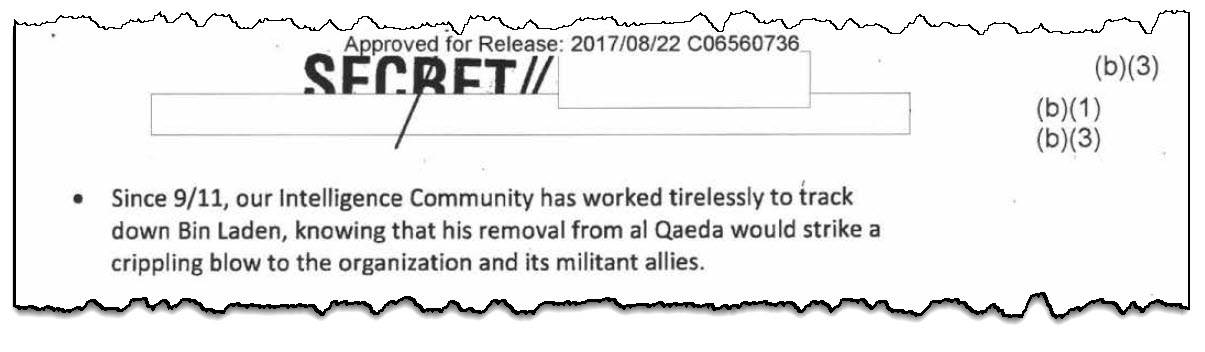
“This military operation was the culmination of years of careful and highly advanced intelligence work.”
It specifically identifies officers from CIA, NGA and NSA as having worked “very hard as a team to analyze and pinpoint this compound.”
The Intelligence Case for the Compound
The proposed remarks for the CIA deputy director go deeper into the intelligence trail that led to Abbottabad.
The talking points state that detainee reporting after September 11 identified individuals who may have provided direct support to bin Laden and Ayman al-Zawahiri, and that one courier drew particular attention.
According to the document:
“Detainees also identified this man as one of the few al Qaeda couriers trusted by Bin Laden.”
The document says intelligence officers eventually identified the courier’s real name and, approximately two years before the raid, identified an area in Pakistan where he and his brother operated. In August 2010, according to the prepared briefing:
“we found their residence — a compound in Abbottabad, a town about 35 miles north of Islamabad.”
The talking points then walk through characteristics that had raised suspicion: the compound’s size, unusually high walls, privacy barriers, lack of telephone or Internet service and the occupants’ practice of burning their trash.
But the prepared language also acknowledged a fundamental uncertainty.
After discussing the intelligence assessments, the document states:
“No other candidate fit the bill as well as Bin Laden.”
It then says the intelligence community’s conclusion was “twofold”: analysts had high confidence that a high-value target was being harbored there, while assessing that there was a “strong probability” that the individual was bin Laden.
An Extensive Q&A Anticipated Difficult Questions
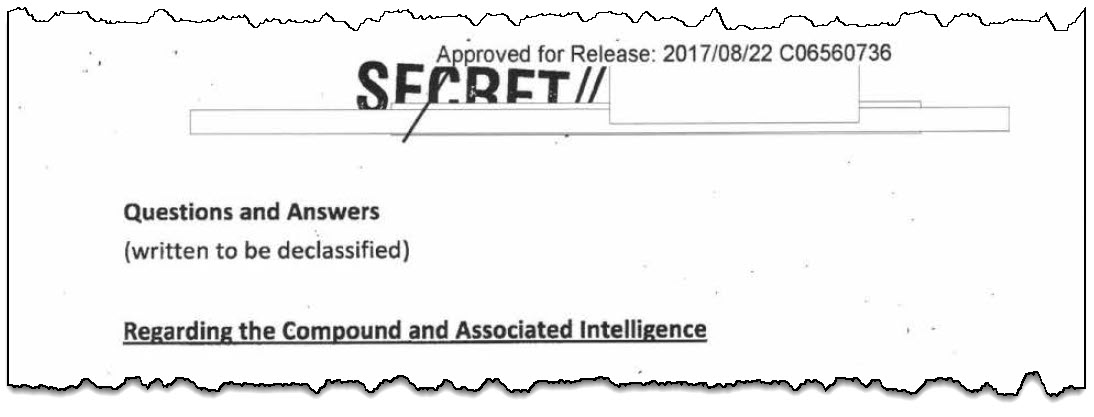
Perhaps the most noteworthy portion of the release is a lengthy, 14-page section titled “Questions and Answers,” also explicitly marked “(written to be declassified).”
It amounts to a prepared government response book covering questions officials expected to face following the raid.
Among them:
“How confident were you that Bin Laden was there?”
The prepared answer distinguished between confidence that the compound contained a high-value terrorist target and confidence that the individual was bin Laden.
Another asks:
“Why didn’t the US trust the Pakistanis enough to share the intelligence with them?”
The prepared response states:
“The United States shared our very sensitive intelligence with no one until this very tightly held in our own government.”
It then says that decision was made to protect intelligence and ensure the operation’s success.
The document also anticipated questions about detainee interrogation.
One asks whether the reporting came from anyone held at a black site or subjected to enhanced interrogation techniques. Another specifically asks whether detainees at Guantanamo provided information leading to bin Laden’s location.
For both, the prepared response declines to discuss the specific sources but says reporting from “a wide variety of sources — independently verified — helped lead us to this location.”
Questions About the Raid — and Answers Officials Were Not Prepared to Give
The Q&A also demonstrates where officials intended to draw the line publicly.
Asked what unit conducted the raid, the prepared answer says only that it was “a small team of highly-skilled operators.”
Asked how many troops were involved:
“I can’t be specific. It was a small team.”
Asked where the operation was launched from:
“For operational reasons, I cannot share that information with you.”
Asked how long U.S. forces were in Pakistan:
“I cannot get into that level of detail with you.”
The document says U.S. forces had left Pakistan after the operation and states that the mission objective, as directed by the president, was:
“To kill or capture Osama Bin Laden.”
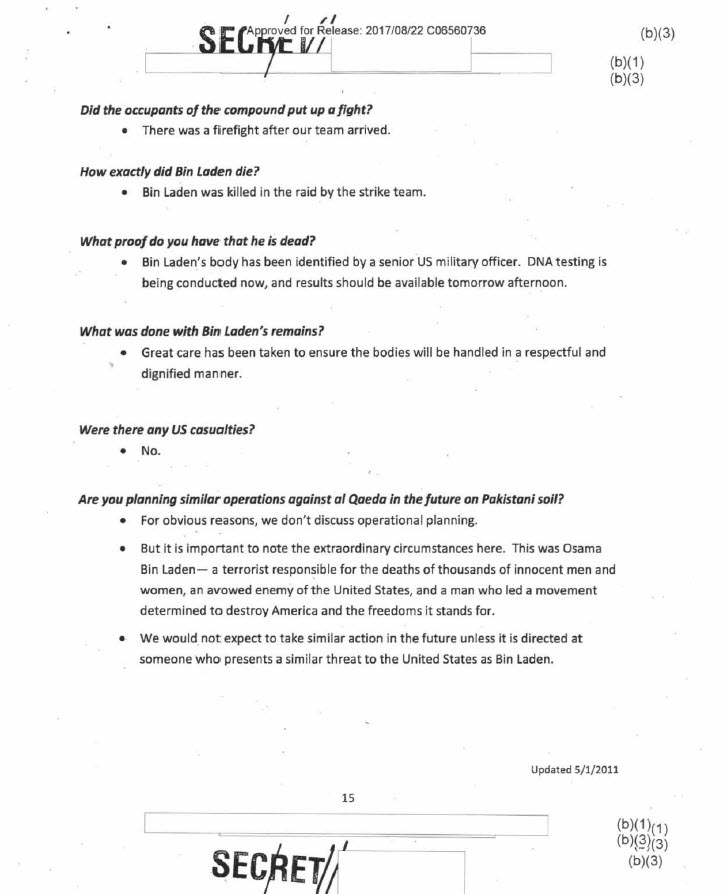
Other anticipated questions addressed whether anyone was captured, how bin Laden was identified, what happened to his remains, U.S. casualties and whether similar operations could be conducted in Pakistan in the future.
Officials Prepared for Questions About Why Bin Laden Was Killed
 The briefing book specifically anticipated:
“Why kill rather than capture?”
The proposed answer was concise:
“There was a firefight when our team arrived.”
Another question addressed why the president authorized the operation despite not knowing with certainty that bin Laden was inside.
The prepared response acknowledged that uncertainty:
“We couldn’t wait for absolute proof that might never come, nor could we risk the possibility that he might relocate.”
It characterized the decision as one involving risks the president was willing to take.
The document also anticipated questions about whether bin Laden’s death would alter U.S. counterterrorism policy, the search for Ayman al-Zawahiri, relations with Pakistan, Afghanistan policy and the possibility of retaliatory attacks.
Public Affairs Guidance Shows the Intended Government Message
The final substantive section is titled “Public Affairs Guidance for the Interagency,” again followed by:
“(written to be declassified)”
Its “Toplines” present a condensed version of the message agencies were expected to use publicly.
It states that President Obama had authorized “a unilateral raid” against the Abbottabad compound and describes the operation as the culmination of intelligence work led by CIA with support from partners across the Intelligence Community.
The guidance also contains sections headed “Impact of Bin Laden’s Death on al Qaeda,” “On the Intelligence Case,” “On the Operation,” “On US-Pakistan Relations,” and “Possible Retaliation by al Qaeda.”
Much of that information closely parallels what government officials said publicly in the immediate aftermath of the raid.
A May 2, 2011, Defense Department background briefing, for example, discussed the compound’s walls, privacy barriers, burned trash, lack of a conventional profile and approximately $1 million assessed value while presenting the government-released imagery.
The National Security Archive subsequently preserved extensive material concerning the government’s public account of the raid, including White House briefings and the NGA compound imagery.
What the Release Adds
The significance of the CIA release is therefore not that every fact or image inside it is new.
Much of the substantive account of the Abbottabad operation became public immediately after bin Laden’s death, and the imagery included in the CIA file can be traced to the government’s May 2011 public rollout.
What the newly obtained package adds is a more complete view of the internal machinery behind that rollout.
The records document Panetta’s request for expedited declassification, Clapper’s authorization permitting intelligence imagery and information derived from it to be used in an unclassified setting, the proposed division of talking points among senior officials, an extensive list of anticipated questions and prepared answers, and interagency public-affairs guidance.
They also preserve material in its internal form, which includes passages explicitly labeled “written to be declassified”, rather than simply the public statements that ultimately emerged from the briefings.
The document itself was approved for release on August 22, 2017, and the CIA told The Black Vault in 2026 that it located the material among its previously released records, but searches have not located this complete CIA package in the agency’s Electronic Reading Room or elsewhere online, leaving open the possibility that at least portions of the internal package are now becoming readily available online for the first time. That possibility cannot presently be confirmed.
###
Document Archive
 F-2013-02406 Release Package [37 Pages, 4.77MB]
 Loading...
 Reload document
 Open in new tab
 Follow The Black Vault on Social Media:


