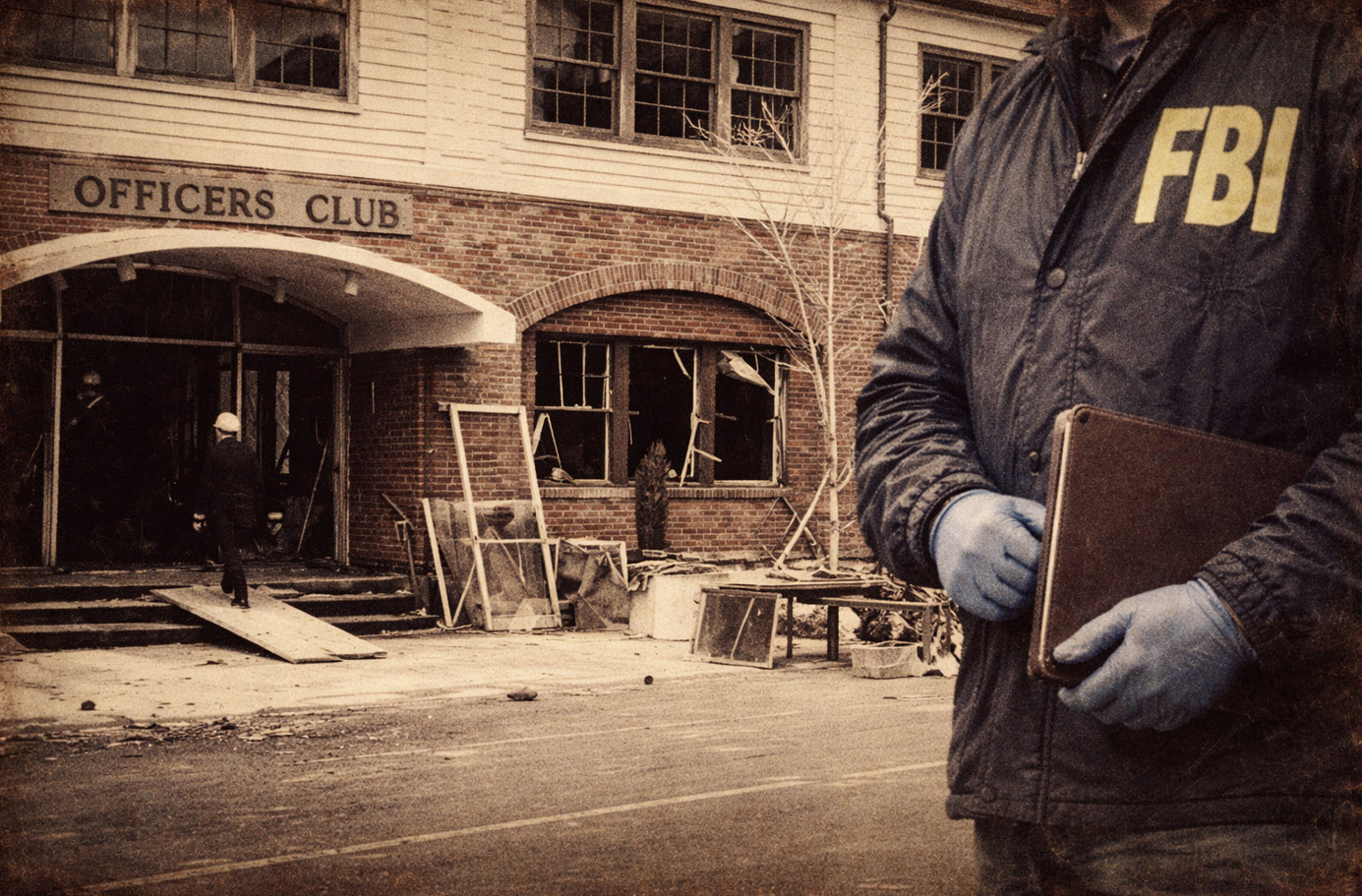

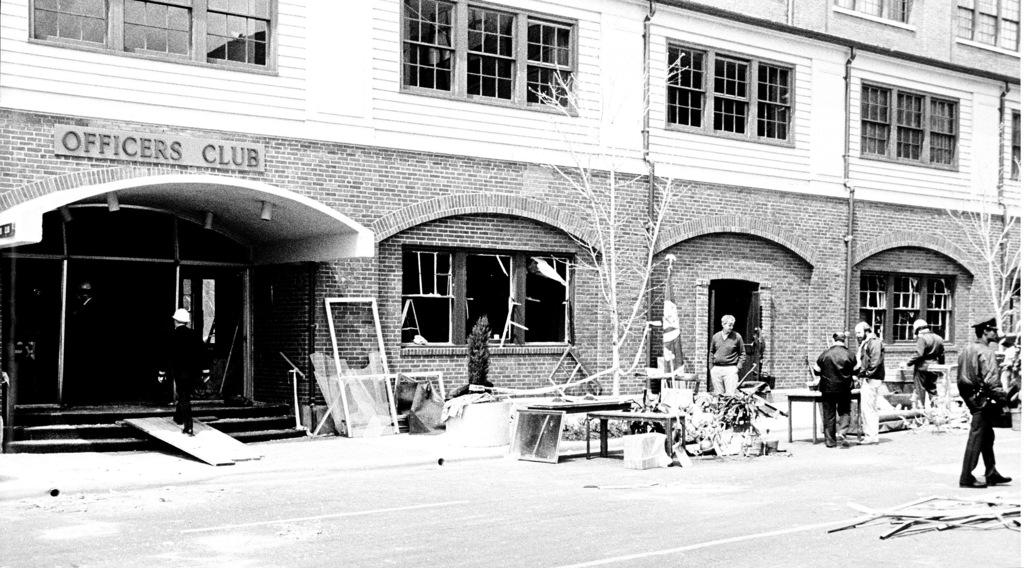
 A newly released FBI file documents the Bureau’s investigation into the April 20, 1984, bombing of the Washington Navy Yard Officers’ Club in Washington, D.C. The records consist primarily of FD-302 interview reports, investigative summaries, and supporting materials compiled by the FBI’s Washington Field Office in coordination with multiple federal and local agencies.
One FBI report dated June 11, 1984 states:
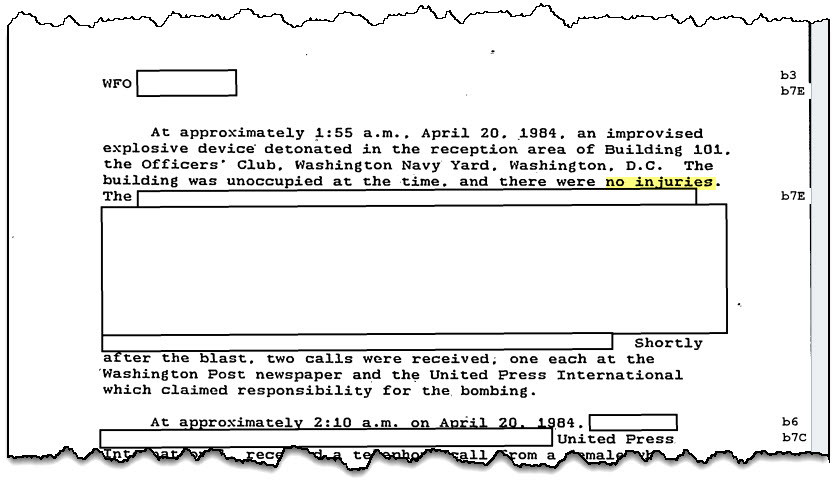
“At approximately 1:55 a.m., April 20, 1984, an improvised explosive device detonated in the reception area of Building 101, the Officers’ Club, Washington Navy Yard, Washington, D.C.”
The same report notes:
“The building was unoccupied at the time, and there were no injuries.”
The investigation was opened under federal jurisdiction due to the use of an explosive device and the possibility of involvement by “terrorist or revolutionary groups.”
Claims of Responsibility
The file documents multiple communications claiming responsibility for the bombing. According to FBI reporting:
“Shortly after the blast, two calls were received; one each at the Washington Post newspaper and the United Press International which claimed responsibility for the bombing.”
One call relayed a recorded message:
“The caller stated that there had been a bombing at the Washington Navy Yard… in support of independence for Puerto Rico… [and]that the FALN was claiming responsibility.”
A separate message referenced a different group:
“The tape recorded message stated something to the effect that the Guerrilla Resistance Movement… bombed the Washington Navy Yard… against United States imperialism in the Caribbean and Central America.”
Mailed Communiqués
The FBI file includes extensive documentation of letters believed to be associated with the group “Red Guerrilla Resistance.” These letters were mailed to various organizations and media outlets and often traced back to the same return address.
An April 30, 1984 interview states:
“She received… pieces of mail, believed to be RED GUERRILLA RESISTANCE communiques, claiming responsibility for the bombing of the WASHINGTON NAVY YARD (WNY) Officers’ Club on April 20, 1984.”
Multiple envelopes were sent to organizations including media outlets and advocacy groups, with a recurring return address:
“840 Barnaby Street, S.E., Apartment #23, Washington, D.C. 20032.”
However, the file notes a key inconsistency:
“There is no apartment #23 at 840 Barnaby Street, S.E., Washington, D.C.”
Additional records show repeated receipt of returned mail bearing the same address, reinforcing its use across multiple communications.
Witness Interviews and Leads
The file contains numerous witness interviews from employees and patrons present at the Officers’ Club prior to the bombing. These include descriptions of unidentified individuals (“Unsubs”) and composite sketches generated during the investigation.
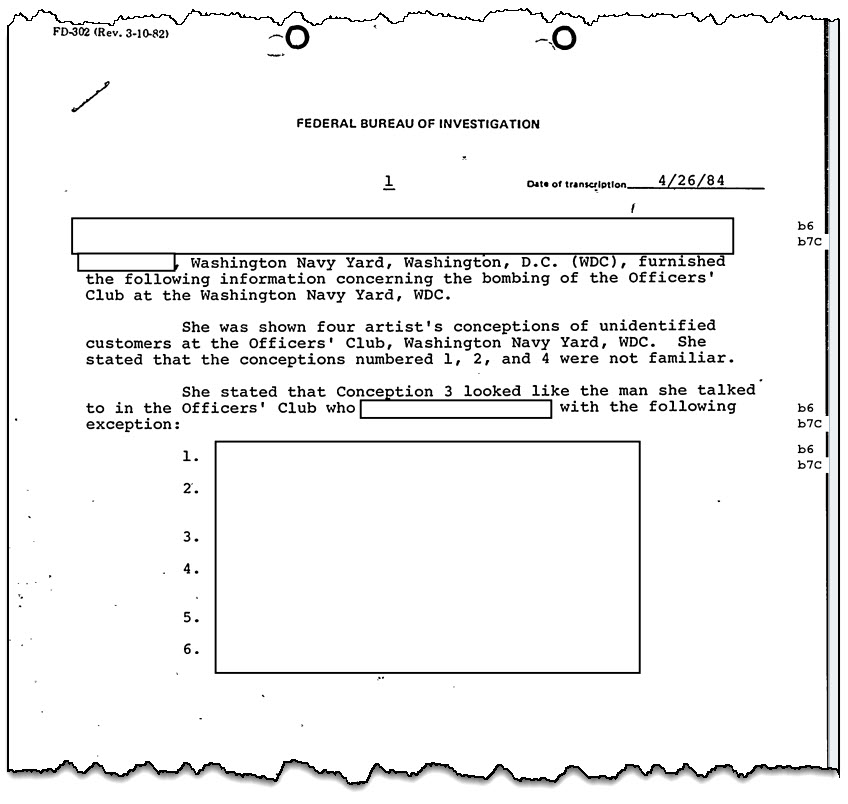
One interview describes a suspicious individual observed the night before the explosion:
“This individual seemed to be deep in thought, gave the appearance of being unfriendly and appeared as though he might be waiting for someone else to arrive.”
Despite these efforts, the investigation encountered significant limitations. A summary states:
“Completed leads to date have met with very limited success and have not identified the perpetrators of the bombing.”
Investigative Scope and Coordination
The case involved coordination between multiple agencies, including:
“The Metropolitan Police Department, United States Secret Service, Bureau of Alcohol, Tobacco, and Firearms, and Naval District of Washington Police.”
The FBI also worked jointly with the Naval Investigative Service (NIS), issuing a unified report to avoid duplication of investigative efforts.
Status Reflected in the File
The documents indicate that, at the time of reporting, the case remained unresolved. The identity of those responsible for the bombing was not determined within the materials released, and investigative leads had not produced definitive results.
Redactions are present throughout the file, particularly in names, identifying details, and portions of investigative analysis, limiting full visibility into certain aspects of the case.
The full release can be seen below.
###
Document Archive
 FBI Released Files [190 Pages, 15.1MB]
 Loading...
 Reload document
 Open in new tab
 Follow The Black Vault on Social Media:


