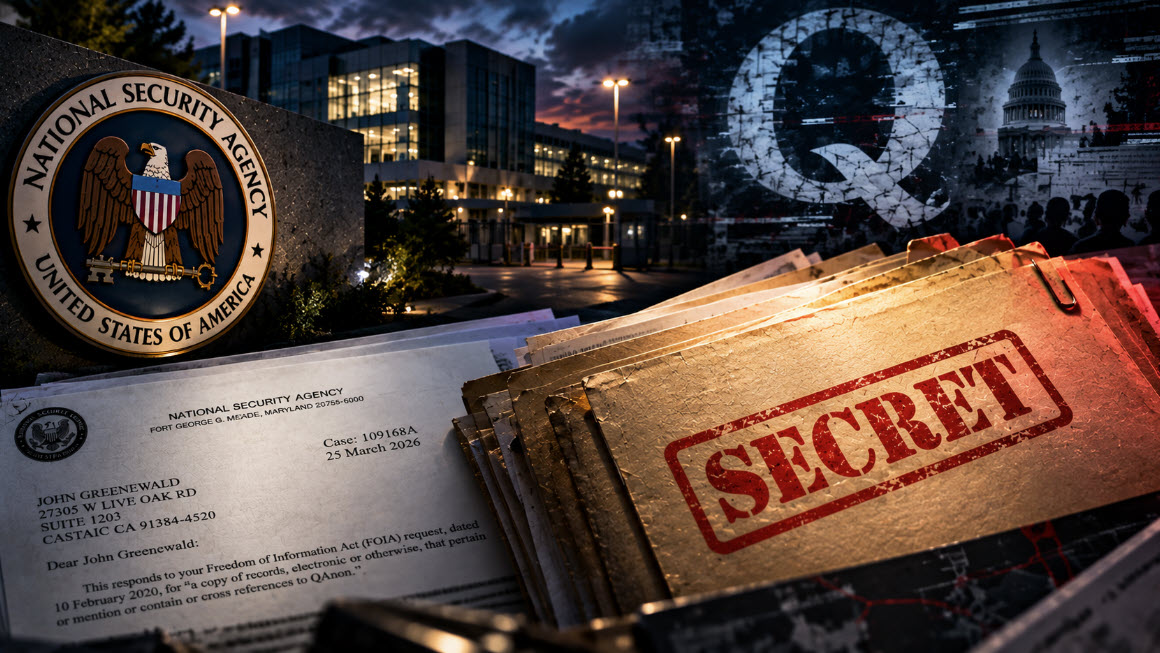

 A Freedom of Information Act request seeking National Security Agency records mentioning or cross-referencing QAnon has produced a limited set of material: an internal employee discussion in which QAnon was invoked casually as a joke, records associated with an earlier FOIA request filed by The Black Vault, and, more significantly, confirmation that the NSA located a separate three-page document that remains classified SECRET and was withheld in its entirety.
The NSA’s March 25, 2026, response concerned a FOIA request filed on February 10, 2020, seeking records that “pertain or mention or contain cross references to QAnon.” The request covered records dating from 2016 through the date the request was processed.
The response does not disclose the subject, origin, date or contents of the three-page classified record. Consequently, the release provides no basis to conclude what connection the withheld document has to QAnon. It could contain a substantive discussion of the movement, a passing reference, a cross-reference comparable to the material that was released, or something else entirely. The available record does not resolve that question.
A SECRET Document Withheld in Full
According to the NSA, “1 document (3 pages) has been withheld in its entirety.” The agency said the document remains properly classified under Executive Order 13526 and specifically cited Sections 1.4(c) and 1.4(g). NSA further stated that the record remains classified at the SECRET level and that disclosure “could reasonably be expected to cause serious damage to the national security.”
Section 1.4(c) of Executive Order 13526 covers classified information concerning “intelligence activities (including covert action), intelligence sources or methods, or cryptology.” Section 1.4(g) covers “vulnerabilities or capabilities of systems, installations, infrastructures, projects, plans, or protection services relating to the national security.” Those classification categories establish the grounds cited by NSA for protecting the information; they do not establish what the three-page document says or how QAnon figures into it.
NSA invoked FOIA Exemption 1, which protects properly classified national-security information. It also invoked Exemption 3 and identified three statutes applicable to the fully withheld document: 18 U.S.C. § 798, 50 U.S.C. § 3024(h), and Section 6 of Public Law 86-36, codified at 50 U.S.C. § 3605.
NSA additionally stated that it “reasonably foresees” disclosure of the withheld material would harm an interest protected by the exemptions it cited.
Nothing in the response identifies whether the classified document was created by NSA, originated elsewhere in the Intelligence Community, or merely contains a QAnon reference that caused it to become responsive to the broad wording of the request.
That distinction matters because the unclassified record released alongside it demonstrates how little a keyword hit can reveal about a document’s actual subject.
The Released QAnon Reference Was a Joke
The substantive released material is a November 2019 discussion among NSA personnel concerning personnel policies, field tours, deployments and promotion requirements.
The pages are printouts from an NSA system labeled “Tapioca: The Stream.” The interface displays threaded posts and replies among multiple users, along with timestamps and automatically associated “Implicit Topics.” The released thread states that it contains 23 replies from 13 people.
The conversation began after a feed apparently cut out while the Director of NSA was discussing field-tour policy. Employees then attempted to reconstruct what had been said, discussing possible requirements for field tours or deployments, promotion to the GS-15 level, jobs at NSA Washington and the meaning of personnel terminology.
One participant complained that field-tour advertisements seemed to disappear. Another said someone had told them that advertisements were displayed only on certain days of the week before being removed.
That prompted the sole QAnon reference visible in the released discussion:
“This actually sounds like some qAnon conspiracy theory. Field ads appear in the hr tool just like other jobs. If you want a specific job, you should write to the org and ask about it.”
In other words, the released thread is not an NSA analysis of QAnon. The term was used colloquially by an employee during an unrelated workplace discussion. Because the 2020 FOIA request explicitly sought records that merely “mention” or “contain” references to QAnon, that passing reference made the discussion responsive.
What is Tapioca?
The released pages themselves provide useful context for Tapioca, although NSA does not provide a separate technical description of the system in this FOIA response.
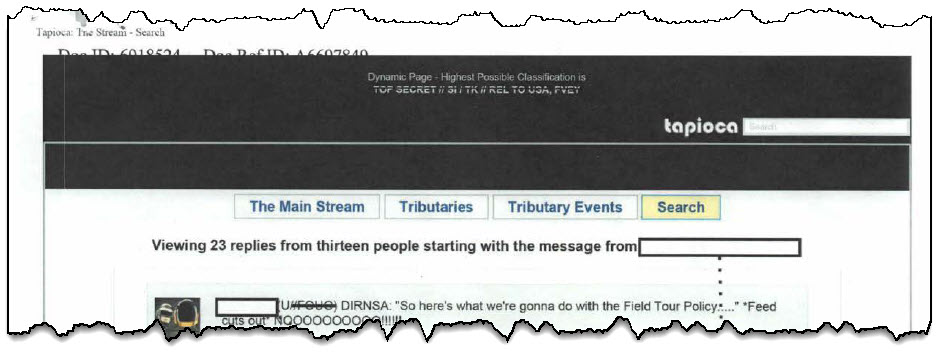
The records identify the interface as “Tapioca: The Stream” and show a social-media-style internal discussion environment. The pages include tabs labeled “The Main Stream,” “Tributaries,” “Tributary Events” and “Search,” while individual entries contain replies, timestamps, topic tags and links indicating that messages were “posted to The Stream.”
An Earlier QAnon Search Found Nothing
The 2026 release also contains records from a separate August 2018 FOIA request, originally filed by The Black Vault, seeking Intellipedia entries for “QANON” or “Q-ANON,” including entries returned through an Intellipedia keyword search.
NSA explained at the time that it serves as executive agent for Intelink and provides technical services enabling Intelligence Community and Department of Defense users to access and share information. It also cautioned that Intellipedia pages are collaborative “living documents” that can be created and edited by users from different organizations and should not be regarded as the final, coordinated position of the Intelligence Community.
NSA reported that a “thorough search of Intellipedia files was conducted,” but that no responsive records were located.
That August 2018 result and the March 2026 response concern different searches and should not be conflated. The earlier request was specifically directed at Intellipedia. The later request was broader, seeking NSA records containing or cross-referencing QAnon.
What QAnon Was — and What Was Never Established
QAnon emerged online in 2017 around anonymous posts attributed to a figure calling itself “Q,” who claimed access to sensitive government information. The posts became the foundation for an expansive collection of conspiracy claims involving political figures, government officials and other public personalities.
Central QAnon claims, which included allegations of a secret cabal engaged in child trafficking and assertions that hidden government operations were underway against that cabal, were never substantiated by credible evidence. The existence of government records discussing QAnon should likewise not be confused with evidence supporting those claims.
Government agencies nevertheless had legitimate reasons to document QAnon as a social and, in some cases, security phenomenon. An FBI record from October 2018, for example, documents database checks and open-source research concerning QAnon. Later FBI and Department of Homeland Security reporting discussed conspiracy theories, including QAnon, in the context of some domestic violent extremists, while emphasizing that ideology or belief alone is not what defines domestic terrorism; the government’s framework centers on criminal acts, threats or violence.
None of that validates QAnon’s underlying allegations.
Previous CIA and FBI Responses on QAnon Records
The NSA response is not the first time a federal intelligence or law-enforcement agency has withheld information in response to a QAnon-related FOIA request. Previous requests by The Black Vault produced substantially different responses from the CIA and FBI.
In February 2020, The Black Vault submitted a request to the CIA for records pertaining to QAnon. The agency responded two days later with what is commonly known as a Glomar response: it would neither confirm nor deny the existence or nonexistence of responsive records. According to the CIA response as reported by The Black Vault at the time, even acknowledging whether such records existed would itself reveal classified information.
The FBI later took a different approach. In records released to The Black Vault and reported in May 2023, the Bureau acknowledged locating 43 pages related to QAnon but released only 19 pages. The remaining pages were withheld under FOIA Exemption 7(A), which applies to law-enforcement records when disclosure “could reasonably be expected to interfere with enforcement proceedings.”
The newly released NSA response adds another, distinct piece to that record. Unlike the CIA, NSA has now acknowledged that responsive records exist. And unlike the FBI withholding, which was based on interference with enforcement proceedings, NSA identified a separate three-page document as currently classified SECRET, stating that disclosure “could reasonably be expected to cause serious damage to the national security.”
Taken together, the three responses establish only what each agency has formally acknowledged through FOIA: the CIA refused in 2020 to say whether it possessed responsive records; the FBI later acknowledged 43 pages while withholding more than half of them on law-enforcement grounds; and NSA has now acknowledged responsive material that includes a three-page SECRET document withheld in full. They do not establish that the CIA, FBI and NSA records are connected, concern the same underlying matter, or substantiate any of QAnon’s claims.
What the NSA Release Does — and Does Not — Establish
The March 2026 FOIA response establishes a narrow but potentially significant fact: when NSA processed a broad request for records pertaining to, mentioning, containing or cross-referencing QAnon, it identified a three-page document that it determined remains classified SECRET and withheld every page.
It does not establish why that document was responsive.
NSA’s decision to withhold it under national-security and statutory exemptions reveals classification grounds, but not the nature of the QAnon connection. The released Tapioca thread provides a useful cautionary example: a record can qualify as responsive simply because someone mentioned “qAnon conspiracy theory” in an otherwise unrelated conversation about personnel policy.
The three-page SECRET record could similarly contain only an incidental reference, or its connection to QAnon could be more substantive. With all three pages withheld and no description of their contents provided, the public record does not permit either conclusion.
For now, what the document contains, and why the term QAnon led NSA to identify it as responsive, remains unknown.
###
Document Archive
 NSA FOIA Case 109168 Release Package [14 Pages, 1.95MB]
 Loading...
 Reload document
 Open in new tab
 Follow The Black Vault on Social Media:


