


The Central Intelligence Agency on Friday released 71 declassified President’s Daily Brief documents related to the September 11, 2001, terrorist attacks, opening a new collection of intelligence assessments that documented what the U.S. government was receiving about Usama Bin Ladin, al-Qa‘ida and terrorist threats in the years leading up to the attacks.
The documents were released September 11, 2026, on the 25th anniversary of the attacks. According to the CIA, the collection represents the Agency’s “single largest release of declassified CIA PDB products related to 9/11” and contains more than 100 pages of intelligence analysis.
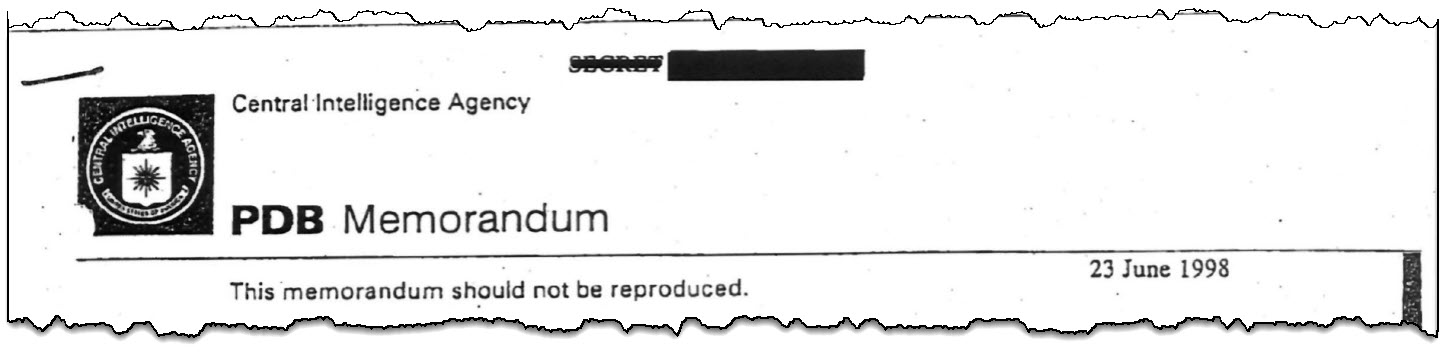
The newly released material spans from February 1998 through September 12, 2001, and includes assessments concerning Bin Ladin’s terrorist network, potential attacks inside the United States, hijacking threats, al-Qa‘ida’s overseas infrastructure, unconventional weapons efforts and the escalating threat environment during the months immediately preceding September 11. The collection concludes with a September 12, 2001, situation report examining intelligence that emerged in the immediate aftermath of the attacks. The CIA’s published index identifies 71 individual products and provides a 101-page compilation of the collection.
CIA Director John Ratcliffe announced the declassification Friday, calling it an “act of exceptional transparency” and saying the Agency was releasing the material to commemorate those killed in the attacks. The CIA described the records as tracing its analysts’ “evolving understanding of al-Qa‘ida” and their efforts to warn about Bin Ladin’s attack planning based on what the Agency characterized as “sparse, vague, and imperfect information.”
The release provides a broader documentary record surrounding one of the most scrutinized intelligence products from the period: the August 6, 2001, President’s Daily Brief titled “Bin Ladin Determined To Strike in US.” That document, portions of which became public during the investigations that followed 9/11, warned that Bin Ladin had wanted to conduct attacks inside the United States for years.
“Clandestine, foreign government, and media reports indicate Bin Ladin since 1997 has wanted to conduct terrorist attacks in the US. Bin Ladin implied in US television interviews in 1997 and 1998 that his followers would follow the example of World Trade Center bomber Ramzi Yousef and ‘bring the fighting to America.’”
The August 6 brief also addressed information then being developed by the FBI:
“Nevertheless, FBI information since that time indicates patterns of suspicious activity in this country consistent with preparations for hijackings or other types of attacks, including recent surveillance of federal buildings in New York.”
It further stated that the FBI was conducting “approximately 70 full field investigations throughout the US that it considers Bin Ladin-related,” while the CIA and FBI were investigating a May 2001 call to the U.S. Embassy in the United Arab Emirates alleging that Bin Ladin supporters were inside the United States planning attacks.
The broader collection released Friday places that well-known August 6 assessment alongside years of earlier PDB reporting about Bin Ladin and his network. A September 4, 1998, memorandum, for example, warned:
“The most serious threat comes from Usama Bin Ladin, but affiliated extremist groups such as the Egyptian Islamic Jihad (EIJ) and the Egyptian al-Gama’at-al-Islamiyya, which have a presence in North America and Europe, could conduct independent attacks or collaborate in terrorist operations against US interests.”
An August 28, 1998, PDB similarly assessed that Bin Ladin could draw upon “a network of individuals and allied groups in at least 60 countries to conduct attacks.” The document stated:
“Bin Ladin’s well-established infrastructure in North America, Europe, and East Asia lends credibility to reports that he also will target US interests in these regions.”
The documents also show intelligence reporting concerning hijacking scenarios years before September 11. A May 22, 2001, PDB titled “Captured Terrorist Details Hostage Plot” discussed an alleged operation involving Bin Ladin and Egyptian Islamic Jihad in which conspirators seeking the release of imprisoned extremists “may hijack an aircraft or storm a US Embassy.”
The assessment noted:
“Bin Ladin’s al-Qa‘ida organization and the two Egyptian groups previously have considered taking hostages—possibly including hijackings—to force concessions.”
The collection also documents the increasingly urgent threat reporting received during 2001. An August 10 PDB, “UBL Associate Planned To Attack US in Europe,” described information that a source had been instructed by senior Bin Ladin lieutenants to prepare a suicide attack against U.S. interests in France. CIA analysts wrote that the information was consistent with other indications that “al-Qa‘ida’s leadership is taking a more active role in directing mujahidin attacks.”
Other assessments addressed al-Qa‘ida’s interest in chemical, biological, radiological and nuclear capabilities. A February 12, 2001, PDB stated:
“Bin Ladin is actively trying to extend his capability to target US interests with more sophisticated unconventional means than the crude attacks with toxic chemicals and biological materials already at his disposal.”
The documents do not provide a single, continuous intelligence picture. Individual assessments contain extensive redactions, and the information available to analysts varied substantially in specificity and reliability. Some reports concerned threats overseas, others addressed possible attacks inside the United States, and numerous documents explicitly acknowledged uncertainty about targets, timing or operational details.
The collection extends through the morning after the attacks. In a September 12, 2001, situation report titled “Bin Ladin’s Tracks,” the CIA wrote:
“Mounting evidence indicates Sunni extremists in Afghanistan and the Persian Gulf recently were aware Usama Bin Ladin-directed attacks were imminent.”
The report said a facilitator in Afghanistan had claimed that Bin Ladin left Kandahar for Kabul in anticipation of a probable operation. It also described reported friction between Bin Ladin and Taliban leader Mullah Omar:
“Bin Ladin and Taliban leader Mullah Omar late last month clashed over Bin Ladin’s determination to mount terrorist attacks. Bin Ladin told Mullah Omar he had operations in progress that would cause great damage to the US.”
According to the same September 12 assessment, an Arab in Kandahar said the attacks resulted from two years of planning and represented “The beginning of the wrath.” The document also stated that “the Capitol and the White House also may have been targets of the operations.”
The September 11 release does not eliminate the redactions remaining throughout the historical record, nor does the collection by itself resolve the longstanding questions surrounding how pre-9/11 intelligence was collected, assessed and acted upon. It does, however, place 71 presidential-level intelligence products into the public record together, allowing the progression of CIA reporting on Bin Ladin and al-Qa‘ida from 1998 through the immediate aftermath of the attacks to be examined as a collection.
The complete set was released by the CIA on September 11, 2026, with the Agency providing both the individual PDB products and a consolidated 101-page file, which is archived here on The Black Vault below.
###
Document Archive
 CIA Releases 71 Presidential Daily Briefs Detailing Intelligence Before 9/11 Attacks [101 Pages, 41MB]
Follow The Black Vault on Social Media:


