

Newly released records detail synchronized drone formations, reported radio interference affecting military personnel, and FBI involvement in investigations that failed to identify the operators.
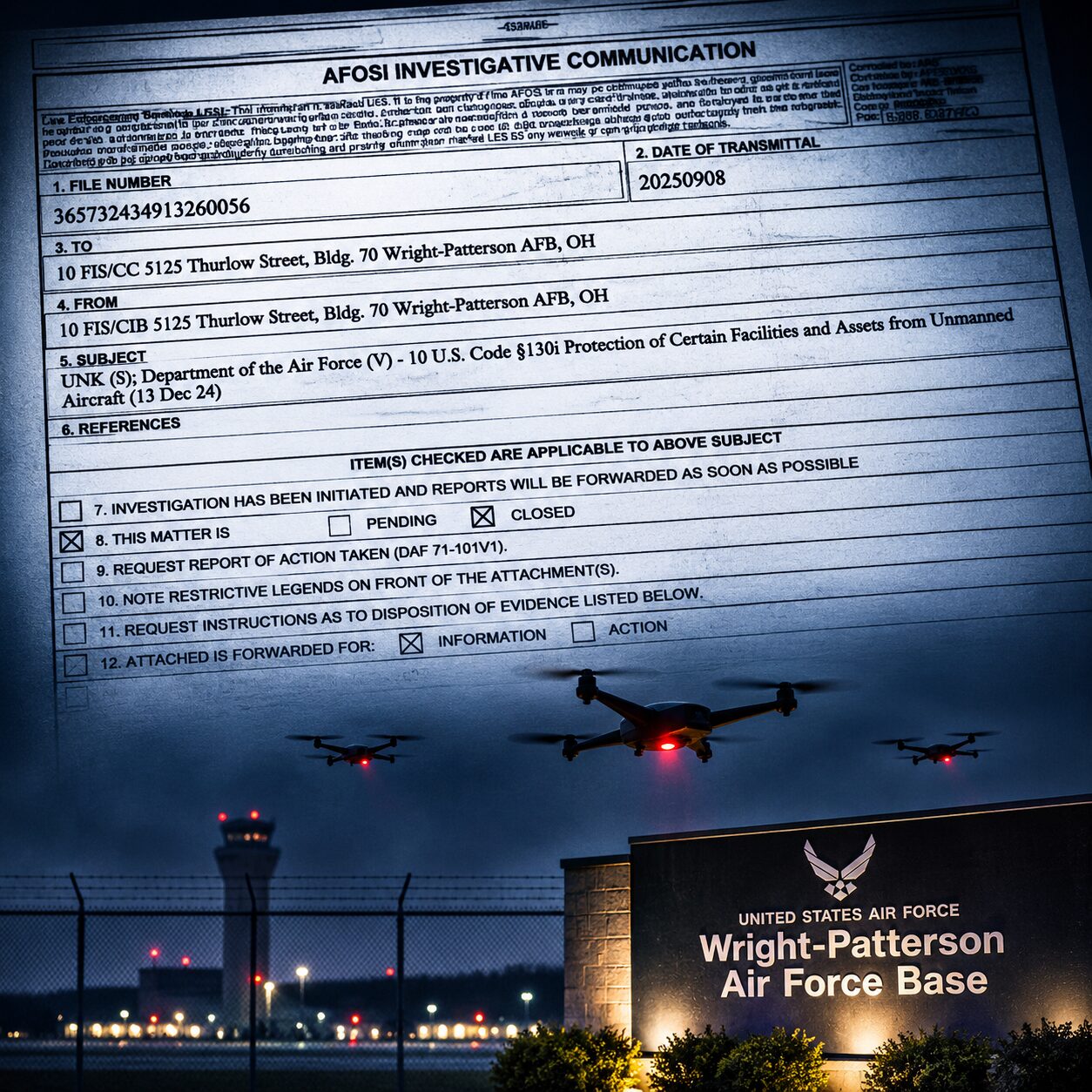 Nearly two years after unauthorized drone activity prompted the closure of the airfield at Wright-Patterson Air Force Base (WPAFB) in Ohio, newly released investigative records reveal additional details about the December 2024 incidents, including reports of synchronized drone maneuvers and communications disruptions experienced by military personnel.
The documents, released by the Federal Bureau of Investigation (FBI) on November 13, 2026, and received by The Black Vault on November 25, originated with the Air Force Office of Special Investigations (AFOSI). They detail three separate periods of reported drone activity between December 11 and 17, 2024, two of which were designated as FBI-led investigative matters.
All three AFOSI investigative communications are marked closed. In each instance, the operators of the aircraft remained unidentified.
The records were obtained only after The Black Vault challenged AFOSI’s initial determination that it had no responsive records concerning the incidents.
From “No Records” to an FBI Referral
Under Freedom of Information Act (FOIA) request 2025-06621-F, The Black Vault sought AFOSI investigative reports, intelligence assessments, threat evaluations and interagency correspondence concerning the December 2024 drone incursions.
In July 2025, AFOSI issued a “no records” response.
That determination was challenged on July 16, 2025, through an administrative appeal citing previously released Air Force documents that explicitly documented AFOSI’s notification of the incidents.
On January 6, 2026, AFOSI issued its final response to the appeal. Rather than maintaining its original determination, the agency acknowledged that responsive records had been referred to the FBI.
“All the records responsive to your request have been referred to another federal agency, FBI,” wrote Roxanne M. Jensen, Chief of AFOSI’s Information Release Branch.
When The Black Vault requested clarification regarding the original determination, AFOSI Information Release Specialist John Jordan responded on January 7:
“You are correct, you did receive a ‘no records’ response. Eventually we received the record in our database and processed it.”
The explanation raises questions about how AFOSI maintained and processed investigative information concerning the incursions.
All three investigative communications ultimately released carry a transmittal date of September 8, 2025, nearly nine months after the incidents and less than two months after The Black Vault filed its appeal.
While those dates do not establish that the specific documents existed at the time of the original FOIA search, the communications themselves document AFOSI’s involvement in December 2024, including interviews conducted jointly with the FBI.
Where that underlying investigative information was maintained before it entered the database, and why it was not located during the original search, remain unanswered.
The FBI ultimately reviewed and released seven pages under FOIPA request 1708151-000, with redactions that the FBI specifically attributed to AFOSI.
Drone Activity Began Before the Airfield Closure
The first of the three investigative communications documents drone activity on the night of December 11, 2024, continuing into the following morning — two days before the incidents that prompted the airfield closure.
Security Forces personnel reported observing an unmanned aircraft hovering over the installation’s military working dog kennel. Searches for suspicious personnel or packages yielded negative results.
Initial reports described an aircraft approximately five by six feet in size and operating with four rotors.
According to AFOSI:
“Interview of SFS personnel disclosed that the sUAS displayed steady and flashing red, white, and green lights, and they did not see visible cameras or payloads on the sUAS.”
Air Force Materiel Command reported that it was not tracking anything in the area and had no scheduled drone events. FAA offices in Columbus and Cincinnati also reported being unaware of drone flights matching the description.
The matter was designated as FBI-led. The investigative communication concludes:
“The operator(s) of the sUAS was not identified.”
Military Personnel Reported Radio Disruptions During Drone Encounters
Among the most significant revelations in the new release are details obtained during joint FBI and AFOSI interviews with Security Forces personnel on December 14, 2024.
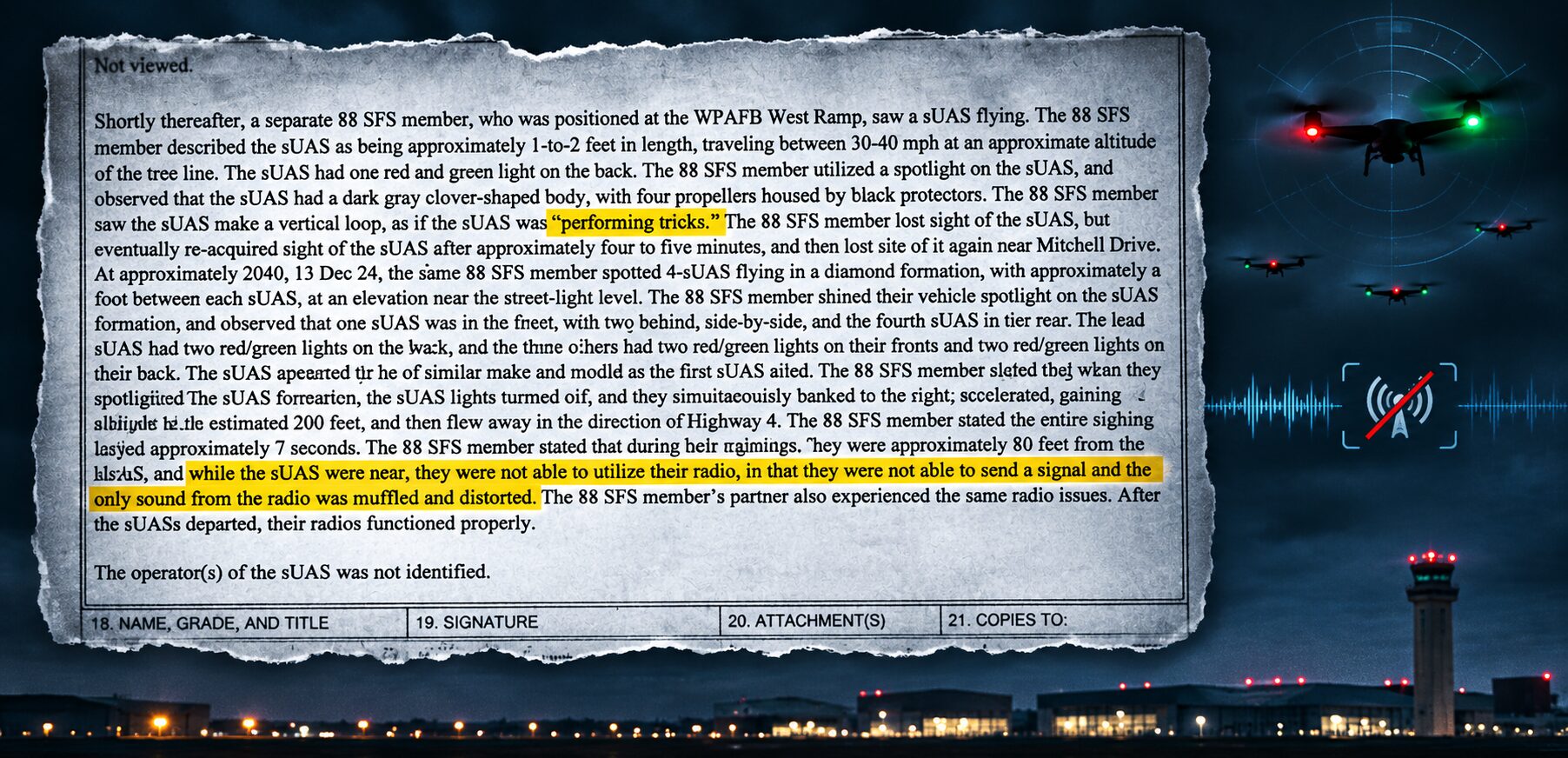
One witness described observing a drone approximately one to two feet in length, traveling between 30 and 40 miles per hour. After illuminating the aircraft with a spotlight, the witness described a “dark gray clover-shaped body, with four propellers housed by black protectors.”
The witness also reported seeing the aircraft perform a vertical loop, as if it was “performing tricks.”
The same individual subsequently observed four drones flying in a diamond formation, separated by approximately one foot. When illuminated by a spotlight, the aircraft reportedly extinguished their lights, simultaneously banked to the right, accelerated and gained altitude before departing.
However, the investigative communication documents another detail concerning the encounters: the reported disruption of military communications equipment.
According to AFOSI:
“The 88 SFS member stated that during both sightings, they were approximately 80 feet from the sUAS, and while the sUAS were near, they were not able to utilize their radio, in that they were not able to send a signal and the only sound from the radio was muffled and distorted.”
The document continues:
“The 88 SFS member’s partner also experienced the same radio issues. After the sUASs departed, their radios functioned properly.”
The released records contain no technical assessment explaining the reported communications disruption. Whether investigators examined the radios, conducted radio-frequency analysis or considered the possibility of deliberate electronic interference is unknown.
The account establishes a reported correlation between the presence of the drones and the communications problems, but it does not establish causation.
Investigators Determined One Sighting Was Mistaken
The newly released records also reveal that investigators determined at least one reported drone sighting during the December 13 incident was erroneous.
AFOSI documented the finding following interviews with Security Forces personnel:
“However, upon further investigation, it was identified that the member was mistaken and a sUAS was not viewed.”
The document does not explain what the individual actually observed, what evidence investigators used to reach that determination, or whether similar assessments were conducted for other reported sightings.
Despite that finding, the same investigative communication documents the separate observations of synchronized drone formations and attributes the airfield closure to the reported drone activity.
The operators were never identified in the released investigative summary.
AFOSI Personnel Witnessed Drones; Thermal Imaging Also Used
The third investigative communication, concerning the December 16–17 incidents, establishes that AFOSI personnel were not solely relying on observations reported by other military personnel.
According to the document:
“At 2237 hours, OSI 10 FIS reported visually observing at least 6 sUAS loitering over Area A, WPAFB, OH.”
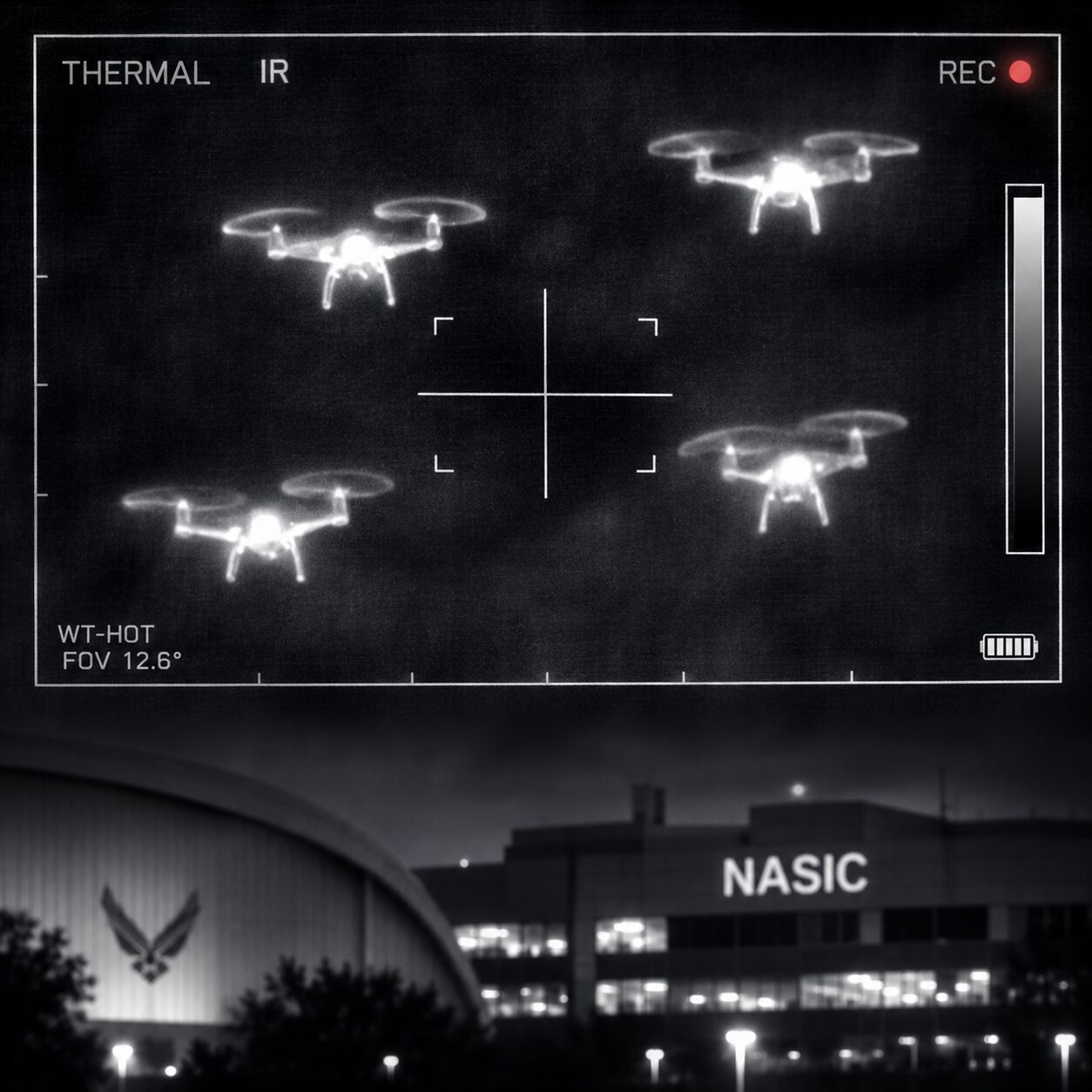
The records also reveal that Wright-Patterson Fire Department personnel reported observing four drones using thermal imaging equipment. One of those aircraft was reported in the general vicinity of the National Air and Space Intelligence Center (NASIC).
Additional observations by Security Forces personnel included drones hovering above the National Museum of the United States Air Force and two drones flying over NASIC.
No thermal imagery is included in the FBI release. Whether the equipment recorded the observations, whether any recordings were preserved, and whether investigators subsequently analyzed that material remain unknown.
The document also contains a discrepancy involving local law enforcement. AFOSI recorded a notification from Dayton Metro Parks Police that its patrols had observed a drone flying toward the installation. Later in the same investigative communication, AFOSI states that coordination with Metro Parks Police yielded reports that none of its patrols had observed drone activity.
Investigators Examined Video of a Suspected Unmanned Aircraft
The newly released documents also confirm that investigators obtained video evidence of an aircraft previously described in sworn military witness statements obtained by The Black Vault.
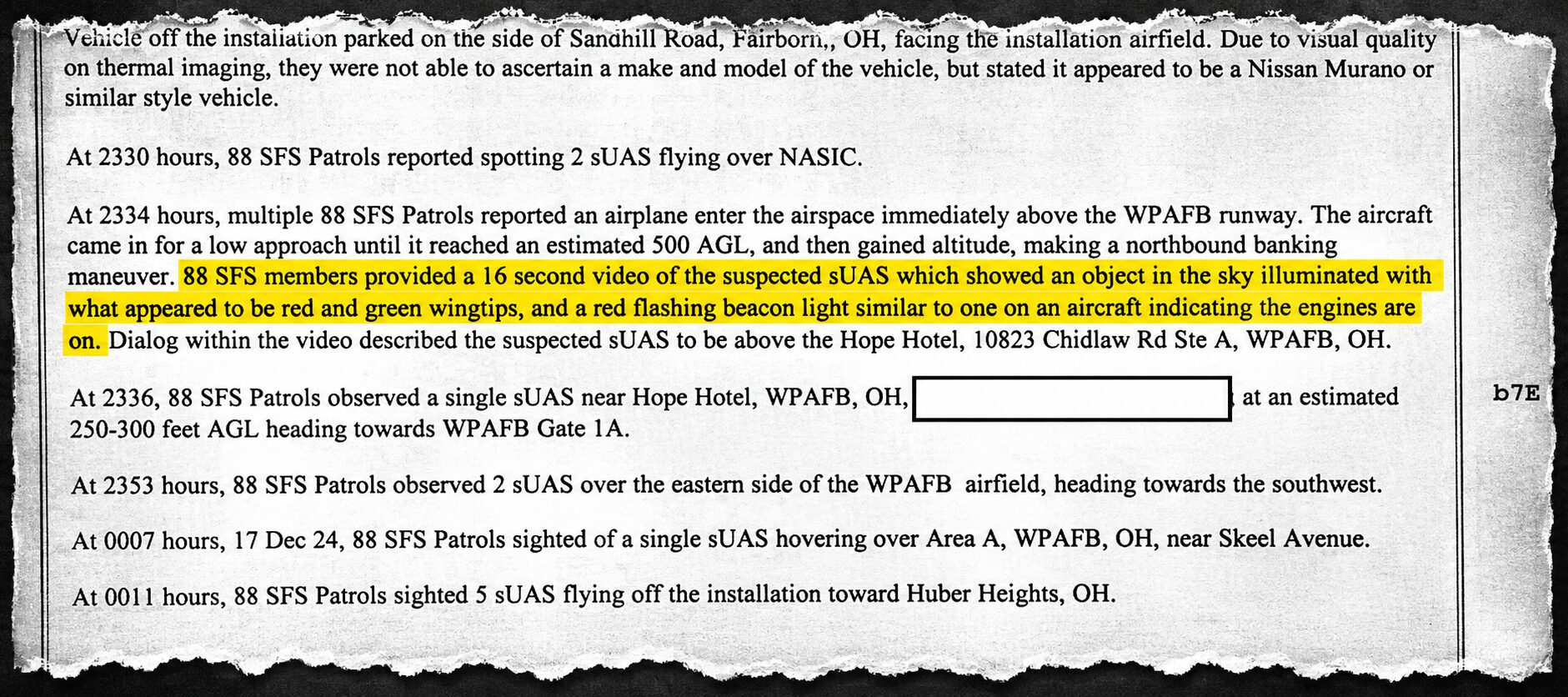
During the December 16 incident, multiple Security Forces personnel reported observing an airplane conducting a low approach over the Wright-Patterson runway before climbing away.
AFOSI documented the existence of a recording:
“88 SFS members provided a 16 second video of the suspected sUAS which showed an object in the sky illuminated with what appeared to be red and green wingtips, and a red flashing beacon light similar to one on an aircraft indicating the engines are on.”
As previously reported by The Black Vault, one Security Forces witness described the aircraft as gray, possessing wings and engines, and estimated it to be larger than an F-16.
The newly released investigative communication does not establish whether investigators ultimately identified the aircraft as manned or unmanned.
It also states that Wright-Patterson Airfield Management Operations and Air Traffic Control reported not seeing any aircraft or drones in the airspace during the incident. Airfield Management Operations clarified that its shift began at approximately 11 p.m.
That account is particularly noteworthy given previously released FAA records documenting between seven and 17 radar targets during the same evening. Although tower personnel reported no visual observations, the FAA records document that Security Forces personnel on the ground reportedly identified the activity as drones.
Whether investigators correlated the video, eyewitness observations and radar returns is not addressed in the new release.
The 16-second video itself was not included in this release, but may be one of those released previously (that are close to 16 seconds) here.
Investigators Pursued Leads Involving Vehicles Near the Base
The new records also provide details about investigative efforts to identify potential drone operators outside the installation.
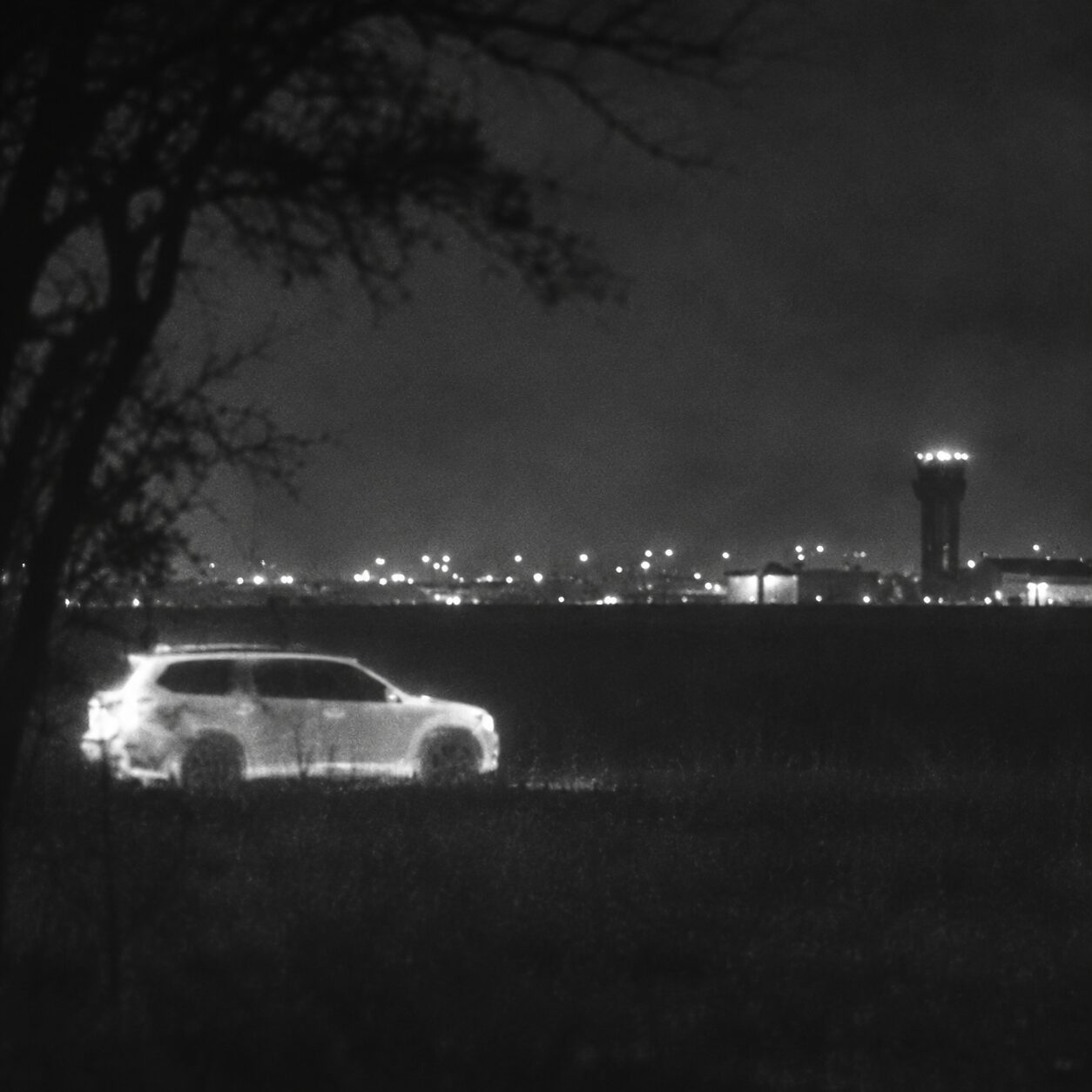
Wright-Patterson Fire Department personnel reported observing a vehicle parked off the installation while using thermal imaging equipment. The vehicle was facing the airfield, although the quality of the imagery prevented personnel from determining its exact make and model.
The investigative communication documents a review of Flock Safety camera footage in connection with the vehicle observation.
A subsequent entry dated December 18 documents investigative efforts concerning a vehicle reported parked off-base near the airfield.
Investigators used the Flock Safety system to obtain information and conducted interviews.
The registered owner acknowledged owning a small hobby drone approximately six to eight inches in size but reported being unaware of drone activity in the Wright-Patterson area.
Another individual interviewed reported not being in the area on December 16.
Portions of the investigative narrative are redacted, including identifying information. The released material does not establish that either individual was responsible for the incursions, nor does it establish a connection between the vehicles and the reported aircraft.
Nevertheless, the records reveal that investigators pursued leads involving potential operators on the ground, rather than limiting their efforts to collecting eyewitness accounts of the aircraft themselves.
Conflicting Accounts Within AFOSI’s Own Investigation
The newly released records also contain an unexplained discrepancy within AFOSI’s own investigative summary concerning observations made by local law enforcement during the December 16–17 incursions.
According to the report:
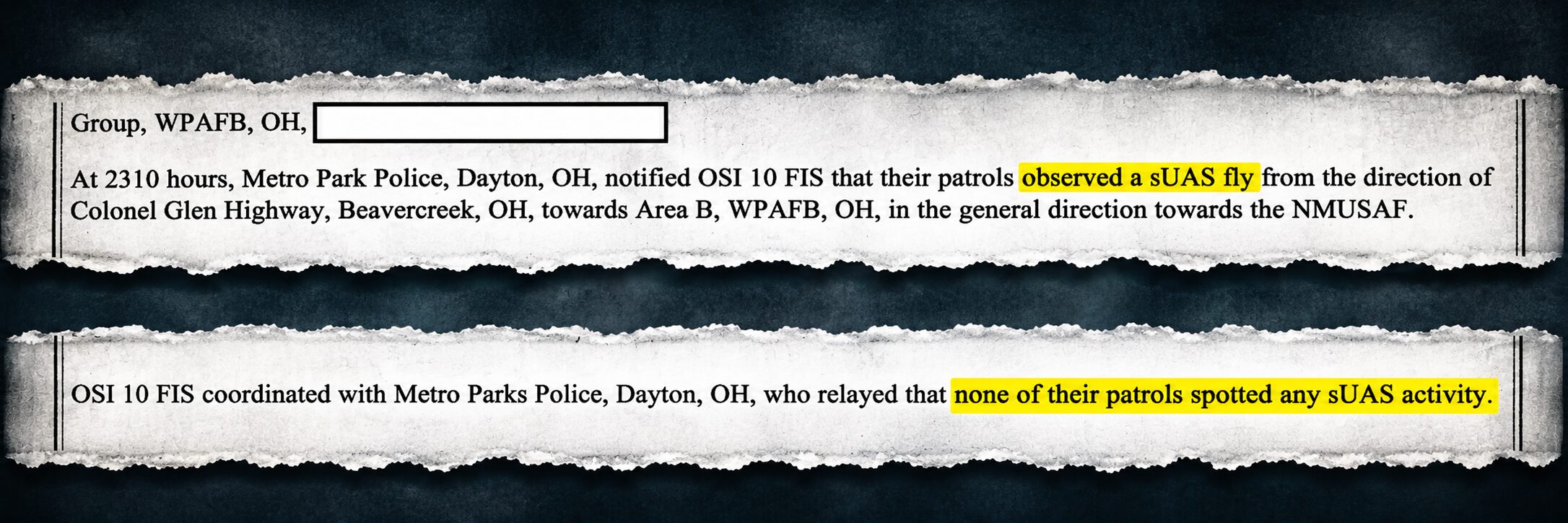
“At 2310 hours, Metro Park Police, Dayton, OH, notified OSI 10 FIS that their patrols observed a sUAS fly from the direction of Colonel Glen Highway, Beavercreek, OH, towards Area B, WPAFB, OH, in the general direction towards the NMUSAF.”
However, further down on the very same page, AFOSI documents an entirely different account:
“OSI 10 FIS coordinated with Metro Parks Police, Dayton, OH, who relayed that none of their patrols spotted any sUAS activity.”
The two statements are contained within the same investigative communication, yet no explanation is provided for the discrepancy.
Was the original sighting subsequently determined to be erroneous? Did the police department retract its initial report? Or did investigators receive conflicting information from different personnel within the department?
The released records do not address these questions, nor do they document any effort to reconcile the two accounts before AFOSI marked the investigative matter closed.
Previously Released FAA Records Raise Additional Questions
The newly released AFOSI investigative records leave unanswered questions when compared with Federal Aviation Administration (FAA) documents previously obtained by The Black Vault under FOIA case 2025-04622.
During the same December 16–17 incident investigated by AFOSI and the FBI, the FAA documented between seven and 17 radar targets within 40 miles of the airport. The FAA’s Mandatory Occurrence Report, number 1530847975, categorized the activity as a “Swarm (Multiple UAS aircraft).”
According to the FAA, the Wright-Patterson air traffic control supervisor “reported that security forces on the ground confirmed that the observed targets were drones.”
Despite documenting numerous visual observations, including those made by AFOSI personnel themselves, the newly released investigative communication makes no mention of these radar detections or any analysis of the associated radar data.
Instead, AFOSI documented coordination with Wright-Patterson Airfield Management Operations and Air Traffic Control, stating that both reported they “did not see any aircraft or sUAS in the airspace during the incident.”
The FAA records distinguish between radar detections and visual observations, noting that the targets were detected on radar but were not visually observed from the tower or by aircraft. Whether the radar information was subsequently provided to AFOSI or the FBI, and whether investigators correlated those returns with observations made by military personnel on the ground, remains unanswered.

Also absent from the newly released records are two subsequent sightings documented by the FAA: a silver unmanned aircraft reported near Wright-Patterson on the afternoon of December 17, and a “black cube”-shaped object reported on December 19 approximately 500 feet beneath an aircraft flying at 16,000 feet.
The FAA noted that the aircraft involved in the latter sighting appeared to be conducting a round-trip flight from Wright-Patterson, although the sighting itself occurred well east of the installation.
Neither sighting falls within the periods of drone activity documented in the three newly released AFOSI investigative communications. Their absence does not establish that investigators overlooked the reports, and no released records establish a connection between those subsequent sightings and the earlier incursions.
Whether either event was investigated by the FBI or AFOSI remains unknown.
The FBI’s November 13, 2026, letter identifies the disclosure as its final response to the FOIA request. That determination, however, concerns the material referred by AFOSI and does not establish that the FBI has released all records independently maintained concerning the incidents. The Black Vault has filed another specific case to the FBI to obtain all other records beyond just the AFOSI referred material.
Despite direct observations by AFOSI personnel, joint interviews with the FBI, reported thermal imaging, video evidence and investigative leads involving potential operators, the released records provide no definitive explanation for the incursions.
Nearly two years after the events, the newly disclosed documents provide a more detailed account of what investigators knew and what evidence they collected, but not who was responsible.
###
Document Archive
 1708151-000 Released Records [8 Pages, 0.5MB]
 Loading...

 Reload document
 Open in new tab


