


 Newly released Central Intelligence Agency records provide the most complete look yet at two separate attempts by Jeffrey Epstein, which were more than a decade apart, to determine what information the CIA maintained about him.
The records were obtained by The Black Vault after case numbers for Epstein’s Privacy Act requests surfaced within the broader government release of Epstein-related files. Rather than requesting CIA records about Epstein specifically, The Black Vault used those case identifiers, listed as P-1999-02450 and P-2011-00673, to seek the records generated during the processing of the two cases. This also stemmed from a public call to action request from political commentator and speechwriter Mike Benz.
The CIA responded on September 18, 2026, under FOIA case F-2026-00889, saying it had located 17 responsive documents. One was released in full and 16 were released with portions withheld under FOIA Exemptions (b)(3) and/or (b)(6).
The resulting near 50-page release contains Epstein’s original 1999 request, internal CIA search records, correspondence between Epstein and the agency, and the records surrounding a substantially more specific request submitted on his behalf in 2011.
The documents establish that the CIA reported finding no records filed under Epstein’s name in response to his first request. In 2011, the agency similarly reported finding no records reflecting an open or otherwise acknowledged CIA affiliation during the period it searched. For records that could reveal a classified connection, however, the CIA gave a different response: it refused to confirm or deny whether such records existed.
That distinction is central to what the newly released records show, and what they do not.
Epstein Asks the CIA for “All Records About Me”
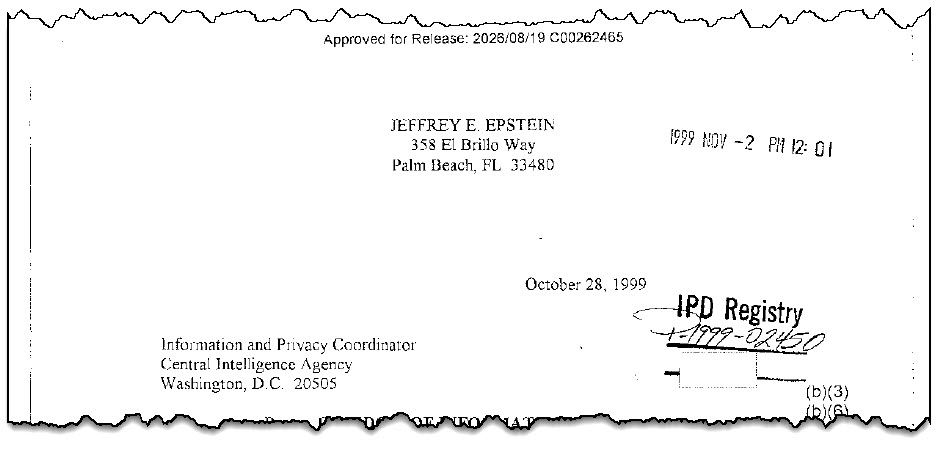
Epstein’s first request was dated October 28, 1999.
Writing directly to the CIA’s Information and Privacy Coordinator, Epstein invoked both the Freedom of Information Act and Privacy Act and made a broad request:
“please furnish me with copies of all records about me indexed to my name.”
Epstein supplied identifying information including his full name, date and place of birth, citizenship, current address and several other addresses. The released document also contained a Social Security number, which is not reproduced here in this written article, though was released by the CIA in their document package under the FOIA.
Epstein told the CIA that if search or copying fees did not exceed $5,000, the agency should provide the information without first notifying him of the cost, as he agreed to pay to that amount. He also asked the CIA to identify the specific exemptions supporting any withholding.
On November 5, 1999, the CIA formally accepted the request as P-1999-02450.
The agency told Epstein:
“This acknowledges receipt of your letter dated 28 October 1999 wherein you requested information about yourself.”
The CIA said the request would be processed under both FOIA and the Privacy Act and that its search would cover records existing through November 5, 1999.
The documents then show the request moving through internal CIA search channels.
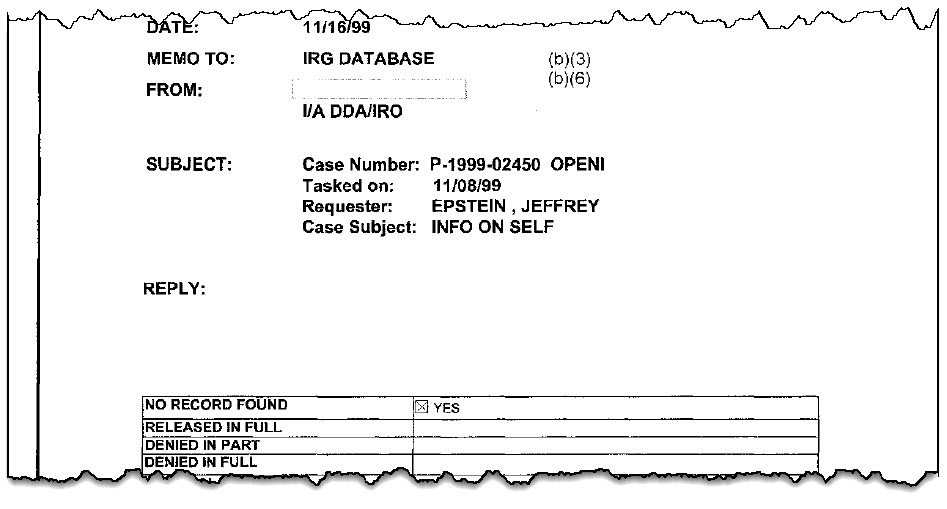
One November 1999 internal record identifies the requester as “EPSTEIN, JEFFREY,” describes the subject as “INFO ON SELF,” and records “NO RECORD FOUND”. This document appears to be only one component within the CIA that searched for records, with a second that would take another two years to complete their search.
Five Months Later, Epstein Wants an Answer
By April 2000, Epstein was pressing the CIA for a response.
In an April 7 letter, he wrote that more than five months had passed since his original submission:
“I would appreciate any efforts that could be taken to expedite a response to my request.”
The CIA answered on April 20.
The agency attributed the delay to its workload, telling Epstein that it was handling approximately 5,000 FOIA and Privacy Act requests and processing them on a first-in, first-out basis. It could not provide a definite completion date. Although Epstein was not notified of the initial negative search result at that stage, the case was still being processed and additional searches remained underway. The newly released internal records therefore provide a chronological view of the CIA’s processing of the request, including interim search results that were not separately communicated to Epstein before the agency issued its final determination.
The case would remain unresolved for nearly another two years.
A February 19, 2002, internal CIA memorandum records a search involving the Directorate of Operations.
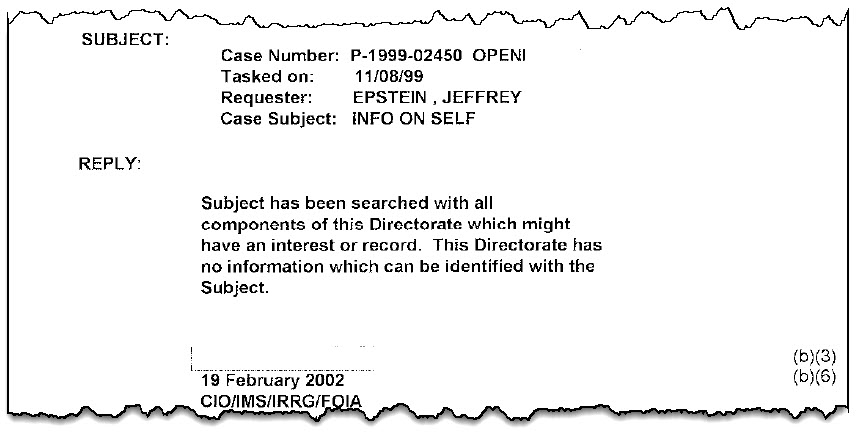 Its conclusion was:
“Subject has been searched with all components of this Directorate which might have an interest or record. This Directorate has no information which can be identified with the Subject.”
Two days later, the CIA issued its final answer.
On February 21, 2002, more than two years after Epstein’s original request, the CIA closed P-1999-02450.
The agency wrote:
“We were unable to identify any information or record filed under your name.”
The CIA characterized its searches as “thorough and diligent” and said it was “highly unlikely” that repeating them would produce a different result, although Epstein retained the right to appeal.
The newly released records therefore provide considerably more information about the 1999 case than simply its case number. They show what Epstein requested, how portions of the CIA searched for responsive information, his follow-up when the process stalled, and the agency’s ultimate no-records determination.
But that was not Epstein’s last request.
A Much More Specific Request in 2011
On June 28, 2011, attorney Martin G. Weinberg submitted another FOIA and Privacy Act request to the CIA on Epstein’s behalf.
Unlike Epstein’s brief 1999 request for all records indexed to his name, the 2011 request specified both a time period and particular categories of records.
Weinberg sought records created between January 1, 2000 and June 28, 2011, including records “prepared, received, transmitted, collected, and/or maintained” by the CIA or its components and field offices.
The first category sought:
“Any records, order, agreement, or accommodation relating or referring to Epstein, including but not limited to records that document monitoring, surveillance, observation, questioning, interrogation, investigation, and/or collection of information relating to Epstein.”
The second sought:
“Any records relating or referring to how, why, or when Epstein was selected to be a subject of monitoring, surveillance, observation, questioning, interrogation, investigation, and/or collection of information.”
Epstein’s attorney also specifically requested a “cross-reference search” and preauthorized as much as $1,000 in fees.
The wording is noteworthy because it establishes precisely what Epstein wanted the CIA to search for. It does not, by itself, establish that the CIA had monitored, surveilled, questioned, investigated or maintained an intelligence relationship with Epstein, but rather, simply shows what Epstein was seeking.
CIA Requires Proof of Epstein’s Authorization
The CIA assigned the second matter P-2011-00673.
But processing initially stalled because the agency said Weinberg’s facsimile did not include the privacy waiver referenced in his request.
The CIA explained that it could conduct a search without authorization, but privacy considerations could restrict disclosure if records were found. It therefore required a properly executed statement establishing Epstein’s identity and authorizing his attorney to receive the results.
The agency gave Weinberg 45 days to provide the documentation.
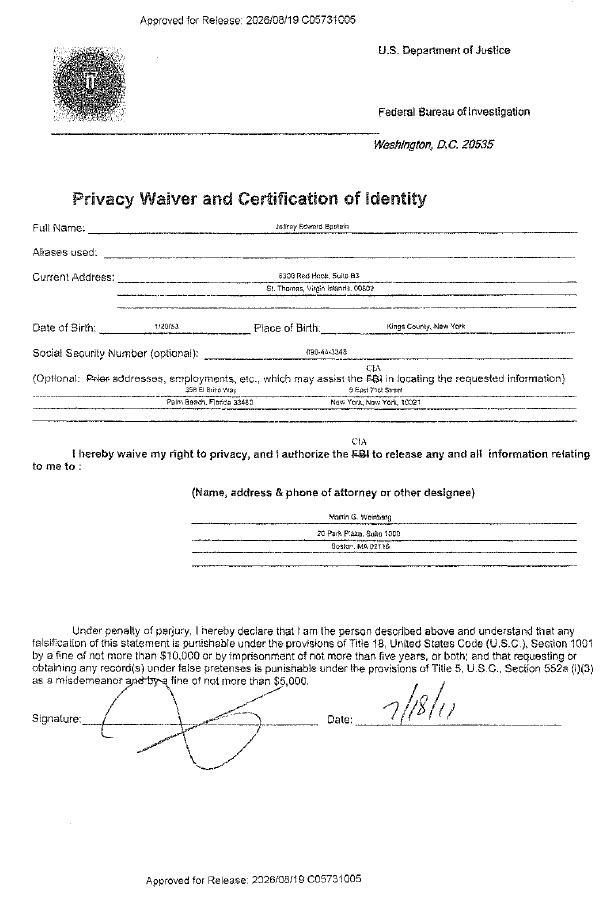
On July 19, Weinberg sent another letter renewing the request and enclosed what he described as “an executed privacy waiver and certification of identity for Jeffery Edward Epstein.”
The release includes that signed authorization. In it, Epstein waived his privacy rights for purposes of the request and authorized the CIA to release information about him to Weinberg.
CIA records also document contact with Weinberg’s office. A July 20 entry states:
“I spoke with Mr. Weinberg regarding his client Mr. Epstein’s PA request. I confirmed he did receive our letter and he stated they sent out the Privacy Waiver to us via Fed Ex.”
The CIA Searches Again
The release contains records documenting the CIA’s second round of searches.
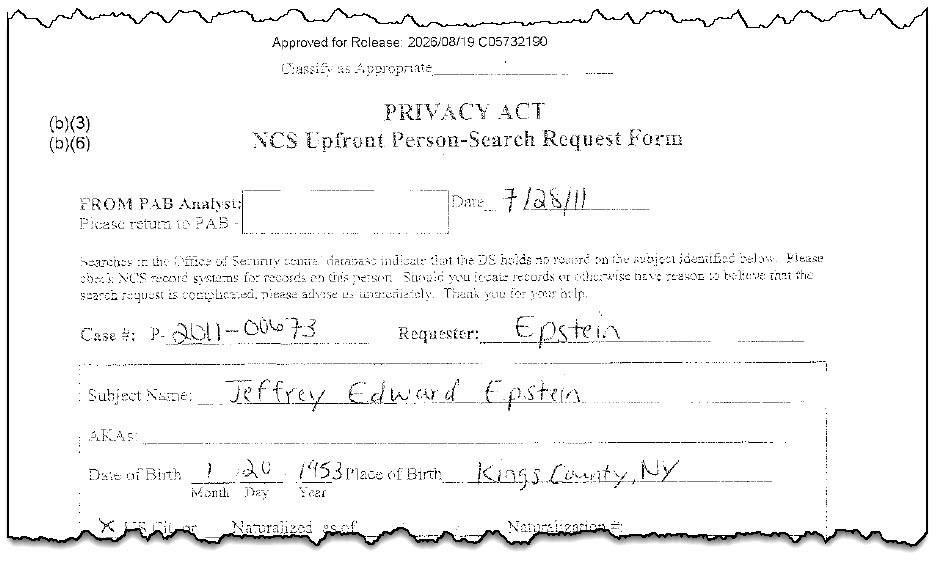
A July 2011 “NCS Upfront Person-Search Request Form” states that searches of the Office of Security central database indicated that the Directorate of Support held no record on Epstein and requested that NCS record systems also be checked. The handwritten search result is marked “Negative.”
Other released pages show searches of an internal security system using Epstein’s identifying information. One screen records a search using his date of birth, while another shows a search using his Social Security number.
Then, on July 29, 2011, the CIA issued its final determination.
That response requires careful distinction between two categories of possible records.
No Records of an Open or Acknowledged CIA Affiliation
For records that could reflect an overt or acknowledged connection between Epstein and the agency, the CIA said it found nothing.
The agency wrote:
“We searched for CIA-originated responsive records that might reflect an open or otherwise acknowledged Agency affiliation existing from 5 November 1999, the date of our previous acceptance letter (P-1999-02450) to 25 July 2011, the date we accepted Mr. Epstein’s current request. We were unable to locate any information or records.”
That statement is the CIA’s documented search result for an open or otherwise acknowledged agency affiliation during the specified period.
But the next paragraph gave a different answer concerning any potentially classified connection.
CIA Would Neither Confirm Nor Deny a Classified Connection
The CIA wrote:
“With respect to responsive records that would reveal a classified connection to the CIA, in accordance with section 3.6(a) of Executive Order 13526, as amended, the CIA can neither confirm nor deny the existence or nonexistence of records responsive to your request.”
The agency said the existence or nonexistence of such records was classified and constituted intelligence sources-and-methods information protected by federal law. It invoked FOIA Exemptions (b)(1) and (b)(3), along with Privacy Act exemptions (j)(1) and (k)(1).
This is commonly known as a Glomar response: rather than acknowledging that responsive records exist and withholding them, an agency declines to confirm or deny whether the records exist at all.
The language therefore should not be read as confirmation that Epstein had a classified relationship with the CIA. Nor does it establish that no such records existed. The CIA expressly declined to answer that question.
An Earlier Epstein Case Had Already Been Destroyed
 One of the more consequential administrative details appears on the final page of the release.
An internal notation concerning the 2011 determination states:
“MFR: Previous case destroyed 14 Sept 2005 per NARA destruction schedule”
The “previous case” is identified in the surrounding 2011 records as P-1999-02450. The newly released package nevertheless contains copies of numerous documents associated with that earlier matter, including Epstein’s original request and the CIA’s correspondence and search documentation.
The notation establishes that the previous case was recorded as having been destroyed pursuant to a National Archives and Records Administration destruction schedule. The released material does not, by itself, explain precisely which original case materials were destroyed in 2005 or why copies of some of those records remained available elsewhere for the CIA’s 2026 search.
What the Records Establish — and What They Don’t
The newly released material establishes a documented chronology.
Epstein asked the CIA in October 1999 for all records about himself indexed to his name. The CIA searched and ultimately told him in February 2002 that it could not identify any such information or records. Internal records released with the case document negative searches, including searches of personnel security systems and the Directorate of Operations.
In 2011, Epstein, through an attorney, returned with a considerably more detailed request. He specifically sought records concerning possible monitoring, surveillance, questioning, investigation or collection of information about him and requested a cross-reference search.
The CIA again reported no records reflecting an open or otherwise acknowledged Agency affiliation between November 5, 1999 and July 25, 2011. For anything that would reveal a classified connection, however, the CIA neither confirmed nor denied the existence of records.
Nothing in the newly released documents establishes that Epstein worked for, assisted, was recruited by, or otherwise maintained a relationship with the CIA. The records establish that Epstein repeatedly asked the CIA what it had on him, and they now reveal substantially more about how the agency processed and answered those requests.
More than two decades after the first case was opened, those administrative files provide a documented answer to at least part of that question: when the CIA searched for records it could acknowledge concerning Epstein, it reported finding none. On the separate question of whether records reflecting a classified connection existed, the agency’s answer in 2011 was neither yes nor no.
###
Document Archive
 F-2026-00889 Release Package [50 Pages, 1.2MB]
 Loading...
 Reload document
 Open in new tab
 Follow The Black Vault on Social Media:


