


 The Federal Aviation Administration (FAA) has released records documenting the September 21, 2026, air traffic control outage that disrupted operations at major airports across the northeastern United States, including Philadelphia, Newark, and New York-area airports.
The records, obtained by The Black Vault through the Freedom of Information Act (FOIA), include operational logs from Philadelphia Terminal Radar Approach Control (TRACON), national traffic management records, and facility metrics documenting the effects of the disruption.
However, the November 17, 2026, response also identifies significant limitations in the records provided. Although the request specifically sought technical assessments, maintenance records, documentation of the equipment failures, and information concerning restoration efforts, the FAA stated that the Philadelphia ATCT/TRACON held no responsive records for several of those categories.
The release provides an operational record of the outage and its effects on air traffic management, but does not include a final technical investigation establishing the sequence of equipment failures or the underlying causes.
A Telecommunications Failure Disrupts Northeast Air Traffic

On September 21, 2026, a telecommunications outage affecting Philadelphia TRACON resulted in widespread air traffic restrictions across the Northeast.
According to reporting by Reuters, the disruption began after telecommunications infrastructure was damaged in New Jersey, affecting FAA systems supporting air traffic operations. Flights into several major airports were halted for hours while technicians worked to restore service.
FAA Administrator Bryan Bedford explained during a September 21 news conference that a primary telecommunications circuit had failed. When the FAA attempted to transition to a backup connection, officials discovered that the backup fiber-optic line had also been damaged.
NorthJersey.com quoted Bedford describing the problem:
“Unfortunately, that circuit failed today and when it went to flip into the back-up, we discovered that the back-up fiber had a break, and that fiber break is probably 13 hours to repair. It’s massive, I’m told.
The reported damaged fiber infrastructure was located between New Brunswick and Newark, New Jersey.
Separately, NJ Transit identified construction activity associated with its Delco Lead project between New Brunswick and North Brunswick. According to a statement reported by CBS Philadelphia, a construction crew accidentally cut into the Verizon fiber-optic line at approximately 9:45 a.m.
NJ Transit stated:
“Preliminary information indicates the crew was operating approximately 10 feet from the utility markings.”
The rail agency also said it was examining the circumstances surrounding the utility markings and the cable damage.
The resulting disruption affected airports including Philadelphia International, Newark Liberty International, John F. Kennedy International, LaGuardia, and Teterboro. Boston Logan also experienced air traffic restrictions.
According to CBS Philadelphia, Philadelphia International Airport had recorded approximately 400 delays and more than 200 cancellations by early that evening.
Transportation Secretary Sean Duffy subsequently announced that the damaged telecommunications lines had been repaired and that airport operations were resuming, although delays continued as airlines worked through the disruption.
What the Newly Released FAA Records Contain
On September 22, 2026, one day after the outage, The Black Vault submitted a FOIA request seeking five categories of records concerning the incident.
The request sought final incident reports, FAA Technical Operations maintenance and trouble tickets, records establishing the cause of the failures, documentation of operational restrictions, and records concerning the timing of the outages and restoration efforts.
In its November 17 response, the FAA’s Air Traffic Organization, Mission Readiness Services, Eastern Service Center, characterized its determination as a “partial no-records disclosure response.”
The agency explained that the Philadelphia Airport Traffic Control Tower and Terminal Radar Approach Control Quality Control Office had conducted a search of Air Traffic Services records.
For the requested incident reports and equivalent documentation, the FAA stated:
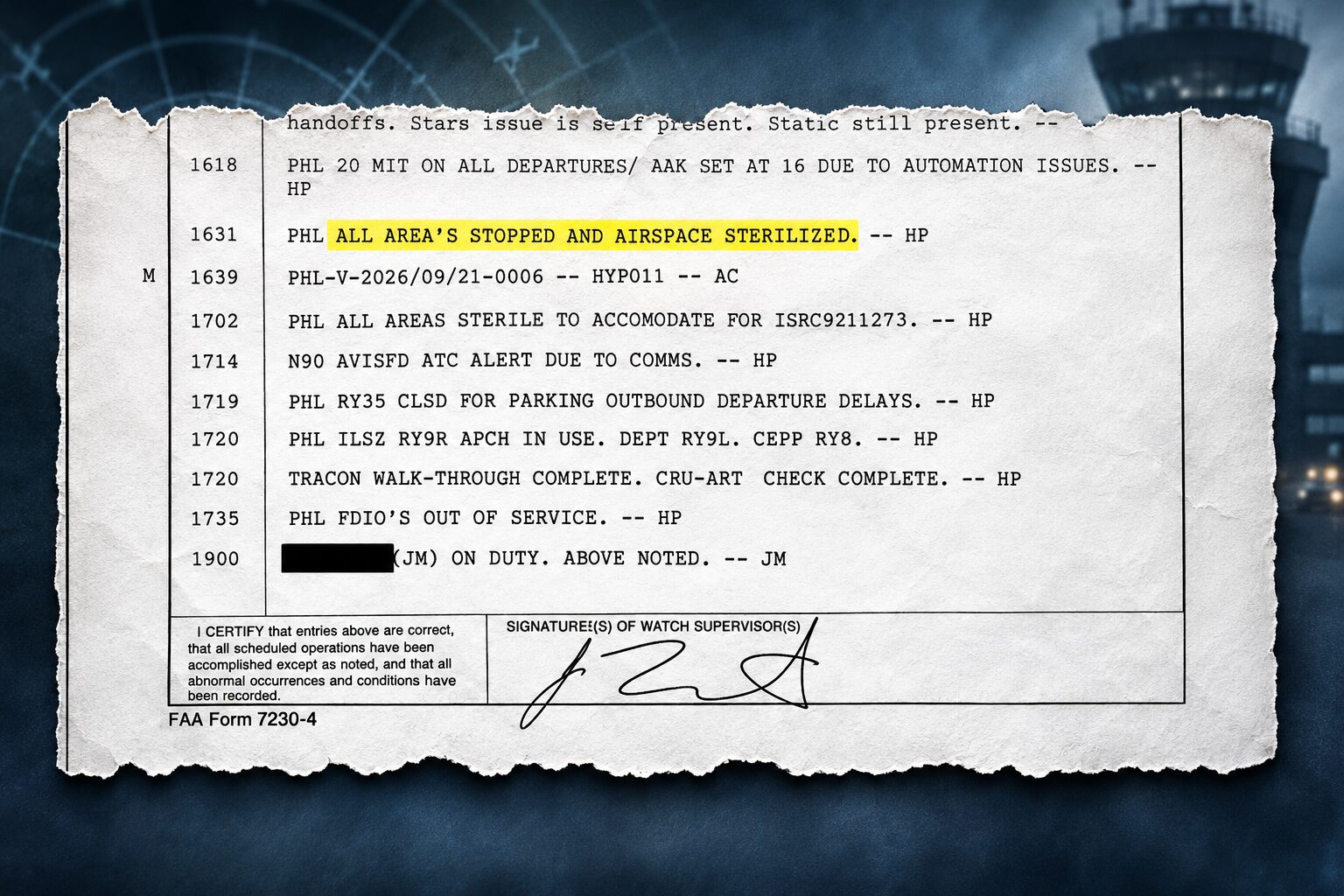
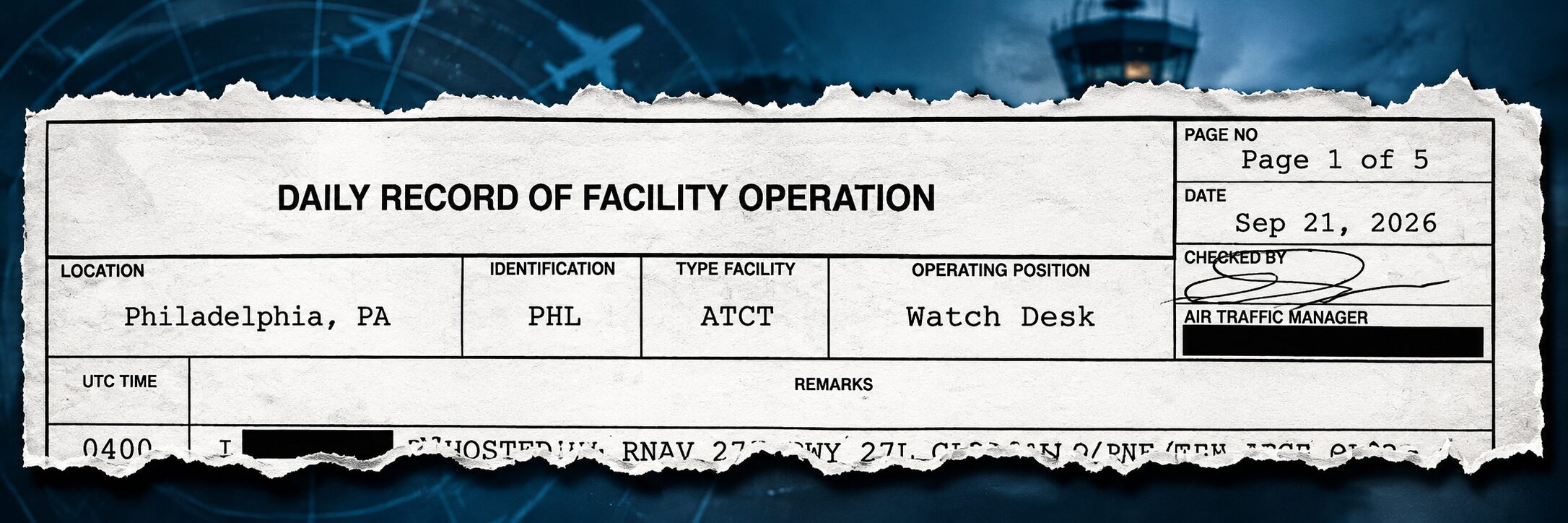
“Facility equipment abnormalities and outages for September 21, 2026, were documented by Air Traffic Services facility personnel on FAA Form 7230-4, Daily Record of Facility Operation for the PHL ATCT/TRACON Area C, which is enclosed.”
The agency added:
“PHL ATCT/TRACON holds no additional records related to this portion of the request.”
The released Daily Record of Facility Operation contains time-stamped entries documenting equipment abnormalities, operational conditions, and actions recorded by facility personnel on September 21.
The release also includes the National Traffic Management Log (NTML), which records traffic management activity, including restrictions and operational adjustments during the disruption.
Additional material consists of an Operations Network (OPSNET) Facility Metrics Report for September 21, providing operational data associated with Philadelphia.
These records offer a way to examine how the outage was managed from the air traffic operations side, separate from the technical investigation into the telecommunications failures themselves.
What Remains Unanswered
The newly released records preserve an official account of the operational disruption experienced by Philadelphia TRACON on September 21, 2026.
They also document the FAA’s traffic management response, including the operational restrictions implemented during the interruption.
The release does not, however, contain a final technical assessment explaining the primary circuit failure, a complete engineering analysis of the backup connection damage, or the requested documentation of equipment restoration and return-to-service testing.
Those subjects were central to the original FOIA request, particularly given the extent of the disruption across multiple airports.
The complete 35-page FOIA package, including the request, FAA response, operational logs, traffic management records, and facility metrics, is preserved below for public examination.
Document Archive
 FOIA Case 2026-06152 Release [47 Pages, 7.5MB]
 Loading...

 Reload document
 Open in new tab


