


Two separate Freedom of Information Act (FOIA) requests to the Department of the Navy, both filed nearly a year apart and scoped differently, have yielded the same single responsive record: a chain of emails detailing a March 2022 briefing on the Advance Aerospace Threat Identification Program (AATIP) and the Airborne Object Identification and Management Synchronization Group (AOIMSG).
The outcome raises questions not only about the scope of the Navy’s search, but also about the content and context of the briefing itself.
The names of the individuals who participated in the briefings are fully redacted from the released records.
The first request, assigned case number DON-NAVY-2021-007791, sought:
“A copy of all emails, sent to and/or from and/or cc’d and/or bcc’d Brennan P Mckernan (CIV USN DCNO N2N6), which contain the following keywords/phrases: ELIZONDO.”
The second request, DON-NAVY-2022-007539, broadened the scope. It requested:
“A copy of all emails, sent to and/or from and/or cc’d and/or bcc’d Brennan P Mckernan (CIV USN DCNO N2N6) and Luis Elizondo (as a private citizen)…”
(Note: Luis Elizondo’s personal emails addresses have been redacted by The Black Vault to protect his privacy. Although listed in the FOIA, The Black Vault is not publishing them in this article, and has redacted them in red in the FOIA response letter below.)
Both requests instructed the Navy to search across classified and unclassified systems, including SIPRNET, NIPRNET, and JWICS.
In both cases, the Navy responded that “one responsive record was found.”
That single responsive record, which is identical in each release, is an email chain arranging and confirming attendance for a March 23, 2022, presentation at Roosevelt Hall on the National Defense University campus at Fort McNair.
The subject line of the email chain reads:
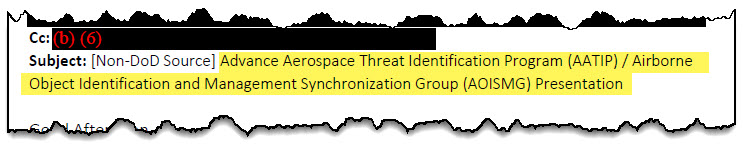 The fact that the email chain originates from a message labeled “[Non-DoD Source]” is significant because it establishes that the initial outreach for the AATIP/AOIMSG presentation did not begin from within an official Department of Defense email system. Instead, it was forwarded into DoD channels from an external account, indicating coordination between government personnel and at least one non-DoD entity.
Although the sender’s identity and email address are fully redacted under Exemption (b)(6), the record’s responsiveness to both FOIA requests strongly suggests that the redacted header fields contained names central to the scope of the searches. The combination of a non-DoD originator, redacted recipient lines, and subsequent TS-SCI-level scheduling inside a SCIF at Roosevelt Hall demonstrates that external actors were engaged in arranging or participating in classified briefings involving AATIP and AOIMSG. While the redactions prevent identification of the individuals involved, the structure of the chain confirms that communications spanning government and non-government systems were directly connected to the secure sessions. Even though the scope of the original requests may offer a likely hint on who this was, it can not definitively be proven.
The event was scheduled for March 23, 2022, and structured into three sessions:
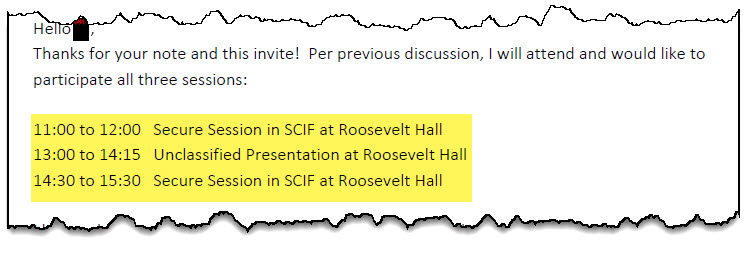
The classified sessions were explicitly described as TS-SCI (Top Secret-Sensitive Compartmented Information) level briefings:
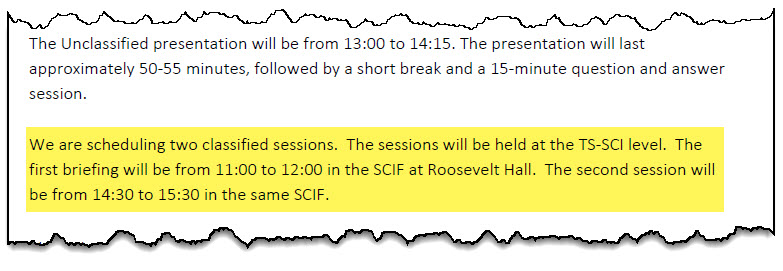
The unclassified session would run approximately 50–55 minutes, followed by a 15-minute Q&A.
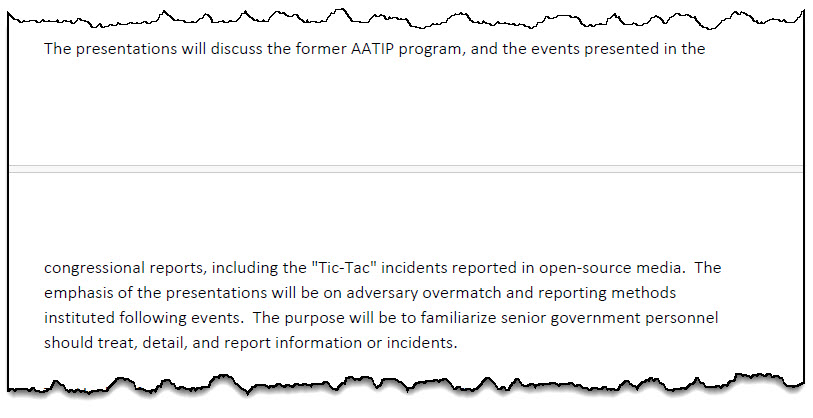
The invitation email stated that:
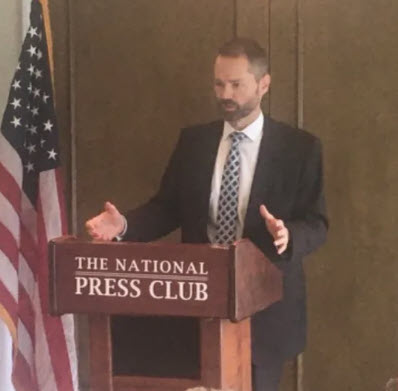
Brennan P. McKernan’s name, who was reported to be the director of the Pentagon’s UAP task force by Politico, does not appear anywhere in the released emails. Yet, both FOIA requests were explicitly scoped to emails “sent to and/or from and/or cc’d and/or bcc’d” him.
The fact that the email chain was deemed responsive strongly suggests that his name appears in a header field, which includes the To, From, Cc, or Bcc lines, and was redacted under FOIA Exemption (b)(6), which protects personal privacy.
Similarly, because the first request required the presence of the keyword “ELIZONDO,” and the second explicitly sought emails involving both McKernan and Luis Elizondo as a private citizen, the record’s responsiveness indicates that the term “Elizondo” appears within the email metadata or body. It is most plausibly located in a recipient or sender field, given the structure of the chain.
All personally identifying details, including email addresses, were redacted under (b)(6).
Although the released version does not visibly display Elizondo’s name in the body text, the document met the scope of both requests. That fact alone demonstrates that communications involving him likely were circulating in connection with this AATIP/AOIMSG briefing at the TS-SCI level. These documents do not prove he was in attendance, or played a role, in those briefings, but do indicate a mention, at the very least.
The Department of Defense has long maintained that AATIP had limited scope and was not a broad-based UAP investigative program, though later admitted it researched a wide variety of information channels, “from a wide variety of sources, including reports of UAPs”. At times, officials have stated that Luis Elizondo had “no assigned responsibilities” within AATIP, which has yet to be walked back or changed since they first issued the statement.
Yet this March 2022 briefing, years after AATIP’s reported 2012 end and Elizondo’s resignation from the DoD in 2017, was explicitly framed as an “AATIP/AOISMG Presentation.”
AOIMSG, established in 2021 as a successor UAP effort, was tasked with synchronizing the Department’s approach to airborne object identification. The presentation appears to have linked AATIP’s legacy activities with AOIMSG’s ongoing mission, discussing congressional reports and the “Tic-Tac” incidents, while emphasizing “adversary overmatch.”
The reference to “Tic-Tac” incidents, plural, is also notable. Public discourse has largely centered on a single 2004 USS Nimitz encounter. The email language suggests that multiple such events were discussed in the briefing itself. (Note: The Black Vault reported on a released NRO document involving a “tic-tac” incident in 2023, after this 2022 briefing. There is no other “tic-tac” incidents that are known to have been reported by any outlet beyond the Nimitz encounter at the time of the briefing, so it is unclear if it being plural was a typo, or a reference to other related “tic tac” incidents beyond the Nimitz encounter that were being discussed at the briefing.)
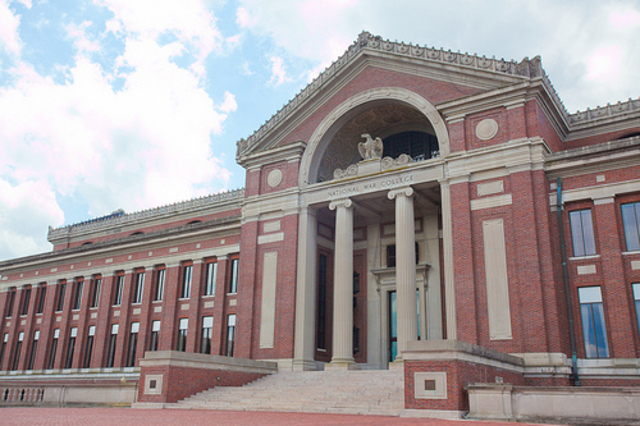
The use of a SCIF at the TS-SCI level for two of the three sessions clearly emphasises the classified nature of at least part of the material presented. The location, Roosevelt Hall at the National War College on the Fort McNair campus, places the event within a senior-level military academic and policy environment. However, without the recipient list which would lend hints to at least some of those who attended, it’s near impossible to determine.
None of this definitively and ultimately disproves the Department’s prior characterizations of AATIP or Elizondo’s role. However, it complicates them. A former program described as limited in scope was presented alongside its successor office in a 2022 briefing that included congressional staffers and required TS-SCI clearances.
Whether additional records exist in other offices or components about this briefing, or others, remains an open question. The releases demonstrate that communications tying together AATIP, AOIMSG, and classified briefings involving redacted participants did occur, and were documented.
They also show that even years after AATIP’s reported closure, its name continued to appear in formal presentations delivered in secure facilities to government and/or military personnel.
A request has been filed for information relating to this briefing specifically. Those results, if any, will be posted when available.
###
Document Archive
 Loading...
 Reload document
 Open in new tab Loading...


