
 A newly released collection of records from the Pentagon’s All-domain Anomaly Resolution Office provides a substantially more detailed look at the government-sponsored UAP research workshop held outside Washington, D.C., in August 2025, including a working agenda identifying speakers and panelists, previously unreleased correspondence concerning foreign participation, and evidence that AARO was already discussing a follow-on workshop months before the first event took place.
The records also document a separate Pentagon engagement with representatives of Uruguay’s official UAP investigative organization, including plans for reciprocal mission briefings, discussions about future collaboration, lunch with senior AARO personnel and a private Pentagon tour.
The documents were released to The Black Vault under Freedom of Information Act case 26-F-1773. The request was filed March 17, 2026, one day after DefenseScoop senior reporter Brandi Vincent broke the story of the invitation-only workshop and obtained additional information about it from the Pentagon. Vincent’s original reporting established that approximately 40 government, academic and independent researchers had participated in the AARO-sponsored gathering and detailed its emphasis on integrating narrative UAP data and applying artificial intelligence to large datasets.
The new FOIA release does not fundamentally alter the publicly stated purpose or findings of the workshop. Instead, its significance is in filling in portions of the administrative record that AARO’s public white paper left anonymous or generalized: who delivered some of the presentations, who sat on the panels, where the workshop actually occurred, and how AARO interacted with at least one foreign government UAP organization before the event.
It is not a complete record. AARO identified 89 responsive pages but withheld 19 pages in their entirety under FOIA Exemption (b)(5), which protects certain deliberative government communications. Portions of the other 70 pages were withheld under Exemptions (b)(5) and (b)(6), with the latter protecting personal privacy.
From a Public White Paper to the Records Behind It
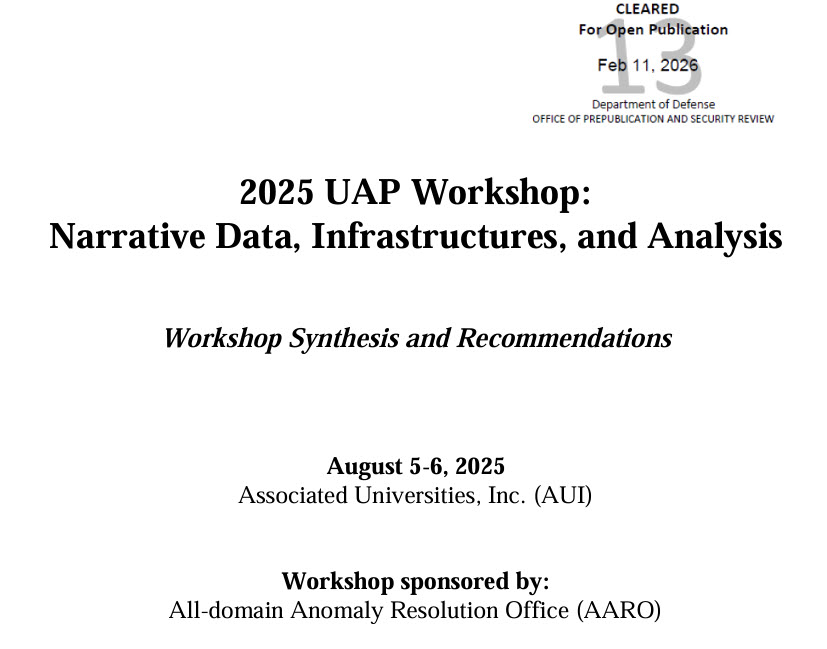 AARO publicly released its 2025 UAP Workshop: Narrative Data, Infrastructures, and Analysis paper in February 2026. The official document described an August 5-6, 2025 workshop sponsored by AARO and hosted by Associated Universities, Inc., or AUI, bringing together 40 participants from government, academia and independent research organizations.
The workshop concentrated primarily on an unusually difficult UAP research problem: narrative reports.
Unlike standardized sensor data, witness accounts can originate in military reports, civilian reporting systems, archives, social media and other sources using different terminology, formats and levels of documentation. The workshop considered methods for standardizing those records, connecting databases and using artificial intelligence and machine learning to process large quantities of material.
Some participants had already publicly acknowledged attending. The National UFO Reporting Center announced its participation on August 11, 2025, just days after the meeting, and later identified Chief Technical Officer Christian Stepien as a participant.
The Society for UAP Studies also subsequently disclosed its involvement and identified several participants. Its account said Michael Cifone delivered a presentation titled It’s All About the Evidence and identified Robert Powell of the Scientific Coalition for UAP Studies among the speakers.
Those disclosures are important because the workshop was private, but its existence and some of its participants were not secret after it occurred.
The Working Agenda Names Speakers and Panelists
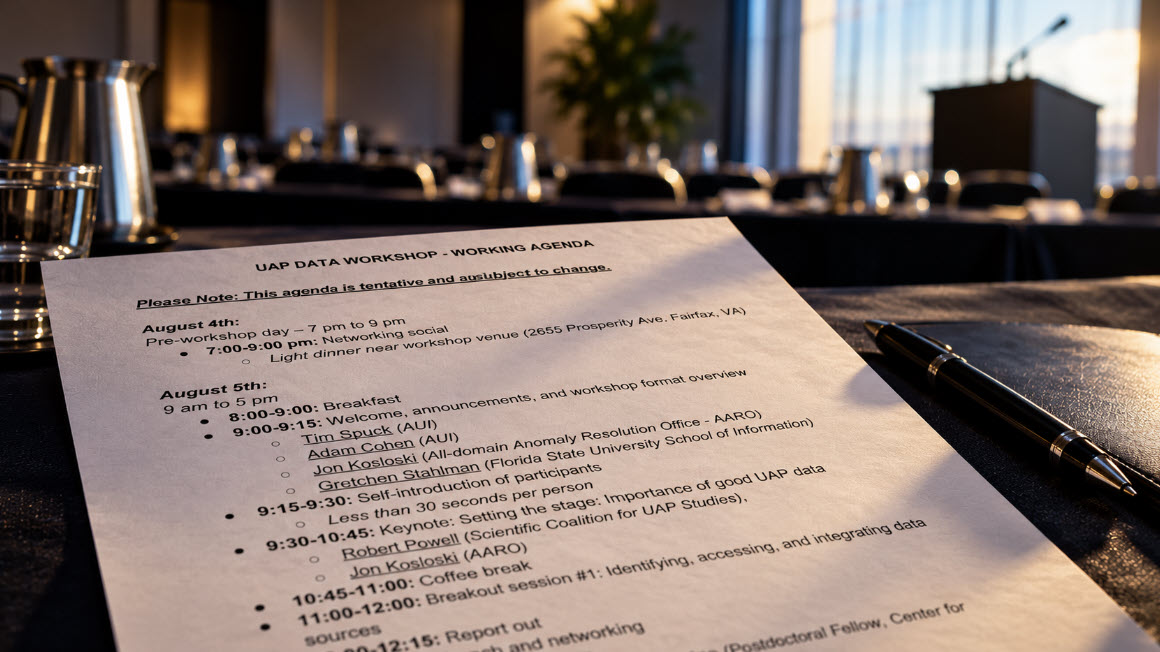
One of the clearest additions is an August 5, 2025, working agenda identifying people whose names and affiliations were omitted from the generic agenda later published in AARO’s white paper.
The newly released agenda identifies the workshop location as Associated Universities Inc., 2650 Park Tower Drive, Suite 700, Vienna, Virginia, across from the Dunn Loring Metro station.
Opening remarks were scheduled from AUI representatives Tim Spuck and Adam Cohen, AARO Director Jon Kosloski, and Gretchen Stahlman of Florida State University’s School of Information.
The keynote, titled “Setting the stage: Importance of good UAP data,” was assigned to Robert Powell of the Scientific Coalition for UAP Studies and Kosloski.
The agenda then names Laura Domine, at the time identified as a postdoctoral fellow at the Center for Astrophysics, Harvard University, for the first session.
Domine’s participation fits directly with the workshop’s technical focus. Her published research includes work on the Galileo Project’s multi-sensor systems for collecting scientific observations of aerial phenomena, including an infrared camera array designed to continuously monitor and classify objects in the sky.
The first panel, “Opportunities and challenges with AI,” was to be moderated by Spuck. The working agenda identifies four panelists:
- Abigail Haddad, identified as a machine-learning engineer;
- Elliott Hauser, assistant professor at the University of Texas at Austin School of Information;
- Duncan McCaskill, identified as formerly with the U.S. Navy Chief Digital and Artificial Intelligence Office;
- Matthew Szydagis, associate professor of physics at the University at Albany.
The second day included a presentation by Stephen Breuhl of Vanderbilt University Medical Center and another panel titled “Harmonizing qualitative and quantitative perspectives on narrative data.”
That panel was scheduled to include Cifone; Amanda Focke, head of Special Collections at Rice University’s Fondren Library; Ben Gibson, identified as a social/behavioral scientist at RAND Corporation; and NUFORC’s Christian Stepien.
The released agenda provides a more specific picture than AARO’s published workshop paper of the mixture of technical researchers, archivists, academics and established civilian UAP organizations invited into the discussion.
AARO Was Also Engaging Uruguay’s Official UAP Organization
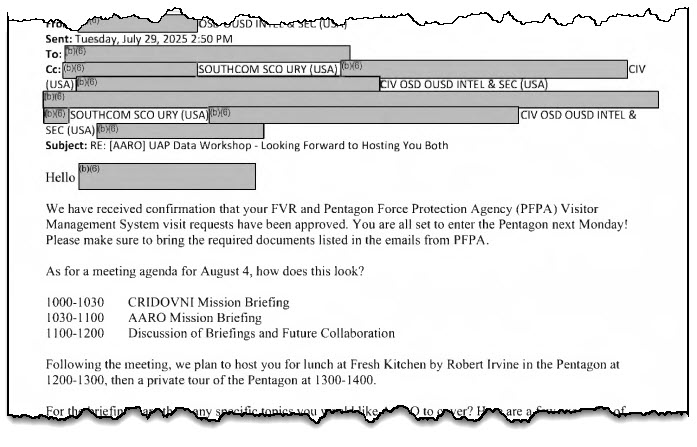
Some of the more substantive new material concerns CRIDOVNI, Uruguay’s official commission for receiving and investigating reports of unidentified aerial phenomena within the Uruguayan Air Force.
Names of the foreign participants are redacted from the FOIA release under Exemption (b)(6), so the documents themselves do not provide a basis for identifying those individuals by name.
In a July 2025 email, an AARO partner-engagement officer told the visitors that AARO would provide hotel accommodations for several nights and proposed a separate August 4 meeting at the Pentagon, the day before the workshop began.
The stated purpose went beyond workshop logistics.
“On 4 August (Monday), would you two be available for a meeting at the Pentagon to provide briefings on our respective work at CRIDOVNI and AARO?”
The AARO official proposed discussing “the types of UAP data our offices analyze, types of analysis we undertake, and ways our offices can collaborate moving forward.”
The Uruguayan correspondent responded affirmatively:
“On August 4, of course, we will be available for a meeting at the Pentagon, it is of special interest to us to be able to establish a further working relationship with the AARO, and to exchange information and experiences.”
The correspondent also accepted an invitation to present CRIDOVNI’s work during the workshop.
Mission Briefings and “Future Collaboration” at the Pentagon
Later correspondence shows the Pentagon visit was approved through the Foreign Visit Request and Pentagon Force Protection Agency visitor systems.
A July 29 email laid out the planned meeting:
“1000-1030 CRIDOVNI Mission Briefing
1030-1100 AARO Mission Briefing
1100-1200 Discussion of Briefings and Future Collaboration”
AARO then planned to host the visitors for lunch and a private Pentagon tour.
AARO also provided a detailed list of what it wanted to learn from CRIDOVNI, including its investigative process, analytical methods and tools, handling of cases containing little or no technical data, notable cases in its database, its organizational relationship with the Uruguayan Air Force, and its scientific and governmental partnerships.
Another email states that a Pentagon lunch reservation had been arranged involving Kosloski and AARO Chief Technology Officer Josh Reiter.
The records do not establish what ultimately resulted from the discussions, whether any formal information-sharing arrangement was reached, or whether the contemplated collaboration continued afterward. No such conclusion can be drawn from the released pages.
They do establish that AARO was actively discussing future cooperation with CRIDOVNI and exchanging information about how the two organizations investigated UAP.
AARO Wanted More South American Participation
The correspondence also provides a glimpse into AARO’s effort to expand participation beyond the United States.
In one email, the AARO official wrote:
“We currently do not have any other registered guests from South America.”
The official said an invitation had been sent through a Chilean contact in Washington in an effort to bring in participants from SEFAA, but that no response had been received.
AARO then asked the Uruguayan representatives for contacts with other South American UAP research organizations that could potentially be invited to a later event.
That request led directly to another notable disclosure.
A Follow-On Workshop Was Already Being Planned
The released email states:
“AARO plans to hold a follow-on data workshop in early 2026, so if you have contact information for other UAP research organizations in South America that you could share with us, we would very much appreciate it and like to extend invitations to them as well.”
The same message described most participants in the 2025 gathering as coming from “U.S.-based universities or UAP research organizations, along with several people from U.S. federal agencies.”
The reference is notable when compared with what the Pentagon publicly said months later.
In Vincent’s March 16 DefenseScoop report, Pentagon spokesperson Sue Gough said AARO hoped to convene future workshops and collaborative opportunities “as needed,” but DefenseScoop reported that Gough said AARO had no additional workshops or plans to announce at that time.
The two statements are not necessarily contradictory. The July 2025 email describes an internal plan for a follow-on workshop in early 2026; Gough’s March 2026 statement concerned what AARO had to announce publicly at that point. The released records do not establish whether the contemplated early-2026 event occurred, was postponed, changed form or was canceled.
They do establish that, before the first workshop had even taken place, AARO personnel were already telling prospective partners that another data workshop was planned.
Hospitality Went Beyond the Formal Workshop
The correspondence also shows the degree of personal and logistical attention provided to the Uruguayan visitors.
AARO arranged airport pickup, hotel accommodations and the Pentagon visit. The emails additionally discuss a Sunday Catholic Mass with Kosloski and the visitor and his wife. One message states:
“Perfect, Dr. Kosloski plans to pick you and your wife up from the hotel on August 3 and drive you to mass.”
The same email explains that Kosloski would locate a church near the visitors’ Virginia hotel.
These details do not bear directly on AARO’s UAP analysis, but they document the level of engagement surrounding the foreign delegation and provide context for a relationship that extended beyond simply registering two people for a conference.
Nineteen Pages Withheld Completely
The release also demonstrates the limits of what AARO was willing to disclose through FOIA.
The Black Vault’s request was intentionally broad. It sought attendee and invitation records, agendas, presentations, breakout materials, notes, transcripts, recordings, records concerning destruction of recordings, after-action reports, drafts of the public white paper, correspondence, contracts, funding records, IRB documentation and records concerning future workshops.
AARO reported locating 89 responsive pages.
Nineteen were withheld completely under Exemption (b)(5), with the agency describing them as inter- or intra-agency records that were deliberative and contained “subjective evaluations, opinions and recommendations.” Portions of the remaining 70 pages were withheld under the same exemption and under the personal-privacy provisions of Exemption (b)(6).
Several pages in the released package consist solely of a page number and a (b)(5) withholding notation, providing no indication of the underlying content.
Consequently, the release cannot be treated as a complete reconstruction of the workshop or AARO’s internal deliberations about it.
The Public Paper Went Through Pentagon Review
The records also include the Defense Department’s DD Form 1910 clearance paperwork for the eventual workshop paper.
The form identifies Kosloski as the author and describes the document as an 18-page white paper titled 2025 UAP Workshop: Narrative Data, Infrastructures, and Analysis. It states:
“This 18-page white paper captures findings and outcomes from an unclassified, AUI-hosted, AARO-sponsored interdisciplinary working group focused on narrative and technical UAP data integration.”
The form states that AUI intended to publish the paper on its website while AARO planned to promote it through social media and link to it from AARO.mil.
A More Detailed Picture of AARO’s Outreach
Taken together, the newly released material provides less of a revelation about what the workshop concluded than about how AARO assembled it and what the office was trying to build around it.
The public white paper already disclosed the methodological conclusions: standardize UAP data, preserve historical records, connect disparate databases, use AI cautiously, retain human oversight and develop a continuing interdisciplinary research community.
The FOIA records add names, affiliations and institutional relationships behind that summary. They show AARO putting its director on a keynote with a prominent civilian UAP researcher; bringing machine-learning specialists, physicists, archivists, social scientists and civilian UAP database operators into the same program; engaging Uruguay’s official UAP investigative body separately at the Pentagon; seeking contacts with additional South American organizations; and discussing another data workshop before the first one convened.
At the same time, the records leave significant gaps. AARO withheld 19 pages completely, redacted portions of others, and the released material does not establish the identities of all 40 participants, the full substance of the workshop discussions, the ultimate outcome of the proposed CRIDOVNI collaboration or what happened to the follow-on workshop contemplated for early 2026.
Additional FOIA requests are set to be filed regarding some of the above revelations, and those findings will be posted here at The Black Vault, when available.
###
Document Archive
 26-F-1773 Release Package [91 Pages, 5.92MB]
 Loading...
 Reload document
 Open in new tab
 Follow The Black Vault on Social Media:


