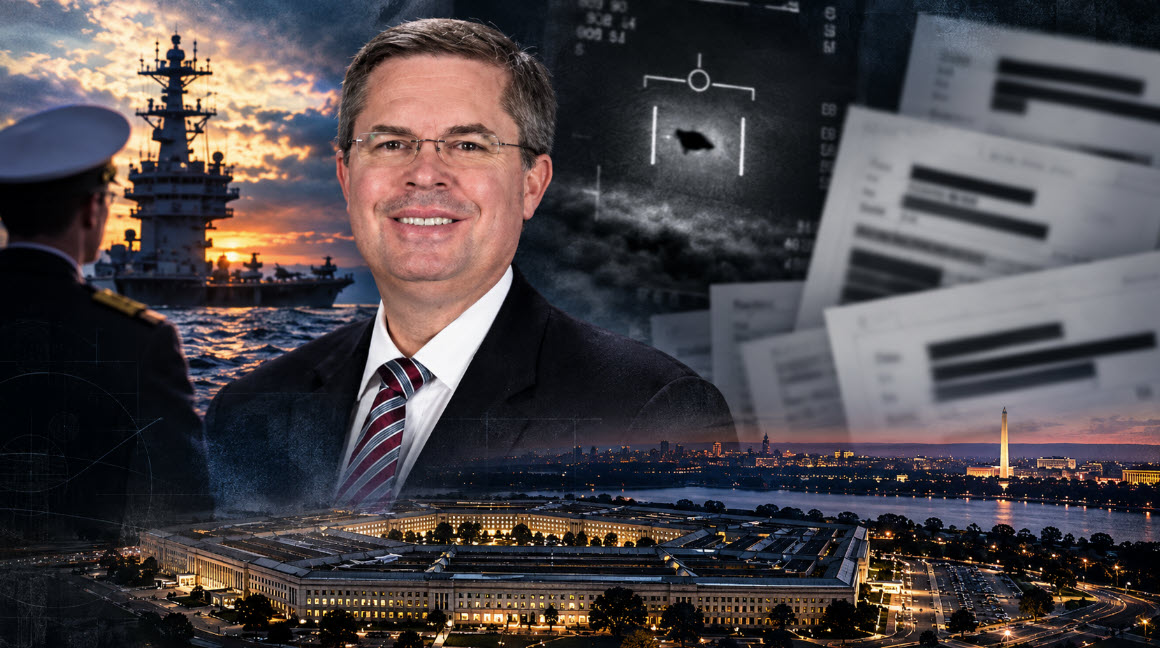

The Department of the Navy has released more than 1,300 pages of emails and related records involving former Deputy Director of Naval Intelligence Scott W. Bray, opening a broad window into government communications surrounding unidentified aerial phenomena during a pivotal period in the Pentagon’s modern UAP effort.
The records were obtained by The Black Vault through a Freedom of Information Act request filed on May 24, 2022. The request sought emails sent to, from, copied to or blind-copied to Bray containing terms including “Unidentified Aerial Phenomena,” “UAP,” “UAPTF,” “UFO,” “AATIP,” “AAWSAP” and several related phrases.
More than four years later, the Navy responded on September 23, 2026. According to its response, the search located 1,321 pages of responsive records. The Navy withheld 302 pages in their entirety, while releasing the remaining 1,019 pages with redactions under several FOIA exemptions.
Who Was Scott Bray?
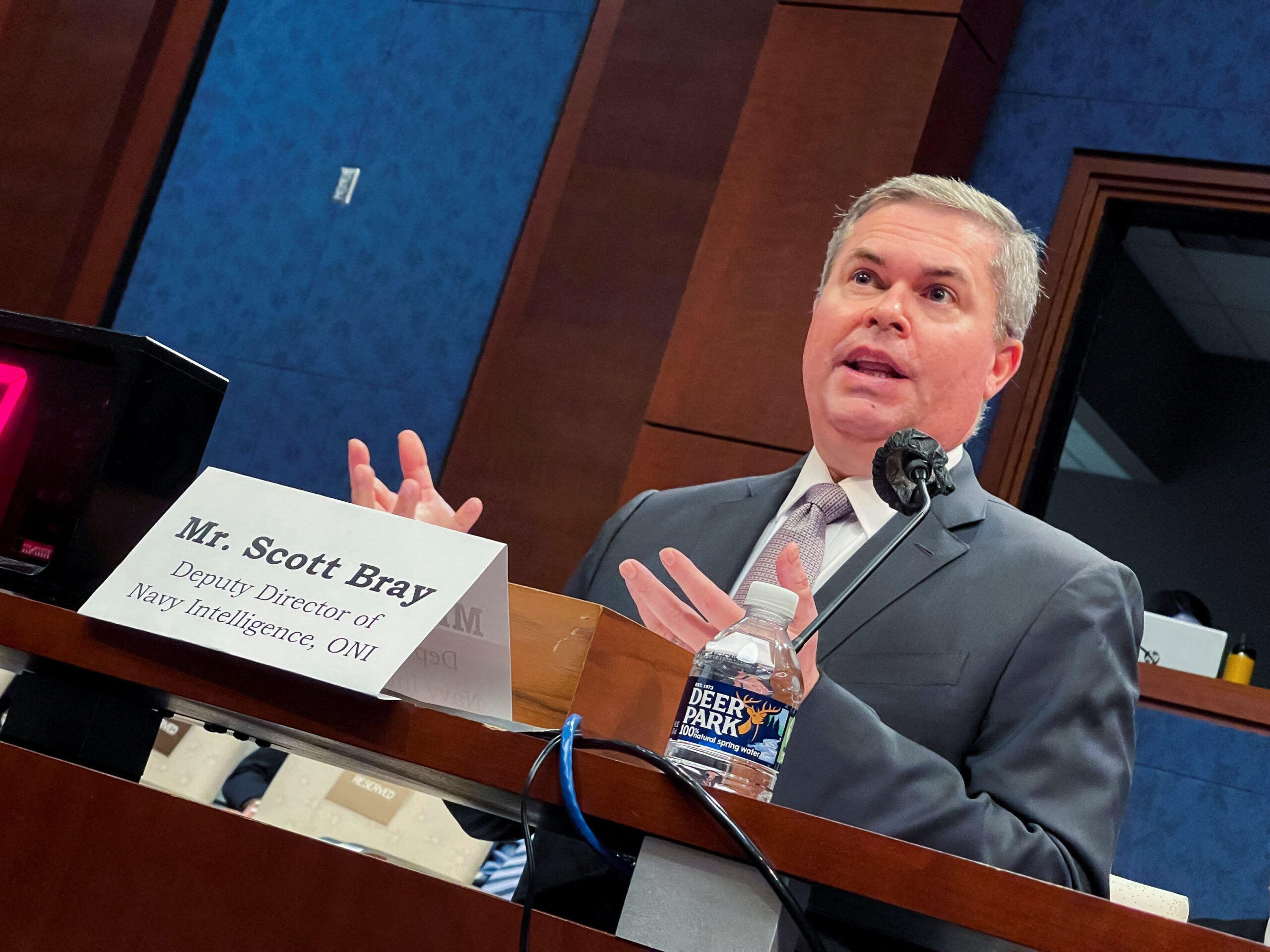 Bray served as Deputy Director of Naval Intelligence and Director of the Naval Intelligence Activity during much of the period covered by the records. His position placed him within a network of Navy, Defense Department and Intelligence Community officials dealing with UAP reporting, briefings, congressional interest and the development of what ultimately became the Navy-led Unidentified Aerial Phenomena Task Force.
One email in the release described the relationship directly, stating that John “Jay” Stratton “leads the UAP Task Force effort for Navy… working directly for Scott Bray, our Deputy Director of Naval Intelligence.”
Bray later became one of the government’s most visible officials on the UAP issue. On May 17, 2022, he appeared with Under Secretary of Defense for Intelligence and Security Ronald Moultrie before a House Intelligence subcommittee during a public congressional hearing devoted to UAP. The hearing was followed by a classified session.
The newly released records provide a much larger documentary backdrop to that public role.
A Broad Look Behind the Government’s UAP Effort
The correspondence stretches across years and includes exchanges involving Stratton, Defense Intelligence official Neill Tipton, senior Navy officials, admirals, Pentagon public-affairs personnel and other Defense and Intelligence Community officials.
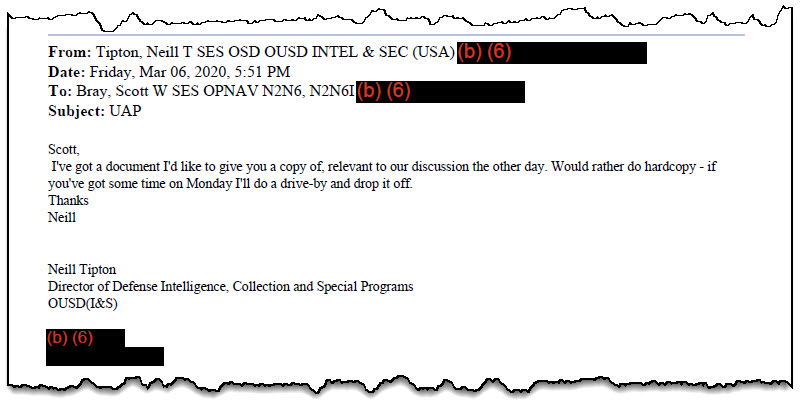
For example, a March 2020 exchange shows Tipton, who was then identified in his signature block as Director of Defense Intelligence, Collection and Special Programs in OUSD(I&S), telling Bray that he had a document “relevant to our discussion the other day” that he preferred to deliver in hard copy. Other correspondence concerning a planned Senate Select Committee on Intelligence briefing includes Bray, Stratton, Tipton and Rear Adm. Kelly Aeschbach.
Elsewhere, the records show Stratton discussing proposed public language concerning the UAP effort and whether it should be reviewed by Bray before being sent forward. Other email traffic includes Vice Adm. Matthew Kohler, Rear Adm. Charles Brown and Rear Adm. Paula Dunn in communications surrounding the April 2020 public release of the Navy UAP videos.
Those are only examples of the names and subjects contained in the collection. The release includes communications surrounding congressional briefings, public-affairs strategy, the UAP Task Force, the 2021 ODNI UAP assessment, media inquiries, FOIA releases, classification questions, senior-level briefings and the government’s evolving organizational response to UAP.
There are also extensive attachments, forwarded news coverage and discussions of claims being made publicly about UAP. Their inclusion in Bray’s email records does not establish that the Navy or Bray endorsed those claims; in many instances, the records simply document what officials were receiving, discussing or preparing to address.
A Large Record With Significant Gaps
The release should not be viewed as a complete history of Bray’s involvement with UAP or of the UAP Task Force itself. The FOIA request was constructed around specific search terms, and the Navy withheld 302 responsive pages completely. Redactions also appear throughout the pages that were released.
What remains is nevertheless an unusually large collection of contemporaneous correspondence from inside the Navy and Defense Department during the years in which the modern UAP issue was developing into a formal, highly visible government effort.
Given the size of the release and the number of separate subjects contained within it, individual email chains and issues may warrant separate examination. The complete released collection is being made available through The Black Vault for independent review.
###
Document Archive
 DON-NAVY-2022-008648 Release Package [1,324 Pages, 47MB]
Follow The Black Vault on Social Media:


