


A Freedom of Information Act request filed in 2009 has reached its conclusion after nearly 17 years, making it the longest-running request documented by The Black Vault. The case, assigned number 09-F-1331, resulted in the identification of responsive records but ultimately concluded with a full denial, with all material withheld under multiple national security exemptions.
The request was submitted on June 1, 2009, and sought a specific Cold War-era report related to anti-satellite weapons policy. The filing requested:
“a copy of document entitled Analysis and Perspectives on ASAT Arms Control, report number AAC-TR-19501/81, dated December, 1981, with AD Number C951399.”
Continue scrolling for more...
According to the final response issued by the Department of Defense, the request was received by the Office of the Secretary of War/Joint Staff FOIA Requester Service Center on July 1, 2009. The agency’s closing letter, dated May 5, 2026, formally ended the case. No processing timeline, interim correspondence, or explanation for the length of time between submission and final response is included in the released documents.
Despite the extended duration, the agency confirmed that records were located, which totaled 80 pages.
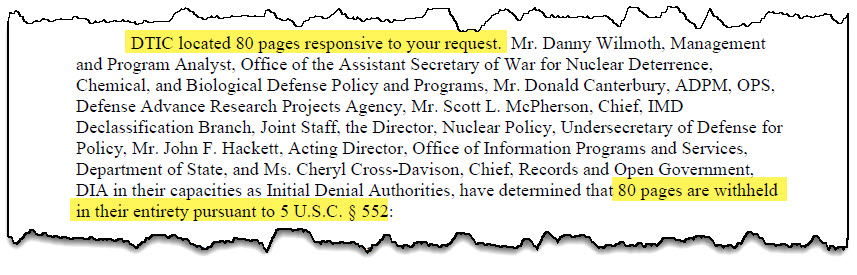
Those 80 pages, however, were withheld in full. The determination cites multiple exemptions under 5 U.S.C. § 552, including classified national security information, intelligence sources and methods, weapons-related data, diplomatic sensitivities, and vulnerabilities tied to national defense systems. The response specifies that the material remains classified under Executive Order 13526 and references statutory protections including 50 U.S.C. § 3024(h) and provisions of the Atomic Energy Act.
The denial was issued with input from multiple offices and officials across defense and intelligence agencies, including personnel associated with nuclear deterrence policy, DARPA, the Joint Staff, the Department of State, and the Defense Intelligence Agency, each acting in a capacity as an Initial Denial Authority. The breadth of involvement reflects the sensitivity attributed to the subject matter of the requested report.
The agency further stated that it applied the “foreseeable harm standard” in reviewing the records, concluding that release would pose risks to national security and related interests. No portions of the document were released in redacted form, and no segregable material was identified for disclosure.
The response letter formally closed the case and advised of the right to appeal within 90 days.
The case represents a rare example of a FOIA request spanning nearly two decades from submission to final determination. While the existence of responsive records was confirmed, the complete withholding of all 80 pages leaves the contents of the requested 1981 report undisclosed. The available documentation does not provide further detail on the report’s substance beyond its title and classification status.
The Black Vault has filed an appeal, along with filed a request to see the FOIA case processing notes and correspondence (beyond that with this article’s author) generated during the request. Those results will be posted, when available.
###
 Loading...
 Reload document
 Open in new tab


