



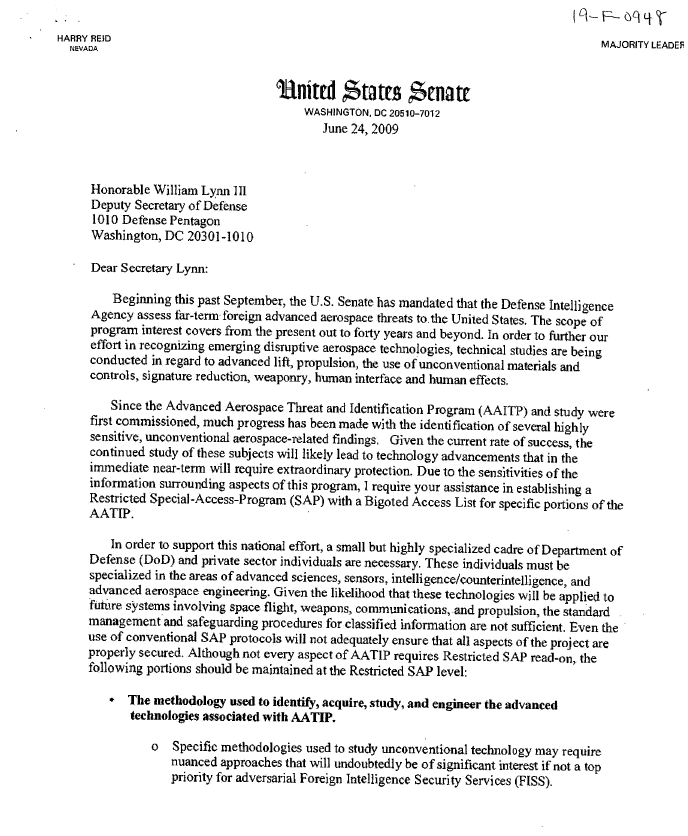
In June 2009, then–Senate Majority Leader Harry Reid sent a letter to the Department of Defense requesting heightened protection for what he described as the Advanced Aerospace Threat Identification Program (AATIP). The four-page letter, addressed to then–Deputy Secretary of Defense William Lynn III, argued that portions of the program warranted Restricted Special Access Program (SAP) status due to sensitivity involving “unconventional aerospace-related findings,” advanced technologies, and national security implications.
The letter itself is no longer in dispute. After years of denials, confusion, and contradictory statements, the Department of Defense ultimately acknowledged its authenticity, and the Defense Intelligence Agency (DIA) released the document publicly. What remains unresolved, even after more than six and a half years after a Freedom of Information Act request first sought it, is the Department of Defense’s response to Reid’s request.
A final FOIA response issued by the Office of the Secretary of Defense/Joint Staff on December 15, 2025, under case number 19-F-0948, again produced only Reid’s original letter, directing The Black Vault to the same DIA-hosted copy previously released years earlier. The response asserted that this constituted a “full grant” of the request and stated that no additional responsive records were found.
That conclusion directly conflicts with prior on-the-record statements from the Pentagon.
A Confirmed Response—But Still Missing
In 2021, Pentagon spokesperson Susan Gough confirmed to The Black Vault that the Department of Defense did, in fact, respond to Senator Reid’s 2009 memo.
“I can confirm that the memo you’re referring to is authentic. DOD received it and responded to Sen. Reid,” Gough stated at the time. She added that her office could not release the response because “the Public Affairs office does not release Congressional correspondence.”
The statement strongly implied that a tangible written response existed and had been located. Yet, when specifically requested under FOIA, and after the scope of the request was amended to remove any ambiguity, the Department of Defense now maintains that no such response can be found.
That amendment was formally submitted in April 2020, explicitly asking that all responses to Senator Reid be included in the search. The Department acknowledged receipt of that amendment and confirmed it was incorporated into the case file.
Despite this, the final determination issued in 2025 claims that no response letter exists within the scope of records searched.
Procedures That Require a Written Answer
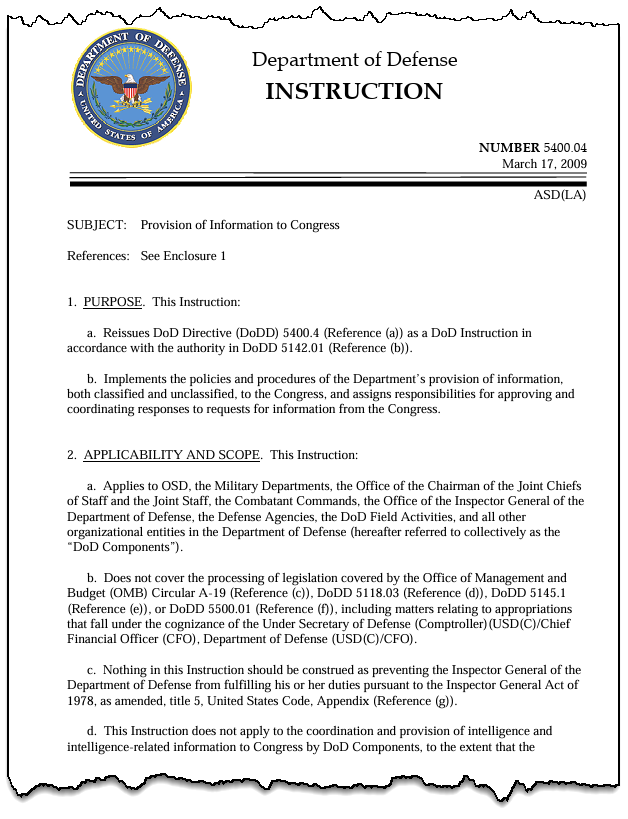 The unresolved absence of a response raises procedural questions that extend beyond AATIP itself.
Department of Defense Instruction (DoDI) 5400.04 governs the provision of information to Congress and requires that inquiries be answered in a “responsive and expeditious” manner, generally within 30 days. Additionally, DoD Manual (DoDM) 5110.04-M outlines the internal handling of congressional correspondence and requires that an initial reply or draft be prepared within 14 calendar days for leadership review.
Taken together, these procedures make clear that a written response to a sitting Senate Majority Leader, especially one requesting Special Access Program consideration, would not be optional or informal. At minimum, a written reply or draft response would normally be generated, staffed, and preserved.
The Department of Defense has not explained how such a response could have been sent, as confirmed by its spokesperson, yet leave no recoverable record across multiple offices years later.
A Program Still in Dispute
The missing response letter adds another layer to the long-running controversy surrounding AATIP itself.
On one side of the debate, Reid’s 2009 letter explicitly refers to AATIP as an existing program, describes work already underway, and requests additional security protections. The attached “Attachment 1” lists AATIP as an unclassified nickname, identifies preliminary funding periods, and names both government and contractor personnel associated with the effort.
On the other side, the Department of Defense has repeatedly stated that AATIP was not an official, standalone program and that Luis Elizondo, often described publicly as its director, “had no assigned responsibilities for AATIP while he was in OUSD(I).” That language was reiterated by Gough even while confirming Reid received a response.
The Department has characterized AATIP references as administrative or informal, while critics argue that such explanations do not reconcile with the detailed content of Reid’s memo or the apparent need for a formal Pentagon reply.
A Pattern of Difficulty
Compounding the issue is the unusual history of locating Reid’s original letter itself. For years, the Department of Defense stated it could not be found. It was later located and released by the DIA. Now, after more than six years of FOIA processing, the Pentagon again claims it cannot locate a closely related record that its own spokesperson has acknowledged exists.
Other correspondence between Senator Reid and the Department of Defense has been located and released without comparable difficulty. Only the response to the 2009 AATIP letter appears to fall into a category of persistent absence.
An Unanswered Question
Whether AATIP existed as a formal program, an informal effort, or something in between remains a matter of ongoing dispute. What is no longer speculative is that Senator Reid requested action, and the Department of Defense has stated it responded.
What remains unanswered is why, under procedures that require written congressional correspondence, no response can now be produced. It also begs the question on why this particular document continues to elude release long after the original request was filed.
Until that question is resolved, the 2009 AATIP letter remains not just a controversial document, but part of an incomplete paper trail at the center of one of the Pentagon’s most debated modern mysteries.
###
 19-F-0948 FOIA Release Package [6 Pages, 0.5MB]
 Loading...
 Reload document
 Open in new tab


