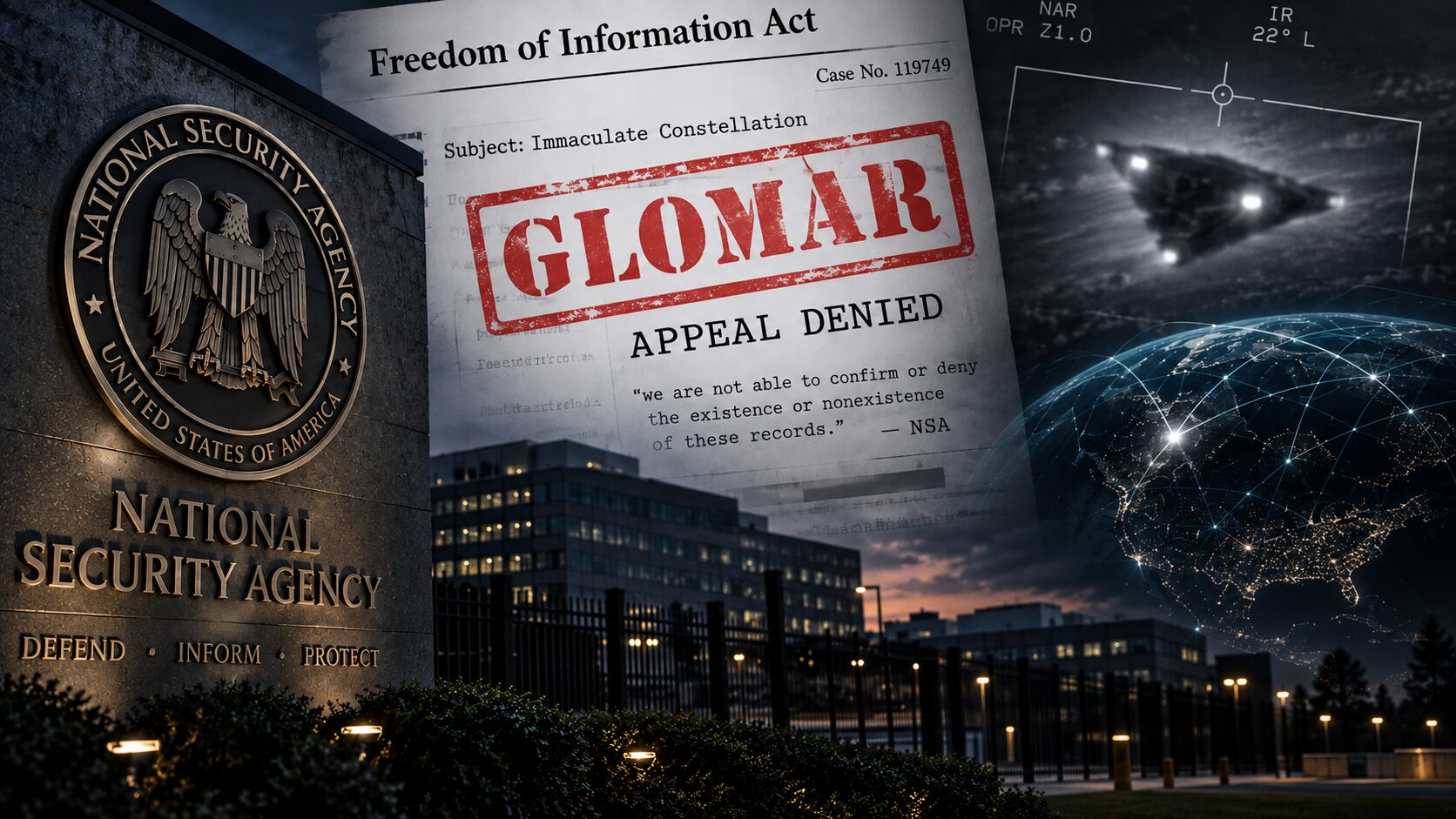

The National Security Agency has upheld its refusal to confirm or deny whether it possesses intelligence records concerning the alleged “Immaculate Constellation” program, rejecting a Freedom of Information Act appeal filed by The Black Vault.
The decision does not establish that Immaculate Constellation exists, that NSA participated in such a program, or even that NSA possesses records about it. Instead, NSA maintains that simply answering the question on whether responsive intelligence records exist at all, would itself disclose classified and statutorily protected information.
That distinction is particularly significant in this case. The Department of War has publicly denied having any record of a Special Access Program by that name, while the document responsible for many of the allegations remains an unverified whistleblower-origin report containing extraordinary claims for which no underlying imagery, intelligence reports, databases or other corroborating evidence described in the report has been publicly produced.
The result is an unusual information gap: one part of the government has publicly said it has no record of the alleged program, while NSA says national security prevents it from saying whether it has records pertaining to the same allegation.
The Immaculate Constellation Allegations
“Immaculate Constellation” entered the public UAP debate in October 2024 through reporting by journalist Michael Shellenberger. A document subsequently provided to Congress was entered into the record of the House Oversight Committee’s November 13, 2024 hearing, “Unidentified Anomalous Phenomena: Exposing the Truth.”
The document describes itself as the product of “a multi-year, internal investigation” concerning UAP, “Technologies of Unknown Origin,” and “Non-Human Intelligence.” It states that it was provided to Congress through UAP whistleblower mechanisms and says its public version was reviewed and approved for public release by the State Department’s Bureau of Global Public Affairs.
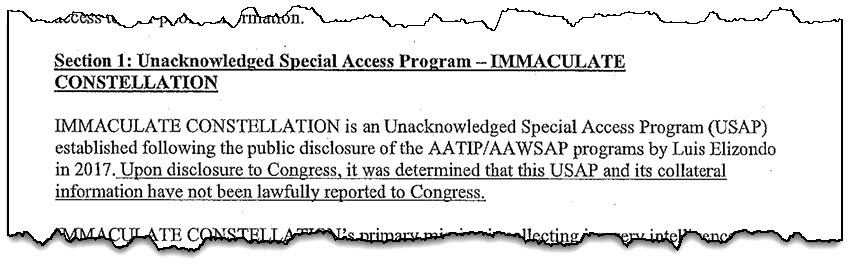
Its central allegation is explicit:
“IMMACULATE CONSTELLATION is an Unacknowledged Special Access Program (USAP) established following the public disclosure of the AATIP/AAWSAP programs by Luis Elizondo in 2017.”
The report further alleges that the program’s “primary mission is collecting imagery intelligence on Unidentified Aerial Phenomena (UAP) and ARV/RV (Reproduction Vehicles)” using tasked and untasked U.S. military-intelligence collection systems.
The claims extend considerably further. The document describes alleged imagery from CENTCOM, INDOPACOM, NORTHCOM and SOUTHCOM environments; asserts that a Defense HUMINT database contains more than 400 UAP/UFO encounter reports from 1991 through 2022; and presents tables cataloging reported shapes, sizes, behaviors, signatures and other characteristics.
Those are allegations contained in the document and are not independently established findings.
The document’s presence in an official congressional hearing record verifies that Congress received and published the report. It does not authenticate the underlying claims, establish that the purported program exists, or demonstrate that the described imagery and databases are genuine.
That evidentiary distinction remains an important part of this. No primary program documentation establishing Immaculate Constellation as an actual USAP has been publicly produced alongside the report, and the underlying imagery and intelligence reporting described in it have not been made publicly available for independent examination.
Pentagon: No Record of the Program
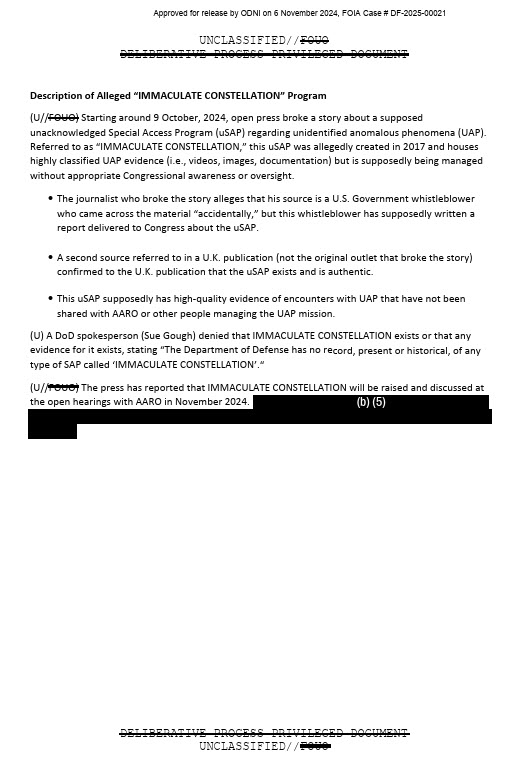
The Department of Defense publicly took a substantially less ambiguous position.
DoD spokesperson Sue Gough stated:
“The Department of Defense has no record, present or historical, of any type of SAP called ‘IMMACULATE CONSTELLATION.’”
That denial was also recorded in an internal Office of the Director of National Intelligence document concerning the allegations. The ODNI document characterized Immaculate Constellation as a “supposed unacknowledged Special Access Program” and summarized what had been reported publicly before recording Gough’s denial.
The available public record therefore contains a direct conflict between the whistleblower-origin allegations and DoD’s stated position. There is currently no publicly available documentary evidence sufficient to independently resolve that conflict in favor of the program’s existence.
The NSA FOIA Request
On December 3, 2024, The Black Vault submitted a request to NSA seeking intelligence records and records concerning intelligence activities pertaining to the alleged Immaculate Constellation program.
The purpose of filing with NSA was not based on evidence establishing that NSA operated the alleged program. Rather, it was part of a broader FOIA strategy used by The Black Vault when attempting to trace claims involving the Intelligence Community.
Records about a program or subject do not necessarily reside exclusively with the agency alleged to have originated them. Intelligence reporting, correspondence, referrals, finished products or other material can potentially exist elsewhere in government. When responsive records originated with another agency, the FOIA process can also involve consultation or referral to the originating agency for review.
Submitting requests to multiple potentially relevant agencies can therefore test a broader portion of the government’s documentary record rather than assuming that only one agency could possess responsive material.
NSA answered on December 6, 2024.
But it did not say that it found nothing.
It would not say whether it found anything at all.
NSA Issues a Glomar Response
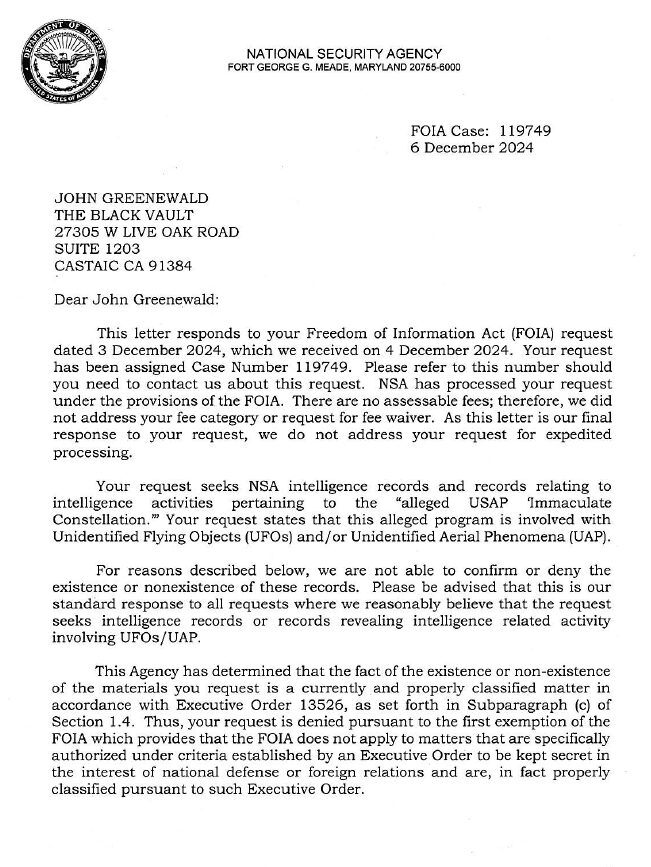
NSA told The Black Vault:
“For reasons described below, we are not able to confirm or deny the existence or nonexistence of these records.”
Importantly, NSA also explained that its response was not unique to Immaculate Constellation:
“Please be advised that this is our standard response to all requests where we reasonably believe that the request seeks intelligence records or records revealing intelligence related activity involving UFOs/UAP.”
NSA invoked FOIA Exemptions 1 and 3. Under Exemption 1, the agency said that even “the fact of the existence or non-existence” of the requested material was currently and properly classified under Executive Order 13526.
For Exemption 3, NSA cited 18 U.S.C. § 798, 50 U.S.C. § 3024(i), and Section 6 of Public Law 86-36, codified at 50 U.S.C. § 3605.
NSA further stated:
“the Agency reasonably foresees that disclosure of the existence or non-existence of the requested information would be harmful to an interest that is protected by the identified exemptions.”
The response is commonly known as a Glomar response: rather than acknowledging whether responsive records exist and then withholding some or all of them, an agency refuses to confirm or deny the existence of responsive records.
Nothing in NSA’s December 2024 response can properly be treated as confirmation of Immaculate Constellation. NSA specifically said the response was its standard treatment for requests it believes seek intelligence records or intelligence-related activity involving UFOs or UAP.
The Black Vault Appeals
The Black Vault appealed the decision on December 9, 2024.
The appeal centered in part on the apparent tension between NSA’s position and the categorical public statement already made by DoD.
It argued that if the alleged program did not exist, acknowledging that fact should not reveal classified information. Conversely, if responsive records existed independently of an NSA-operated program, for example, records discussing allegations concerning a program elsewhere in government; the FOIA process could potentially identify those records and subject them to normal classification and referral procedures.
The appeal specifically requested that NSA reconsider the Glomar response, “explicitly confirm or deny the existence of records related to ‘Immaculate Constellation,’” process any non-exempt portions, and provide appropriate justification for information that remained withheld.
NSA has now rejected that argument.
NSA: Even Acknowledging Records Could Harm National Security
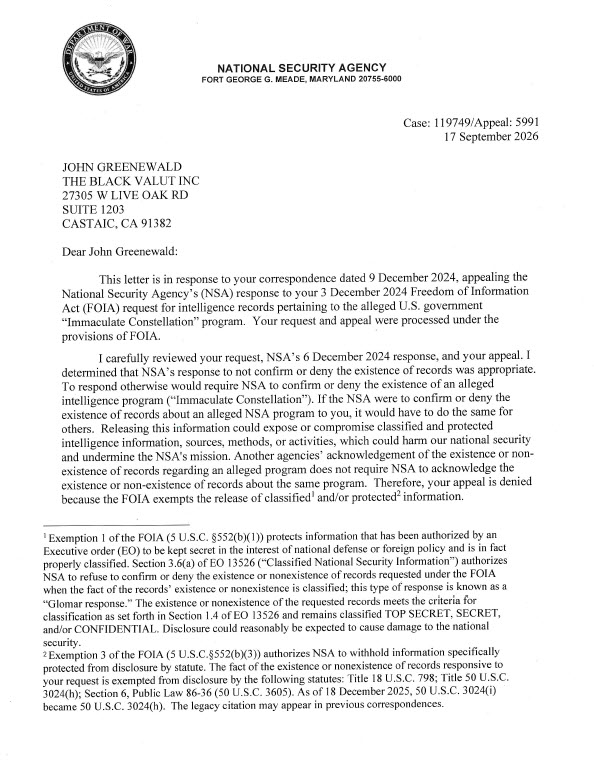
In its appeal determination, NSA said its original response was appropriate and again declined to answer whether responsive records exist.
The appeal authority wrote:
“I determined that NSA’s response to not confirm or deny the existence of records was appropriate.”
The agency then explained the reasoning behind maintaining the Glomar response:
“To respond otherwise would require NSA to confirm or deny the existence of an alleged intelligence program (‘Immaculate Constellation’).”
NSA continued:
“If the NSA were to confirm or deny the existence of records about an alleged NSA program to you, NSA would have to do the same for others.”
According to the agency, releasing that information could “expose or compromise classified and protected intelligence information, sources, methods, or activities,” potentially harming national security and undermining NSA’s mission.
The appeal determination also directly addressed the argument concerning another agency’s public statements.
NSA wrote:
“Another agencies’ acknowledgement of the existence or non-existence of records regarding an alleged program does not require NSA to acknowledge the existence or non-existence of records about the same program.”
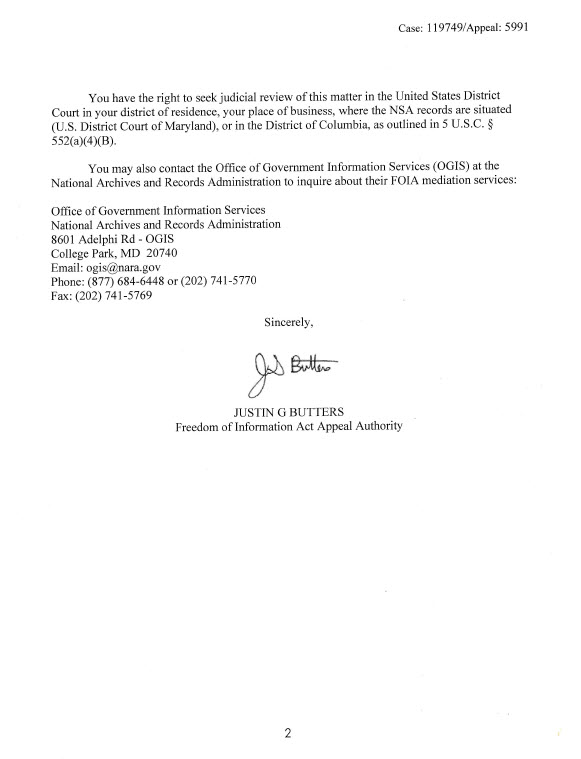
The appeal was therefore denied.
What the NSA Response Does — and Does Not — Establish
NSA’s decision creates no evidentiary support for the underlying Immaculate Constellation allegations.
A Glomar response cannot logically be read as “yes.” By design, it provides neither a confirmation nor a denial.
That limitation is particularly important because NSA explicitly stated in its original response that this is its standard treatment for requests seeking intelligence records or intelligence-related activity, even that which is involving UFOs and UAP.
Consequently, the NSA correspondence provides no basis for concluding that the agency operated Immaculate Constellation, participated in it, knows that it exists, or possesses any of the extraordinary imagery or intelligence described in the whistleblower-origin report.
The documentary record remains considerably narrower.
A report alleging the program’s existence was provided to Congress and formally entered into a House hearing record. The report contains detailed allegations concerning imagery intelligence, HUMINT reporting, signals intelligence and government UAP activities. DoD has publicly stated that it has “no record, present or historical” of a SAP called Immaculate Constellation. And NSA refuses to say whether it possesses intelligence records pertaining to the allegation.
Those facts can coexist without confirming the alleged program.
The Continuing Problem With Glomar
The NSA case also illustrates a recurring transparency problem created by Glomar responses.
There is an important distinction between asking whether a classified intelligence program exists and asking whether an intelligence agency possesses records concerning allegations about such a program. The latter could encompass material originating outside NSA, correspondence discussing press reports, intelligence reporting, interagency communications, referrals or other records without establishing that the alleged program itself exists.
Indeed, the ODNI record demonstrates that this distinction is not merely hypothetical. ODNI possessed an internal document discussing the Immaculate Constellation allegations, summarizing press reporting and recording DoD’s denial. Its existence did not establish that the alleged program was real.
NSA nevertheless maintains that even acknowledging the existence or nonexistence of intelligence records responsive to the request would reveal protected information.
That leaves a fundamental question unresolved: if an allegation is false, and an agency truly possesses no responsive intelligence records, what national-security interest would be damaged by simply saying so?
NSA’s appeal determination does not provide a case-specific public explanation answering that question. Instead, it states that confirming or denying records concerning alleged intelligence programs could expose classified intelligence information, sources, methods or activities, and that another agency’s acknowledgement does not bind NSA.
That is the government’s legal position. It is not evidence that Immaculate Constellation exists.
For now, the publicly available evidence remains insufficient to substantiate the extraordinary allegations contained in the whistleblower report. NSA’s Glomar response does nothing to change that evidentiary picture. It establishes only that NSA will not say whether responsive intelligence records exist, even after another component of the U.S. government publicly stated that it has no record of the alleged program.
The distinction between a government record documenting an allegation and government documentation proving the allegation remains essential in evaluating Immaculate Constellation. At present, the public record establishes the former, but not the latter.
###
Follow The Black Vault on Social Media:


