



A recent Freedom of Information Act response issued by the Department of War raises significant questions about the government’s obligations under FOIA, after officials declined to conduct even a basic email search tied to allegations surrounding the so-called “Immaculate Constellation” program.
The request, filed by The Black Vault and assigned case number 25-F-3827, sought a search of emails sent to or from Maj. Gen. Derek J. O’Malley, Director of Special Programs and Director of the Department of Defense Special Access Program Central Office, for communications containing the phrase “Immaculate Constellation.” The request explicitly asked for both classified and unclassified records.
In its final response dated January 26, 2026, the Office of the Secretary of War/Joint Staff stated that no search would be conducted at all. According to the letter, “a search was not conducted as they confirmed the subject matter itself does not exist, and an extensive email search on the custodian would not yield responsive records.”
The rationale offered by the Department of War hinges entirely on the premise that because the alleged Special Access Program does not exist, records discussing it cannot exist either. That position stands out as unusual within FOIA practice, where agencies are generally expected to conduct searches for records responsive to the wording of a request, regardless of whether the subject matter later proves to be inaccurate, unsubstantiated, or false.
Allegations, Denials, and Congressional Attention
The phrase “Immaculate Constellation” entered the public record in late 2024 following the submission of a document by Congresswoman Nancy Mace, during the “Unidentified Anomalous Phenomena: Exposing the Truth” hearing held on November 13, 2024. The document was later revealed to have been authored by Matthew Brown, who was subsequently profiled in a NewsNation investigation examining claims that his whistleblower allegations regarding unidentified anomalous phenomena were ignored by government agencies.
Journalist Michael Shellenberger, who testified at the UAP hearing in November 2024, also submitted extensive testimony about Immaculate Constellation and the UAP topic in general.
In parallel, the Office of the Director of National Intelligence released a one-page, unclassified document under FOIA case DF-2025-00021, explicitly addressing the allegation. That document summarized press reporting on the purported unacknowledged SAP and included an unequivocal denial from the Department of Defense.
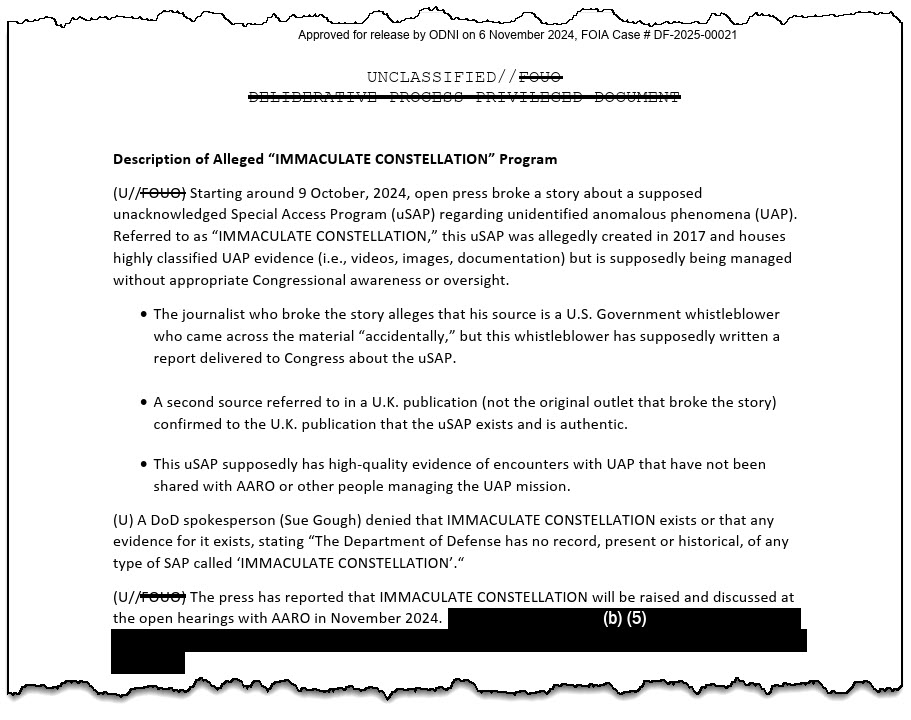
“The Department of Defense has no record, present or historical, of any type of SAP called ‘IMMACULATE CONSTELLATION’,” DoD spokesperson Sue Gough stated in the document.
The ODNI record itself exists precisely because the allegation was circulating publicly and required internal documentation and assessment. The document also noted that the press had reported the issue would be raised during open hearings with the All-domain Anomaly Resolution Office in November 2024.
Government Denial of Existence Does Not Eliminate FOIA Obligations
A central issue raised by FOIA case 25-F-3827 is not whether the alleged “Immaculate Constellation” program exists, but whether the government may decline to process a FOIA request based solely on its own assertion that the subject matter is fictitious.
In its response, the Department of War asserted that because the alleged Special Access Program “does not exist,” an email search would not yield responsive records and therefore was not conducted. That reasoning conflates the government’s position on the validity of an allegation with its separate obligation under FOIA to search for records responsive to the language of a request.
FOIA does not require a requester to prove that an allegation is true, nor does it allow agencies to decline a search simply because they believe a claim to be false. Federal agencies routinely create and retain records discussing inaccurate reports, rumors, hoaxes, or media-driven allegations, even when those allegations are ultimately rejected. Those records may include internal emails responding to press coverage, coordinating official denials, briefing senior leadership, or assessing whether an allegation requires follow-up. The potential falsity of an underlying claim does not negate the existence of records discussing the claim itself, nor does it relieve an agency of its obligation to search for them.
The Office of the Director of National Intelligence’s one-page release on “Immaculate Constellation” illustrates this distinction. While the document explicitly denied the existence of the alleged SAP, it nonetheless documented internal awareness of the allegation, summarized press reporting, and recorded official responses. The existence of that record demonstrates that even when a program is denied, responsive records discussing the allegation itself can and do exist.
That distinction is directly implicated in the Department of War’s handling of case 25-F-3827. The request did not seek confirmation that “Immaculate Constellation” is real. It sought emails containing a specific phrase, which is language that had already entered official government documentation, congressional submissions, press reporting, and interagency discourse. Declining to conduct a search on the grounds that the subject matter is alleged to be nonexistent sidesteps the core procedural requirements of the Freedom of Information Act.
Contrasting FOIA Responses Across Agencies
The Department of War’s refusal to conduct a search also contrasts sharply with how other agencies have handled similar requests.
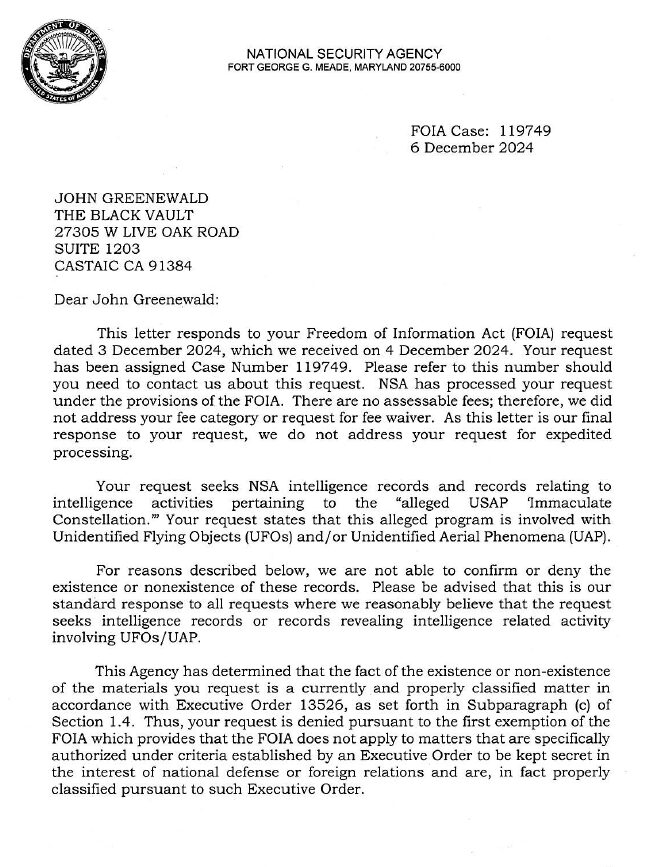
In December 2024, The Black Vault received a response from the National Security Agency to a FOIA request seeking records related to the “alleged USAP ‘Immaculate Constellation.’” Rather than asserting that no search was necessary, the NSA issued a Glomar response, stating it could neither confirm nor deny the existence of responsive records.
“For reasons described below, we are not able to confirm or deny the existence or nonexistence of these records,” the NSA wrote, adding that “the fact of the existence or non-existence of the materials you request is a currently and properly classified matter.”
The NSA further noted that this was its “standard response to all requests where we reasonably believe that the request seeks intelligence records or records revealing intelligence related activity involving UFOs/UAP.”
While Glomar responses are themselves controversial, they nonetheless reflect acknowledgment of FOIA’s requirement to address the request through established exemption frameworks. The Department of War’s approach, by contrast, bypassed the search process entirely based on an assertion about subject matter non-existence.
Why the Distinction Matters
The core issue raised by FOIA case 25-F-3827 is not whether “Immaculate Constellation” is real. It is whether an agency may refuse to search records simply because it believes an allegation is false.
FOIA does not permit agencies to pre-judge the outcome of a search and decline to conduct it on that basis alone. Records discussing false claims, responding to media narratives, or coordinating official denials are still records. Some may be classified, some exempt, and some releasable, but the search itself is a foundational requirement.
By asserting that “an extensive email search on the custodian would not yield responsive records,” without conducting that search, the Department of War effectively substituted an assumption for a records determination. That approach risks undermining the transparency mechanisms FOIA is designed to enforce, particularly in areas involving secrecy, special access programs, and public controversy.
The response letter does leave the door open for further action, inviting additional “event or file-related information” that might justify a search. Yet the existence of ODNI records, NSA correspondence, congressional submissions, and widespread press coverage already demonstrates that “Immaculate Constellation” was discussed at senior levels of government, regardless of its factual basis, thus has paved the way for The Black Vault to file an appeal on their initial decision to not honor the request.
###
Document Archive
 Loading...
 Reload document
 Open in new tab


