
 A Freedom of Information Act (FOIA) case involving congressional briefings on the James Webb Space Telescope (JWST) has yielded additional records following a successful appeal, but the newly released material continues to be heavily redacted, leaving key portions of the briefing content concealed.
The case, labeled as 25-00860-F-HQ, stems from a September 22, 2024, FOIA request seeking “all briefings about the James Webb telescope and program, made for Congress,” including both classified and unclassified material related to discoveries made by the observatory. The request was originally denied with a “no records” determination, a conclusion later overturned on appeal.
As previously reported, NASA ultimately acknowledged that responsive records did exist and released a set of briefing slides in August 2025. However, those materials were almost entirely redacted under FOIA Exemption (b)(5), which protects pre-decisional and deliberative communications within government agencies.
Appeal Results in Limited Additional Disclosure
Following a subsequent appeal challenging those redactions, NASA issued a supplemental response on March 27, 2026, stating that “previously withheld information can now be disclosed” and providing an updated version of the records.
The newly released material primarily affects the “Themes” section of the briefing slides, which had previously been fully withheld. The updated version now reveals a series of high-level talking points prepared for NASA officials ahead of a November 16, 2022, House Subcommittee on Space and Aeronautics hearing.
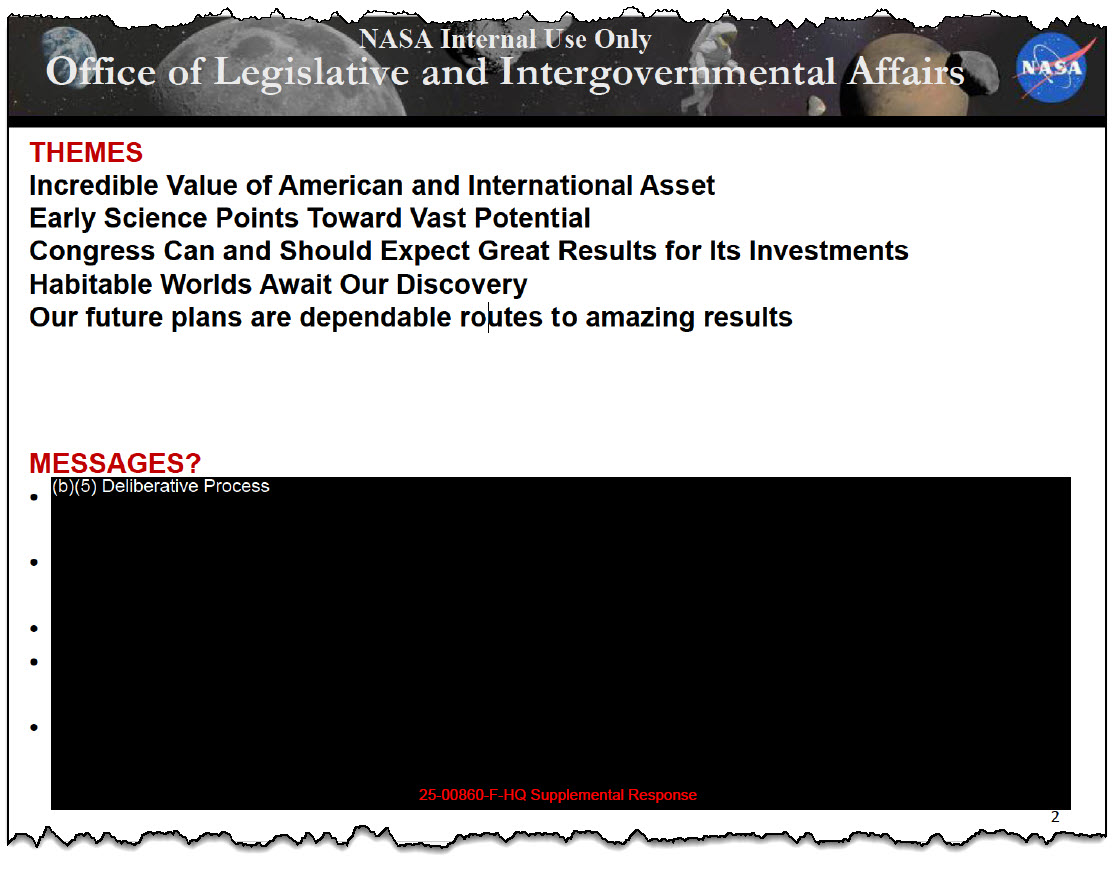
Those themes include:
“Incredible Value of American and International Asset”
“Early Science Points Toward Vast Potential”
“Congress Can and Should Expect Great Results for Its Investments”
“Habitable Worlds Await Our Discovery”
“Our future plans are dependable routes to amazing results”
These statements provide a broad framing of how NASA intended to present JWST’s early scientific achievements and future promise to lawmakers. However, they remain general in nature and do not disclose any specific findings or detailed scientific conclusions.
Continued Reliance on FOIA Exemption (b)(5)
Despite the partial release, the vast majority of the briefing content remains withheld under FOIA Exemption (b)(5). As explained in NASA’s original response letter, this exemption covers “inter-agency or intra-agency memorandums or letters” that would not be available in litigation and includes the deliberative process privilege.
NASA further explained that to qualify under this privilege, records must be both “pre-decisional and deliberative,” meaning they were created prior to an agency decision and reflect internal discussions, recommendations, or evaluations.
In this case, the agency argued that the withheld portions consist of internal preparations for a congressional hearing, including “the development of critical questions, evaluations, and proposals.”
The agency also warned that disclosure could inhibit candid internal discussions, stating that if such communications were released, “NASA and other Executive Branch employees would be much more cautious in their discussions with each other,” potentially impairing decision-making processes.
Redactions Persist in “Questions to Think About”
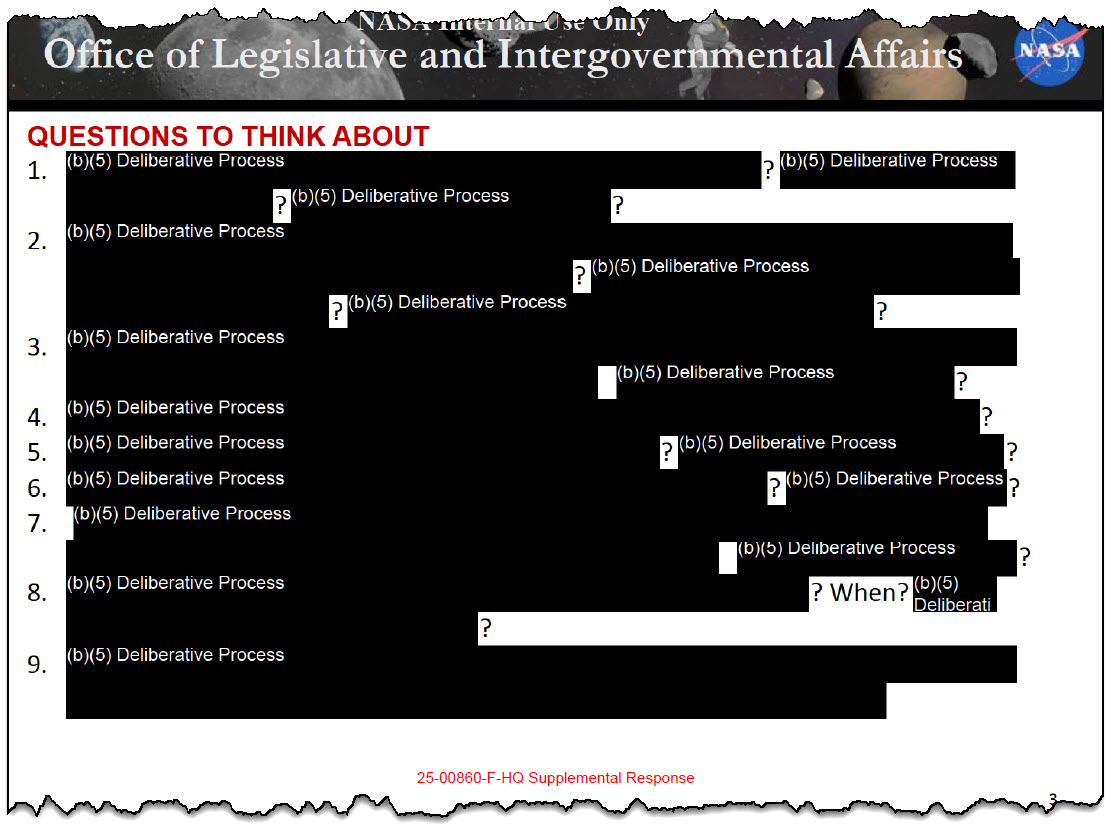
The supplemental release makes clear that while some material was disclosed, most of the document remains unchanged in its level of redaction. Sections titled “Messages?” and multiple pages of “Questions to Think About” continue to be almost entirely blacked out.
Notably, the updated version reveals only minimal fragments within these sections. In several instances, punctuation marks such as question marks are visible, along with a single discernible word: “When?” embedded within an otherwise redacted line.
Context: Public Hearing, Private Preparations
The records at the center of this case were created in preparation for a public congressional hearing held on November 16, 2022, titled “Unfolding the Universe: Initial Science Results from JWST.”
That hearing featured testimony from NASA officials and academic experts and was openly broadcast, with detailed discussions of JWST’s early scientific results. The released slides were prepared internally by NASA’s Office of Legislative and Intergovernmental Affairs ahead of that public session.
The existence of preparatory materials for such hearings formed the basis of the original appeal, which argued that it was “highly improbable that no materials… were generated or retained” in connection with a congressional briefing of that scale.
NASA ultimately agreed that additional records existed, leading to the initial release and now the supplemental disclosure.
Ongoing Questions and Broader Context
The FOIA request itself was prompted by widespread online speculation in 2024 suggesting that NASA may have provided classified briefings to Congress about JWST discoveries, including unverified claims of unusual or unexplained findings. While no evidence has emerged from the released records to support those claims, the persistence of heavy redactions adds only more mystery to the saga.
The newly disclosed “Themes” emphasize optimism about JWST’s capabilities and future discoveries, including references to “Habitable Worlds” and “vast potential.” However, the continued withholding of detailed talking points and internal questions leaves unanswered what specific issues NASA anticipated from lawmakers, or how it internally framed those discussions.
While the appeal succeeded in forcing additional disclosure, the result offers only a narrow glimpse into NASA’s internal preparation process for JWST briefings which leaves the majority of that process, and the questions it may have addressed, still out of public view.
###
Document Archive
 FOIA Case 25-00860-F Supplemental Release Package [7 Pages, 2.9MB]
 Loading...
 Reload document
 Open in new tab


