
Human Subjects Research, commonly abbreviated as HSR, refers to scientific studies that involve data obtained directly from living individuals. Such research can include physical interventions, behavioral testing, biometric data collection, or the analysis of large datasets derived from human activity. Within the Department of Energy, HSR is governed by a framework of ethical, legal, and oversight requirements designed to protect individual rights while allowing research deemed necessary for national security or scientific advancement.
A newly released Department of Energy document sheds fresh light on a subset of this research that remains classified in whole or in part. The release, obtained through a Freedom of Information Act request filed by The Black Vault in March 2019, was not finalized until January 22, 2026, nearly seven years later. The responsive record is a single-page attachment titled “Projects that are Classified HSR, FY 2018 DOE Report,” which was released in full, and expands the public knowledge about HSRs that was first derived from a previously released document to the Federation of American Scientists (FAS) in 2017.
Why These Lists Exist
The requirement to compile and publish lists of classified HSR projects stems from DOE Notice 443.1, issued as part of broader reforms following revelations in the 1990s about Cold War-era human radiation experiments. Those experiments, some conducted without informed consent, prompted public outrage, congressional scrutiny, and the establishment of a presidential advisory committee to examine the government’s historical record.
In response, the Department of Energy formalized stricter oversight of human subjects research, including classified work. DOE Notice 443.1 requires that classified HSR projects be tracked and reported, even if substantive details remain protected. The intent is to ensure accountability, ethical review, and senior-level awareness of research involving human participants.
DOE Notice 443.1 was later superseded by DOE Order 443.1C, which remains in force today and preserves the requirement to track and oversee classified human subjects research. Those protections were further reinforced in 2020 when DOE codified its human subjects framework in federal regulation under 10 C.F.R. Part 745.
The Earlier Public Disclosure
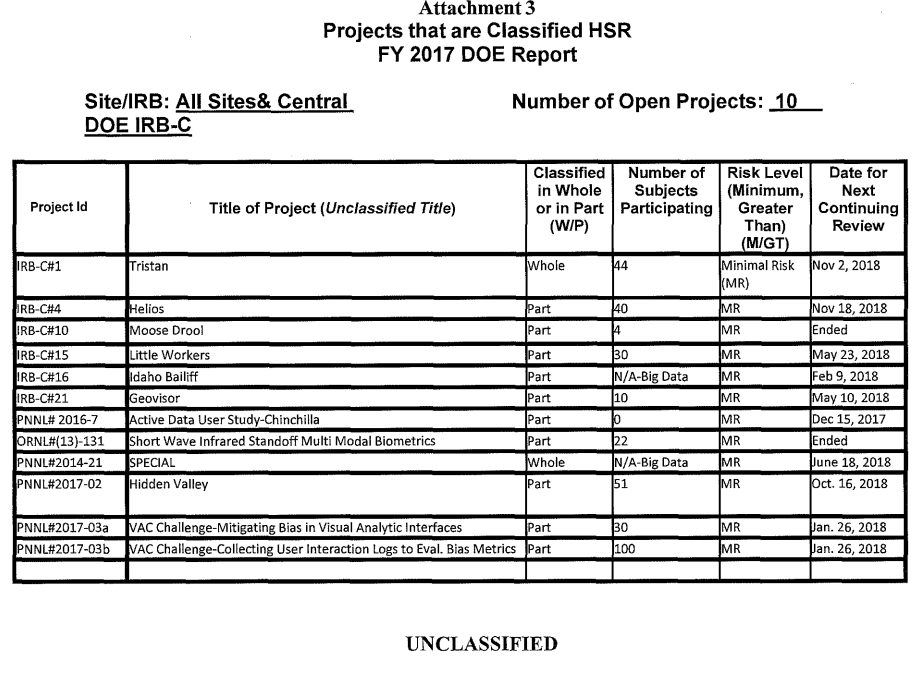
In August 2018, the Federation of American Scientists published an article titled “Classified Human Subjects Research Continues at DOE,” written by Steven Aftergood. That reporting was based on a DOE FOIA release covering FY 2017 and revealed ten classified HSR projects with opaque code names such as “Tristan,” “Idaho Bailiff,” and “Moose Drool.”
The FY 2017 list, released under FOIA case HQ-2018-00158-F, showed that classified human subjects research was ongoing and formally acknowledged within DOE oversight channels. At the time, it offered one of the rare public glimpses into this tightly controlled area of research.
The New FOIA Release: FY 2018
The newly released document obtained by The Black Vault represents the subsequent fiscal year: FY 2018. According to the DOE’s final response letter, the request sought “the most recent list, as issued under DOE Notice 443.1, of the list of Human Subjects Research (HSR) projects that are classified in whole or in part.” The search was conducted by both the Office of Intelligence and Counterintelligence and the Office of Science.
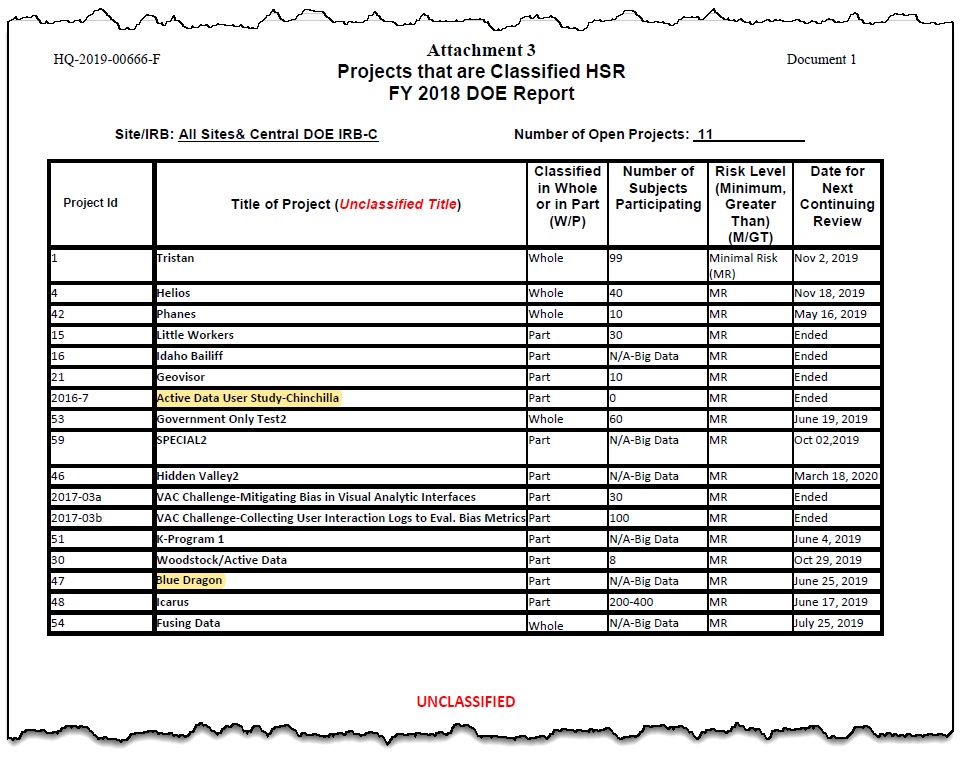
The FY 2018 list shows that the number of classified HSR projects increased from ten in FY 2017 to eleven open projects in FY 2018. Several projects carried over from the earlier list, while new entries appeared.
Projects listed as classified in whole during FY 2018 include:
- Tristan (99 participants)
- Helios (40 participants)
- Phanes (10 participants)
- Government Only Test2 (60 participants)
- Fusing Data (Big Data project)
Projects classified in part include titles such as Little Workers, Idaho Bailiff, Geovisor, SPECIAL2, Hidden Valley2, K-Program 1, Woodstock/Active Data, Blue Dragon, and Icarus, some involving large-scale or undefined “Big Data” participation counts.
Notably, several projects such as Tristan, Helios, Little Workers, Idaho Bailiff, Geovisor, and the VAC Challenge studies, appear on both the FY 2017 and FY 2018 lists, indicating continuing efforts rather than one-off, short-term, program studies.
What Is Known—and What Is Not
DOE maintains a publicly accessible Human Subjects Research Database that catalogs unclassified HSR projects conducted or funded by the department. That database provides project summaries, oversight information, and institutional review board status for unclassified research.
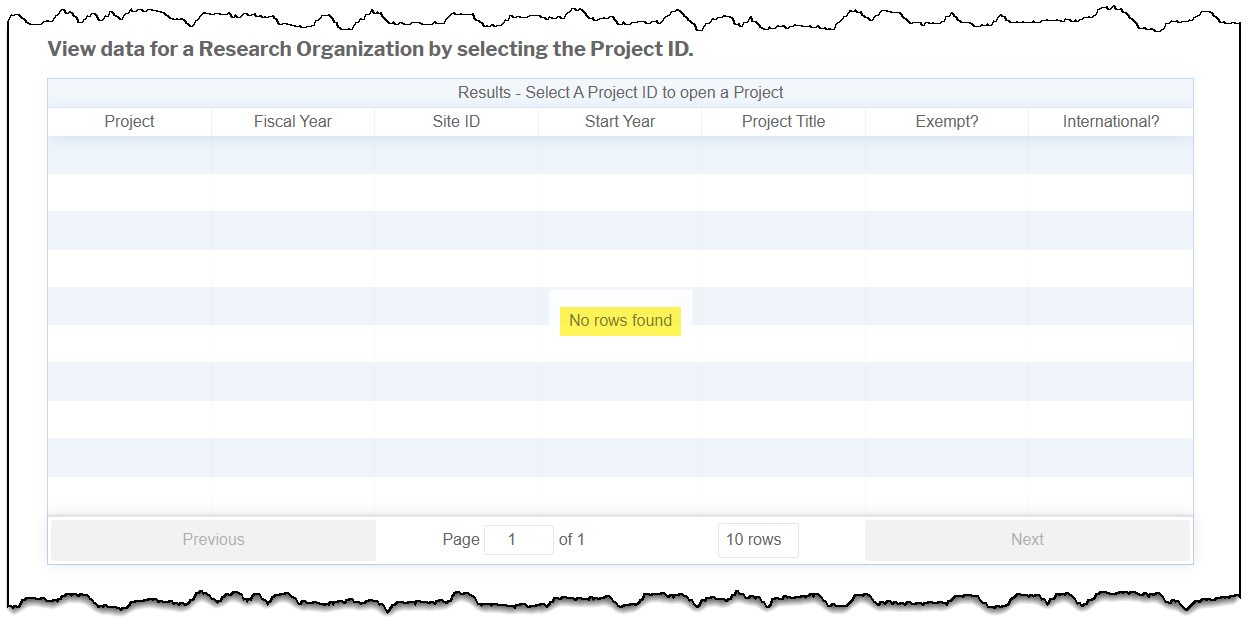
However, searches of that database do not reveal entries matching the code names listed in the classified HSR tables. While this is expected for projects classified in whole, it is notable that even the unclassified titles provided in the classified reports do not appear elsewhere in DOE’s public-facing research records.
As a result, the public is left with only high-level descriptors: project titles, participant counts, risk levels (all listed as “Minimal Risk”), and review dates. No descriptions of methodologies, objectives, or sponsoring programs are included.
While the newly released list does not provide operational details, it serves as a marker that classified research involving human participants persists within the Department of Energy. The repetition and growth of project names across fiscal years suggest structured, ongoing programs rather than isolated experiments.
For now, these lists remain one of the few official acknowledgments of the classified nature to some of these programs available to the public.
The Black Vault, as of today, filed a new request for the most recent list created by the subsequent directives mentioned earlier. Those records, when available, will be posted on The Black Vault.
###
Document Archive
 FOIA Case HQ-2019-00666 [3 Pages, 0.7MB]
 Loading...
 Reload document
 Open in new tab
 Follow The Black Vault on Social Media:


