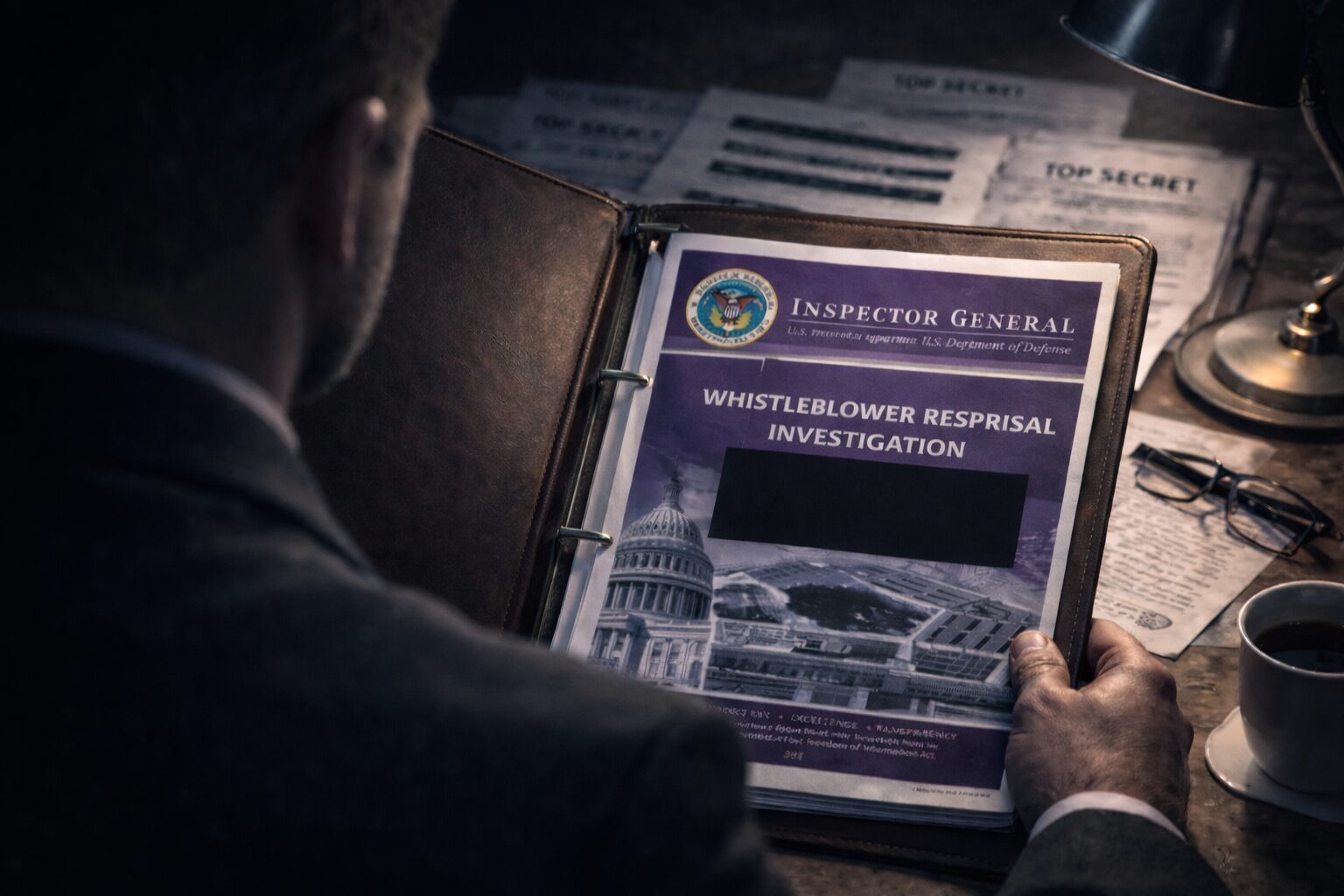

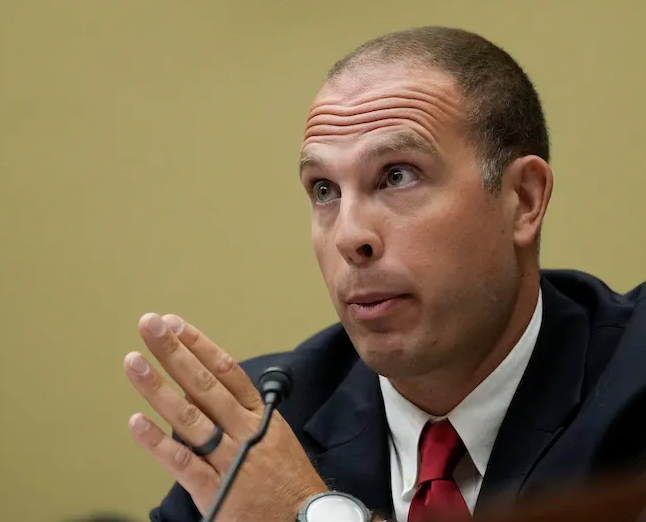
A heavily redacted Department of Defense Office of Inspector General (DoD OIG) release made public on January 7, 2026, reveals a UAP-related whistleblower reprisal investigation centered on the revocation of classified access that was closed in February 2025. The records do not identify the complainant by name, but the chronology and subject matter overlap with publicly documented whistleblower filings that have been associated with former intelligence official David Grusch. The documents do not confirm that connection, but with the dates and information publicly available, the connection seems highly likely.
(Note: Grusch has repeatedly ignored past attempts by The Black Vault to contact him both via his attorney and close associates, so no additional attempts were made for this story. He is always welcome to contact The Black Vault to respond to a number of open questions.)
This document release was in response to a Freedom of Information Act request filed by The Black Vault in April 2025 seeking DoD/IG complaints and reprisal investigations involving whistleblowers who reported UAP-related programs or technologies.
 What the DoD IG Investigated
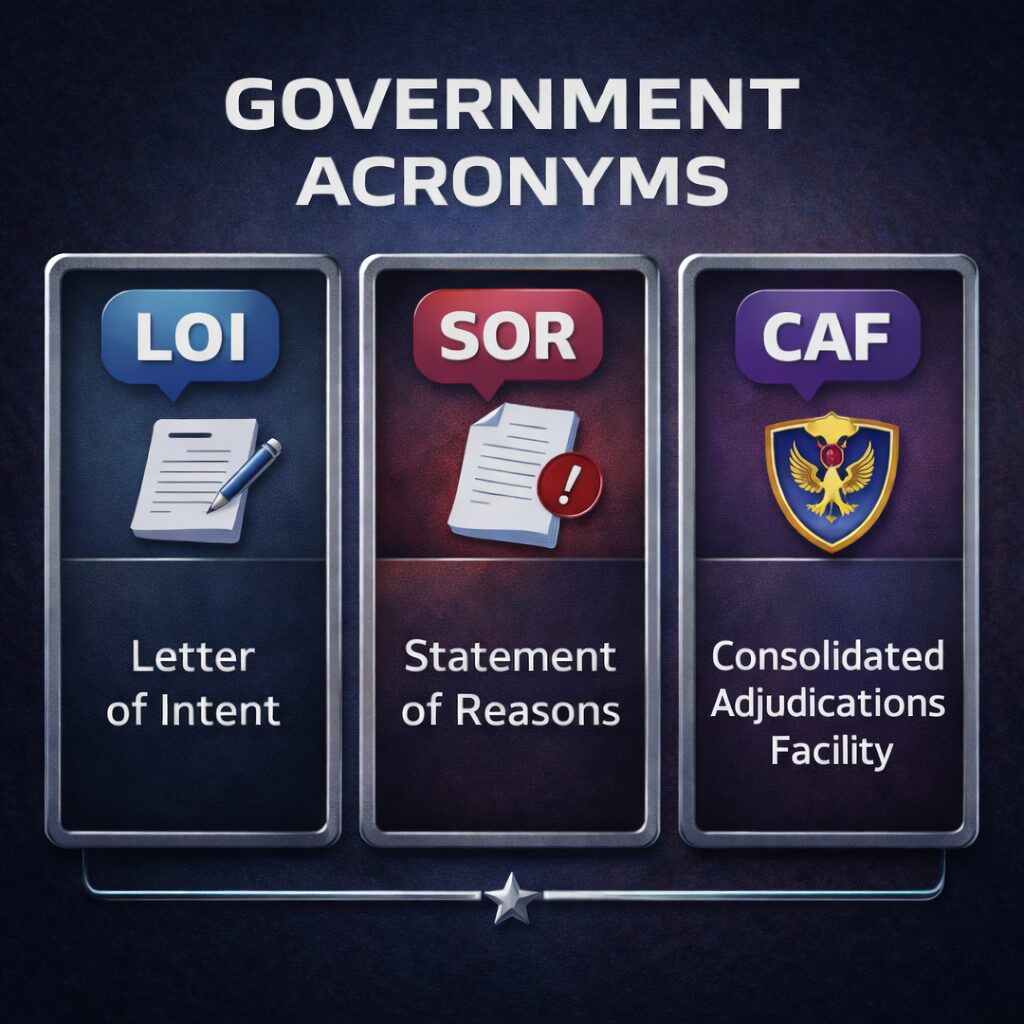
The DoD OIG report describes a reprisal complaint alleging that officials revoked the complainant’s eligibility for access to classified information and refused access to compartmented programs because of UAP-related reporting to the Inspector General.
The Executive Summary states:
“We conducted this investigation in response to a reprisal complaint alleging that officials at the [REDACTED] revoked [REDACTED] (the Complainant) eligibility for access to classified information and refused to grant him access to [REDACTED] compartmented programs. The complaint alleged that this was done in reprisal for reporting Unidentified Anomalous Phenomena (UAP)-related matters to the DoD Office of Inspector General (DoD OIG).”
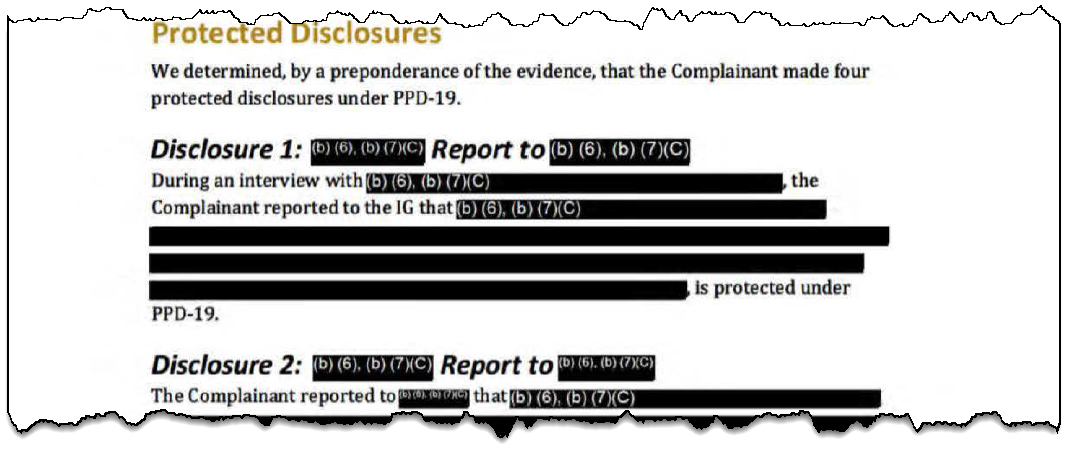
The DoD OIG found the complainant “made four protected disclosures,” including one “to the DoD OIG,” with additional recipients redacted.
The Adverse Actions at the Center of the Complaint
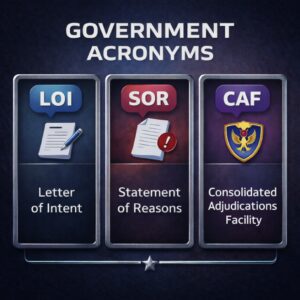
The released report ties the reprisal allegation to specific clearance-related actions handled through the Consolidated Adjudications Facility (CAF), including the initial proposal to revoke access and the final revocation.
The report documents an August 29, 2022, notice:
“On August 29, 2022, the [REDACTED] CAF provided the Complainant an LOI and an SOR notifying him that it intended to revoke his eligibility for access to classified information… The notice also removed the Complainant’s access to classified systems and facilities and required him to relinquish his access badges and be placed on paid administrative leave pending the adjudication process.”
It further records the final revocation:
“On December 12, 2022, [REDACTED] signed the final letter of revocation, and on December 13, 2022, emailed the letter to the Complainant notifying him that the CAF revoked his eligibility for access to classified information.”
While the report confirms the existence of UAP-related protected disclosures, the substance of those disclosures is largely obscured by redactions.
The Bottom Line: “Not a Contributing Factor” and “No Recommendations”
The DoD OIG concluded that the protected disclosures were not a contributing factor to the initial intent to revoke and that the final decision would have been the same even if the disclosures had not occurred.
The report states:
“Therefore, we concluded that the Complainant’s protected disclosures were not a contributing factor in the CAF’s initial intent to revoke the Complainant’s eligibility for access to classified information.”
It adds that even after CAF personnel later learned the complainant was claiming whistleblower status, the outcome would not have changed:
“However, clear and convincing evidence established that [REDACTED] would have taken the same action absent the Complainant’s protected disclosures.”
What the Inspector General found was a contributing factor were substantiated findings of misconduct, which the report describes as independent of any whistleblower activity and sufficient, on their own, to justify adverse action. After those findings were developed, the investigation states that CAF was formally notified and conducted its own assessment. According to the report, “on receiving [REDACTED] findings, [REDACTED] reviewed the derogatory information, as well as the Complainant’s history, and felt a revocation was warranted in accordance with DoDM 5200.02.” The report further explains that this determination “was based on a pattern of misconduct,” and referencing a “pattern of behavior issues” underscoring that the decision was not tied to a single event or disclosure, but to cumulative conduct evaluated under established adjudicative standards.
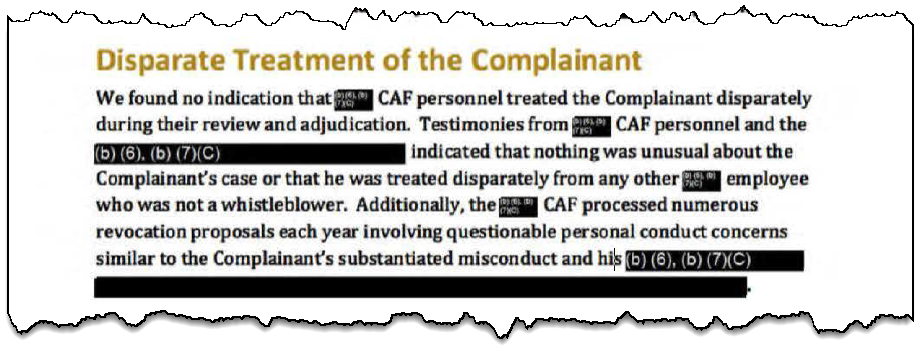
The Inspector General also addressed whether the complainant was treated differently because of his whistleblower status and found no evidence to support that claim. In a section titled Disparate Treatment of the Complainant, the report states plainly, “We found no indication that [REDACTED] CAF personnel treated the Complainant disparately during their review and adjudication.” Testimony from CAF personnel and a review of comparable cases, the report continues, “indicated that nothing was unusual about the Complainant’s case or that he was treated disparately from any other [REDACTED] employee who was not a whistleblower.”
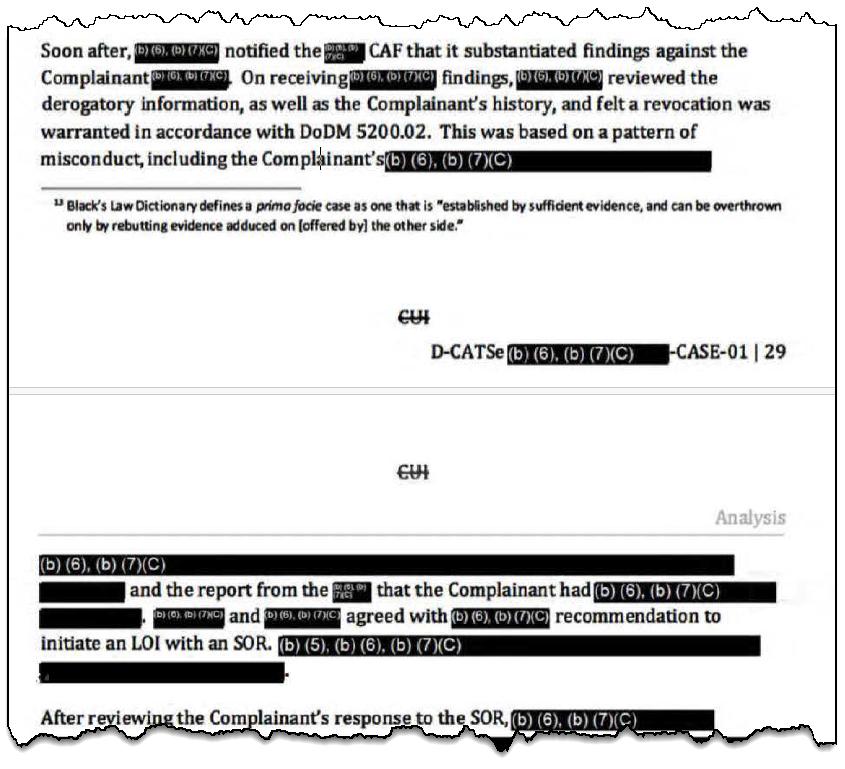
The investigation adds that “On receiving [REDACTED] findings, [REDACTED] reviewed the derogatory information, as well as the Complainants history, and felt a revocation was warranted in accordance with DoDM 5200.02.” It goes on to state that, “This was based on a pattern of misconduct, including the Complainants [REDACTED].”
While much of the underlying conduct and history remains obscured by redactions, the report repeatedly signals that additional, sensitive factors informed the outcome. Large portions of the analysis referring to the complainant’s conduct and history are withheld under privacy and national security exemptions, indicating that information materially relevant to the adjudication could not be publicly released without identifying the individual. Based on the totality of the evidence reviewed, including those redacted elements, the Inspector General concluded the disclosures themselves did not drive the decision, and the complaint was ultimately not substantiated.
Internal Messages Show Confusion Over the Whistleblower Claim and Optics Concerns
One of the more revealing windows into the case appears in redacted internal messages summarized in the findings. Those communications show CAF personnel questioning what, exactly, constituted whistleblowing in the first place, suggesting a disconnect between the clearance adjudication process and the reprisal allegation being asserted.
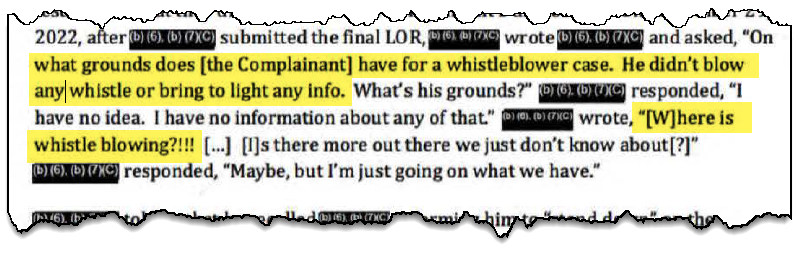
The report recounts an exchange dated September 29, 2022, including the following:
“On what grounds does [the Complainant]have for a whistleblower case. He didn’t blow any whistle or bring to light any info. What’s his grounds?”
 A reply followed:
“I have no idea I have no information about any of that.”
Then came the line that underscores the uncertainty:
“[W]here is whistle blowing?!!! … [I]s there more out there we just don’t know about[?]”
Later communications reflect hesitation about timing and “optics,” including instructions to delay sending the revocation letter:
“[W]e haven’t gotten the OK … to do that[.] … [H]e’s claiming whistleblower status … and [REDACTED] doesn’t want the optics to be terrible[.]”
The report also notes a “stand down” directive tied to concerns about how the action could be perceived.
Those passages do not change the DoD OIG’s final conclusion, but they do document uncertainty and communication gaps inside the process at the time key steps were unfolding.
Return to Work and Restoration of Clearance
While the DoD Inspector General ultimately rejected the reprisal allegation, the report documents that the complainant’s security clearance was later restored through a formal appeals process and that he returned to work. According to the findings, after CAF revoked the complainant’s eligibility for access to classified information, he appealed the decision to the Personnel Security Appeals Board (PSAB). The report states: “On January 9, 2023, after the CAF revoked his clearance, the Complainant appeared before a Personnel Security Appeals Board (PSAB) and presented his appeal to the revocation.” The following day, the outcome changed. As the report records, “the PSAB overturned the original determination to revoke his eligibility for access to SCI, and that his TS/SCI was reinstated this date.”
The investigation further explains that the board’s decision was based on mitigation presented by the complainant rather than any whistleblower considerations. According to the report, during the PSAB hearing the complainant “provided compelling information on each of the other factors outlined in the SOR, which the board felt mitigated the security concerns.” As a result, “the board… voted unanimously to restore the Complainant’s security clearance.” The report also notes that appeals boards overturn revocations with some regularity, with one official estimating that reversals occur “one third of the time,” and stating that there was “nothing unusual about the Complainant’s case.”
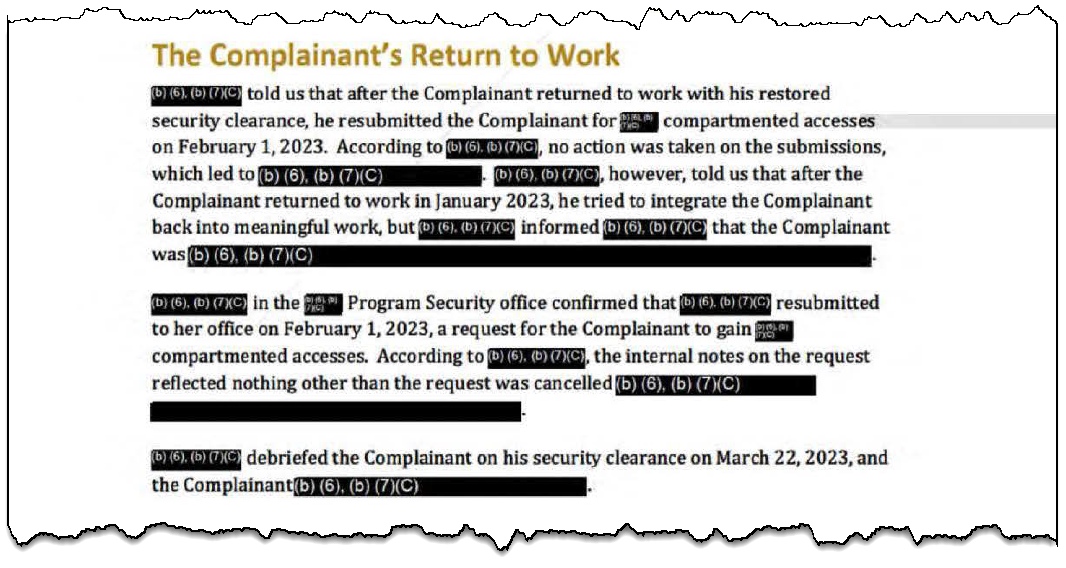
Following the restoration of his clearance, the report documents the complainant’s return to duty. Under a section titled The Complainant’s Return to Work, investigators write that “after the Complainant returned to work with his restored security clearance,” officials resubmitted him for compartmented accesses in February 2023. The report states that while those submissions did not result in immediate access, supervisors attempted to reintegrate him into his position. One official told investigators that after the complainant returned to work in January 2023, he “tried to integrate the Complainant back into meaningful work.” The report also notes that the complainant was later formally debriefed on his security clearance status on March 22, 2023.
Taken together, the DoD OIG record shows that although the reprisal complaint was not substantiated and the clearance revocation was deemed justified at the time, the complainant ultimately regained his clearance through the established appeals process and returned to work. The report treats these events as procedurally separate from the whistleblower reprisal analysis, reinforcing the Inspector General’s conclusion that the protected disclosures themselves were not the driving factor behind the original adverse action.
Heavy Redactions and What the FOIA Exemptions Mean
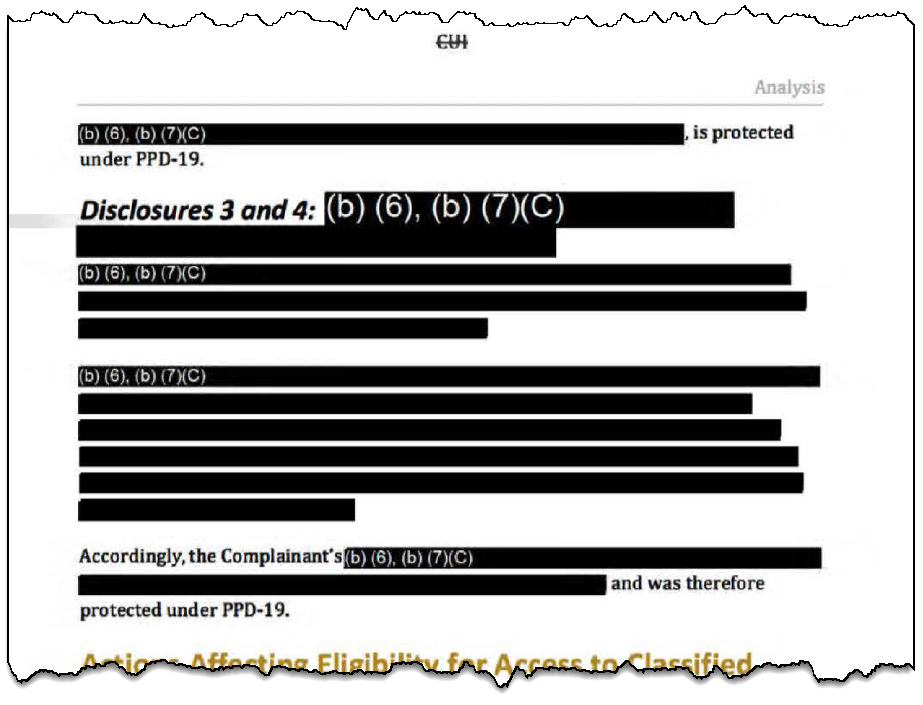 The DoD OIG letter accompanying the release states that “an additional 44 pages are exempt from release in their entirety” and that the withheld material was determined in coordination with the Office of the Director of National Intelligence (ODNI).
Among the exemptions cited:
The DoD OIG invoked FOIA Exemption (b)(3) for information “exempted from release by statute,” citing 50 U.S.C. § 3024(i)(1) for intelligence “sources and methods,” 50 U.S.C. § 3024(m) for ODNI personnel identifying information, and 5 U.S.C. § 407 for “the confidentiality of employee complaints to the Inspector General.”
The release also relied on (b)(5) for deliberative process material, (b)(6) and (b)(7)(C) for personal privacy, (b)(7)(D) for confidential sources, and (b)(7)(E) for sensitive law enforcement information that could risk circumvention of the law.
The combined effect of these exemptions is substantial: identities, offices, and much of the UAP-related content are removed, limiting independent verification of the complainant’s narrative beyond the broad framework described by the DoD OIG.
The Grusch Question: What Can Be Proven From Public Sources and This Report
 The released DoD OIG report confirms a UAP-related reprisal allegation tied to clearance access, investigated under a whistleblower reprisal framework, involving protected disclosures to the DoD OIG and subsequent adverse security clearance actions in 2022.
Public records and reporting associated with David Grusch describe a notably similar structure, but the available evidence does not conclusively establish that this DoD OIG case is his, mainly due to the name being redacted.
Despite that, there is supporting evidence suggesting this case directly relates to Grusch.
An unclassified procedural filing to the Intelligence Community Inspector General associated with Grusch is dated May 25, 2022, and reflects a “DISCLOSURE OF URGENT CONCERN(S); COMPLAINT OF REPRISAL,” signed under penalty of perjury by “DAVID C. GRUSCH.”
The same filing states that Grusch “confidentially provided UAP-related classified information to the Department of Defense Inspector General (DoD IG)” and describes alleged retaliation and “numerous adverse security clearance actions” after those protected disclosures.
A 2023 report by The Debrief stated the Intelligence Community Inspector General found Grusch’s complaint “credible and urgent” in July 2022.
In sworn congressional context, a hearing document published on Congress.gov reflects Grusch describing reprisals and reporting the matter to an inspector general before filing a whistleblower complaint. Congress.gov
The Black Vault has also previously documented the May 25, 2022, date of the procedural filing and its general allegation of “adverse security clearance actions.”
The FOIA request that this case tied to, as filed by The Black Vault, did not specifically ask for, nor even mention, Grusch in any way. The exact wording of the request was:
“I respectfully request a copy of the following records: all Inspector General complaints, reprisal investigations, threat assessments, or disciplinary communications created from January 1, 2021, to present referencing whistleblowers within the Department of Defense or Intelligence Community who reported UAP-related programs or technologies. This includes, but is not limited to, complaints referencing retaliation for disclosures made to Congress or the media.”
In the responsive records, only one case came up, which indicates given the timeline above, this is most likely Grusch’s case he has made reference to in the past.
But beyond all that, what is arguably the most convincing evidence, though still not definitive proof, is the comparison of the redacted report just released by the DoD OIG, and the previously released, unclassified and un-redacted, “Disclosure of Urgent Concern(s) Complaint of Reprisal” submitted to the Intelligence Community Inspector General. The signature block comparison is below, which indicates it was likely the same law firm that drafted both documents, with a similar signature block structure, length, phrasing choices, and use of fonts.
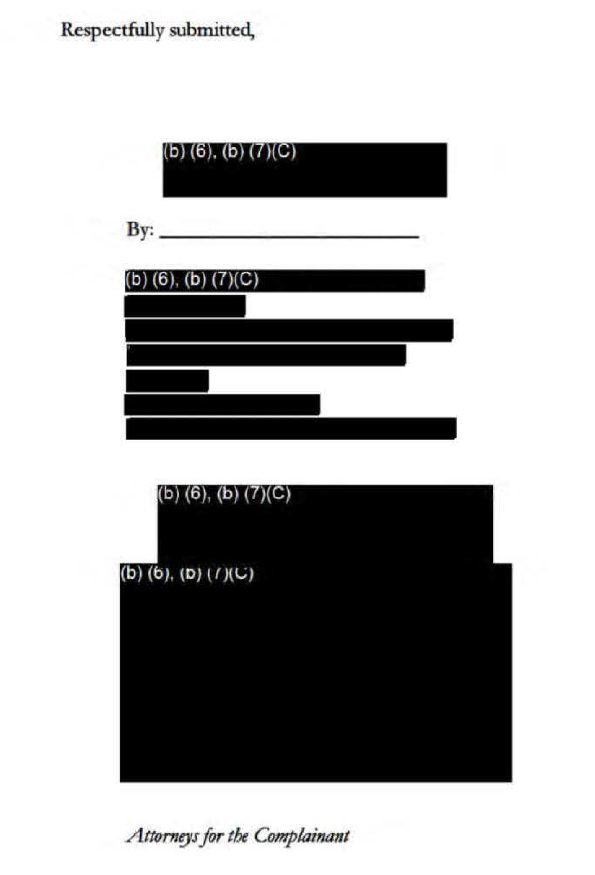
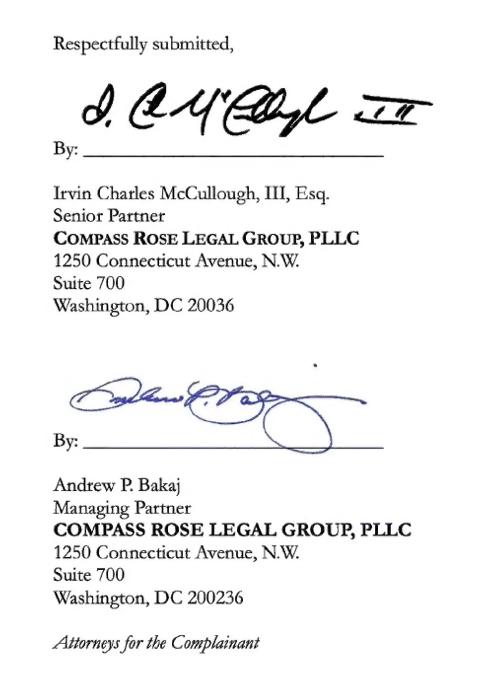
The released DoD OIG records strongly indicate a UAP-related whistleblower reprisal dispute involving clearance access and protected disclosures. The public timeline and subject matter overlap with publicly available filings and testimony associated with David Grusch. However, the documents released by DoD OIG do not provide enough verifiable information to prove the complainant is Grusch, and the identity cannot be confirmed from this release alone.
Why This Release Still Matters
Even with heavy redactions, the report provides a rare, document-based look at how a UAP-related reprisal allegation moved through an internal national security adjudication and investigative pipeline. It also documents internal confusion about the whistleblower allegation and explicit concern about “optics” while clearance actions were pending.
The DoD OIG’s final position is unambiguous: the complaint was not sustained, and the clearance revocation would have occurred regardless of the protected disclosures.
###
Document Archive
 FOIA Case DODOIG-2025-000932 [66 Pages, 8MB]
 Loading...
 Reload document
 Open in new tab
 Follow The Black Vault on Social Media:


