
 Newly released records obtained through the Freedom of Information Act show which journalists were privately invited to an embargoed, invite-only Pentagon media roundtable on Unidentified Anomalous Phenomena (UAP) held on March 6, 2024. This event tied to the Department of Defense’s first volume of the congressionally mandated Historical Record Report on U.S. government UAP programs.
The responsive document, released under FOIA case number 24-F-0895, consists of the email invitation sent by Pentagon spokesperson Susan Gough to a limited list of media recipients, outlining the terms, restrictions, and conditions for participation in the briefing with Acting All-domain Anomaly Resolution Office (AARO) Director Tim Phillips.
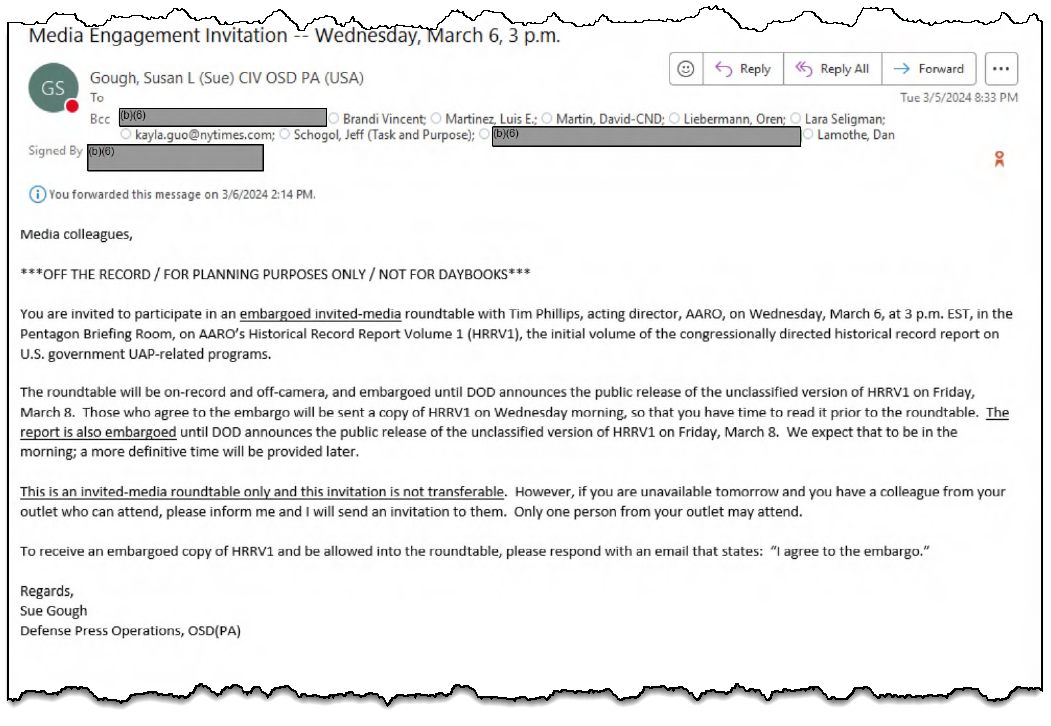
According to the invitation email, the briefing was described as an “embargoed invited-media roundtable” focused on “AARO’s Historical Record Report Volume 1 (HRRV1), the initial volume of the congressionally directed historical record report on U.S. government UAP-related programs”.
The report itself was required by Congress in the Fiscal Year 2023 National Defense Authorization Act (NDAA), which directed the Department of Defense and the Office of the Director of National Intelligence to produce a comprehensive historical review of U.S. government involvement with unidentified anomalous phenomena dating back decades. The March 6, 2024, briefing was held two days before the public release of the unclassified version of the report.
The invitation imposed strict conditions. It was marked:
“OFF THE RECORD / FOR PLANNING PURPOSES ONLY / NOT FOR DAYBOOKS”
While the roundtable itself was described as “on-record and off-camera,” participation was contingent upon agreeing to an embargo until the Department of Defense announced the public release of the report on March 8. Invitees were instructed:
“To receive an embargoed copy of HRRV1 and be allowed into the roundtable, please respond with an email that states: ‘I agree to the embargo.’”
Only one representative per outlet was permitted to attend, and the invitation was explicitly “not transferable” without prior approval from the Pentagon press office.
Who Was Invited and Who Was Not
The FOIA-released email reveals by name a small group of journalists and outlets that were granted access. Among those listed in the invitation or BCC fields were representatives from The New York Times, CNN, Politico, Task & Purpose, and The Washington Post, including Kayla Guo, Jeff Schogol, David Martin, Oren Liebermann, Lara Seligman, and Dan Lamothe.
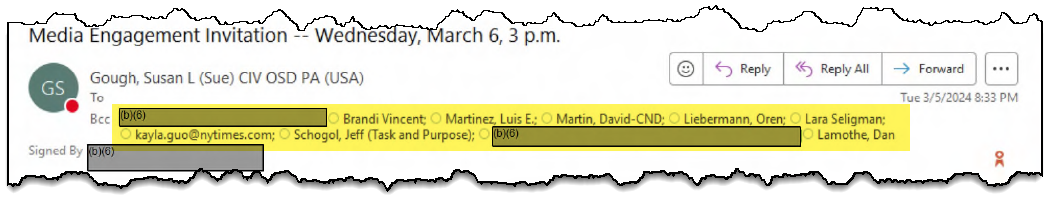
Several of these names were already known publicly due to their participation in the briefing itself. In March 2024, The Black Vault published the full transcript of the roundtable, in which some reporters identified themselves by name and outlet when asking questions. That transcript provided partial insight into who had access, but not a complete accounting of all invitees.
The newly released invitation fills in additional details, but also raises new questions.
At least two individuals listed in the BCC field of the email were redacted by the Department of Defense under FOIA Exemption (b)(6), which protects against what the agency described as “a clearly unwarranted invasion of the personal privacy of individuals”.
The redactions obscure whether those recipients were additional journalists, staff members from major outlets, or other media-affiliated personnel who were included quietly on the distribution list. The possibility that these names were possibly other military or government personnel rather than media invitees also can’t be ruled out.
The presence of redacted BCC recipients underscores that the publicly known list of participants, which was from the derived previously from the transcript, was incomplete. It remains unknown which outlets, if any, were represented by those redacted names, or whether additional media voices were given access without being publicly identifiable.
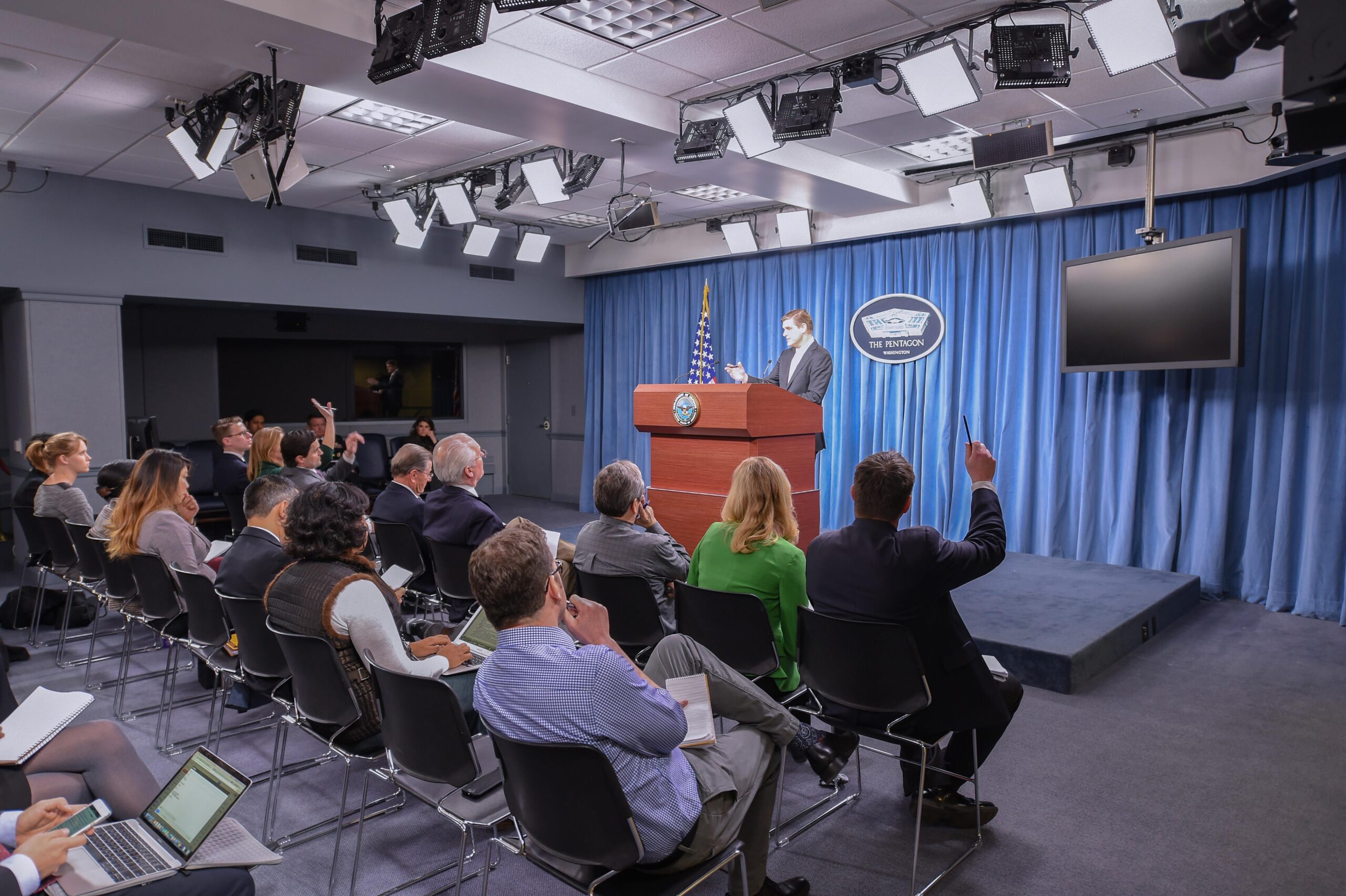 Unlike more typical Pentagon press engagements, which often allow larger pools of credentialed media to listen in remotely or submit written questions, this roundtable was tightly controlled. Attendance was limited, listening access was restricted, and participation was conditional on advance agreement to an embargo.
The email emphasized that the event was “an invited-media roundtable only,” reinforcing that access was selectively granted rather than broadly available.
This stands in contrast to many background or senior-level briefings, where dozens of outlets may be allowed to listen in even if only a subset are called upon to ask questions. In this case, even passive access was limited to those specifically chosen by the Department of Defense.
Transparency Concerns Around UAP Disclosure
The subject of the briefing, which highlighted the government’s historical accounting of UAP programs, has been the focus of sustained public, congressional, and media interest. The NDAA mandate reflected bipartisan concern over secrecy, oversight gaps, and inconsistent public disclosures related to unidentified objects and alleged legacy programs.
Against that backdrop, the decision to brief only a small group of journalists, under embargo, before public release has drawn scrutiny. While embargoed briefings are a common practice across government agencies, the narrow scope of this invitation, combined with the classified history and ongoing public debate surrounding UAP transparency, has amplified questions about information control and selective access.
The FOIA response letter confirms that the Office of the Assistant to the Secretary of Defense for Public Affairs located only this single responsive document, and that no additional invitation records were released beyond the email itself.
Taken together with the previously published transcript, the FOIA-released invitation provides a clearer, albeit still incomplete, picture of how the Department of Defense managed media access to the release of Volume 1 of their UAP report.
It confirms that only a handful of outlets were selected, that participation required adherence to strict conditions, and that at least some invitees remain unidentified due to privacy redactions. As debates over UAP transparency continue, the records illustrate how access to information about the government’s historical review was carefully controlled even as the report itself was framed as a step toward openness.
The documents released in FOIA case 24-F-0895 are now part of the public record, offering a rare look behind the scenes at how the Pentagon curated press engagement on a topic Congress has explicitly directed it to clarify for the American public.
###
Document Archive
 24-F-0895 Release Package [3 Pages, 0.5MB]
 Loading...
 Reload document
 Open in new tab


