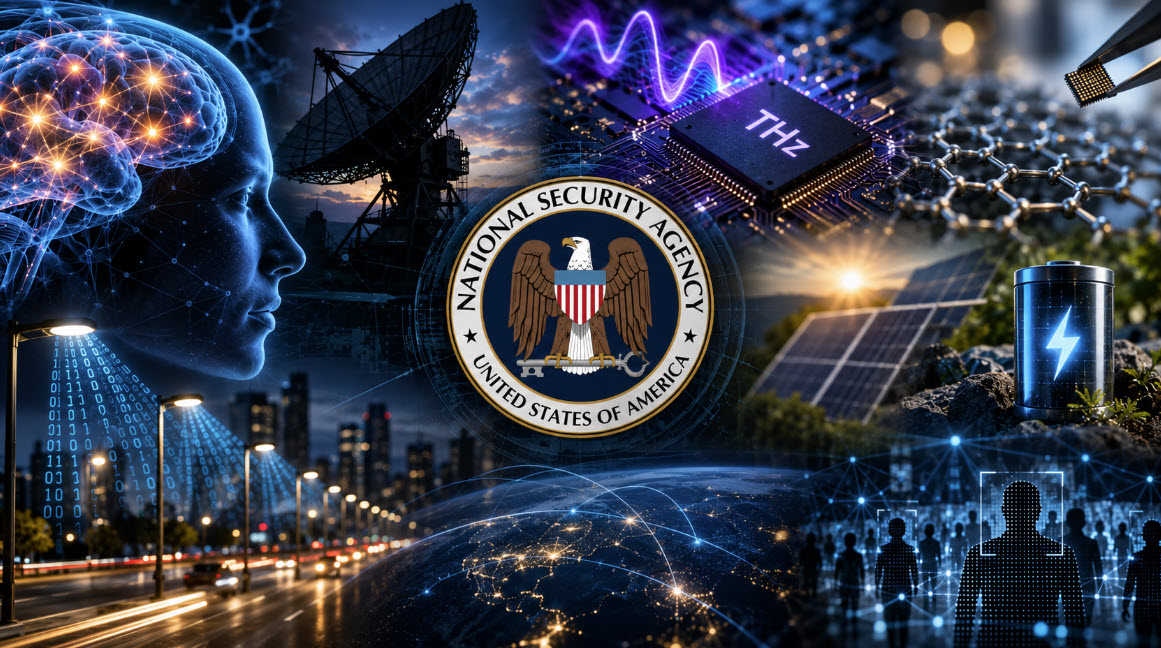


A collection of eight National Security Agency technology forecasting studies, spanning topics from privacy and anonymity to brain-network interfaces, advanced antennas and terahertz electronics, has been released through the Freedom of Information Act after a request that dated back to May 25, 2011.
The original FOIA request sought ten documents described as “Point Forecasts issued by the Futures Intelligence Team.” The requested studies covered solid-state lighting for wireless communications, human interaction with computer networks, antenna technology, energy storage and ultrathin electronics, post-Moore’s Law materials, terahertz microelectronics, harvested power, bio-inspired computing, privacy and anonymity, and position-location technologies.
The documents requested sought the following titles:
- Using Solid-State Lighting for Wireless Communications
- The Human Side of the Net
- Antenna Technologies
- Point Forecast for Small Energy Storage and Ultrathin Electronics
- What’s Beyond Moore’s Law
- Terahertz Solid-State Microelectronics
- Harvested Power and the Need
- Bio-Inspired Computing
- Privacy and Anonymity
- Position Location
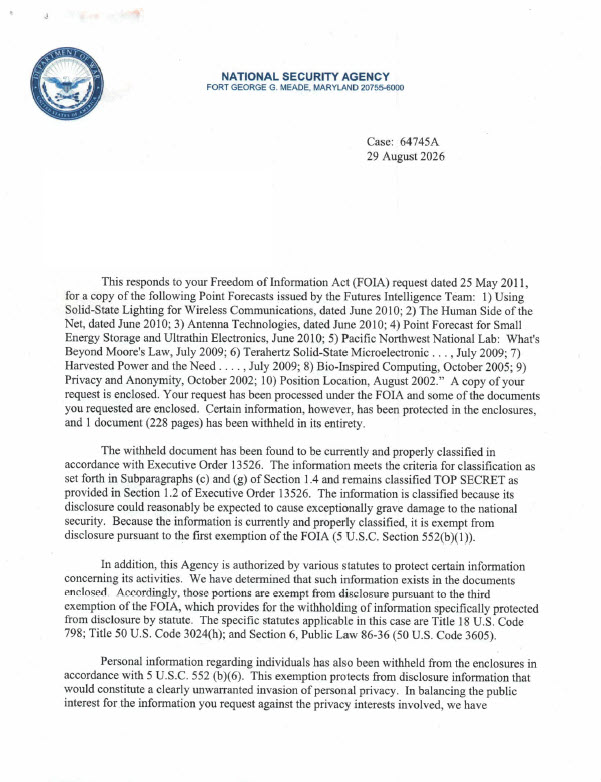 NSA’s response, dated August 29, 2026, came more than 15 years after the request was filed. The agency stated that some of the requested documents were enclosed, with information withheld from portions of the records, and that one document totaling 228 pages was withheld in its entirety. NSA did not identify that fully withheld document by title in its response.
NSA said the 228-page document remained “currently and properly classified” under Executive Order 13526 and invoked FOIA Exemption 1. The agency also cited Exemption 3 for information protected under federal statutes, specifically Title 18 U.S.C. §798, Title 50 U.S.C. §3024(i), and Section 6 of Public Law 86-36. Personal information was withheld under Exemption 6. NSA additionally stated that the Department of Energy requested protection of certain information under Exemptions 6 and 7, with those redactions marked “OGA,” for Other Government Agency.
The eight released studies now archived by The Black Vault correspond to eight of the ten titles listed in the 2011 request.
A Window Into NSA Technology Forecasting
Although the subjects vary considerably, the documents belong together for a specific reason: they were produced as forward-looking assessments intended to examine technologies that could affect national-security missions.
One of the earliest records in the collection, the 2002 Privacy and Anonymity study, provides unusually direct context for that effort. Its preface states that NSA’s Technology Forecasting Program was established to “anticipate the impact of advancing technologies on NSA’s mission.” It describes a process under which analysts examined emerging technologies, market trends and research activity to identify technologies that could affect future operations.
Later reports show national laboratories playing a significant role in that process. Several were produced by Sandia National Laboratories for NSA’s Research Transformation activities, while others were prepared by Pacific Northwest National Laboratory. The documents often combine scientific literature reviews, technology assessments, commercial-market analysis, international research comparisons and forecasts of capabilities several years into the future.
What emerges is not a single research program devoted to one technology. Instead, the papers provide snapshots of what government technology analysts considered potentially consequential at different points between 2002 and 2010: how humans might interact directly with networks, how tiny autonomous devices could power themselves, whether visible light could carry wireless data, what might replace traditional semiconductor scaling, how terahertz systems could be miniaturized, and how advances in antennas could reshape sensing and communications.
Below are the eight released records.
The Released Documents
 Privacy and Anonymity: A Technology Forecast [44 Pages, 11.671MB]
Dated October 29, 2002, Privacy and Anonymity examines the collision between technological development, electronic surveillance, information security and individual privacy. The study was prepared by NSA’s Information Assurance Research Group and places the issue squarely in the post-September 11 environment. Its executive summary discusses competing pressures: government efforts to improve security and surveillance capabilities, commercial collection of personal information, and public concern over privacy protections.
The report surveys anonymity technologies, public-key infrastructure, SSL, virtual private networks, wireless security, biometrics, intrusion-detection systems and emerging privacy standards. It also discusses U.S. and international privacy law and the relationship between stronger security technologies and potential loss of anonymity. The paper does not treat privacy solely as a legal issue; rather, it assesses how technical systems themselves can either preserve anonymity or make individuals increasingly identifiable. Its age makes it particularly notable because many of the tensions it describes — identity, tracking, network security and the collection of personal data — became substantially larger issues in subsequent decades.
What’s Beyond Moore’s Law: Emerging Research Materials [91 Pages, 26.229MB]
This May 2009 Pacific Northwest National Laboratory study examines what could happen as conventional semiconductor scaling approaches physical and economic limits. The report frames its central question around the continuing viability of Moore’s Law and evaluates candidate technologies and materials that might sustain increasing computing performance when simply shrinking silicon transistors becomes more difficult.
Among the subjects are advanced lithography, carbon nanotubes, graphene, molecular electronics, self-assembly, metamaterials and other nanoscale approaches. The study separates its forecast into near-, mid- and longer-term horizons and explicitly warns that replacing silicon would not be simple. Its conclusion identifies carbon-based nanoelectronics as one possible route while emphasizing that silicon had accumulated enormous manufacturing, engineering and economic advantages. The report therefore functions less as a prediction that one particular material would replace silicon than as an assessment of the competing research paths being explored as traditional scaling encountered increasingly difficult constraints.
Technology Point Forecast: Terahertz Solid-State Microelectronics [109 Pages, 22.913MB]
Prepared by Sandia National Laboratories in April 2009, this study examines the difficult technological region between microwave and infrared frequencies known as the terahertz, or THz, spectrum. The report describes what it calls the “THz Technology Gap”: the difficulty of extending conventional electronic technologies upward in frequency while extending photonic technologies downward far enough to efficiently cover the same region.
The forecast identifies potential applications with clear national-security relevance, including remote identification of hazardous or toxic chemical vapors, detection of materials associated with weapons of mass destruction, imaging of concealed weapons or other objects, secure high-data-rate communications, radar and medical or biological imaging. It also evaluates the severe limitations imposed by atmospheric absorption, particularly water vapor, and analyzes possible solid-state sources and detectors including quantum-cascade lasers, frequency multipliers, photomixers and other devices. Rather than assuming rapid adoption, the document repeatedly emphasizes the technical obstacles that would have to be overcome before THz systems could become practical outside specialized laboratory environments.
Overview of Harvested Power and the Need [37 Pages, 12.255MB]
Also prepared by Sandia National Laboratories in April 2009, Overview of Harvested Power and the Need examines how increasingly miniaturized sensors, actuators and communication modules could obtain power without relying exclusively on conventional batteries. Its executive summary surveys power harvested from photovoltaic, chemical, thermal, mechanical and electromagnetic sources and assesses how much usable energy each approach could realistically provide.
The study discusses low-light photovoltaic systems, biofuel cells, thermoelectric conversion, vibration and mechanical harvesting, and radio-frequency energy capture. One recurring problem throughout the paper is scale: reducing the physical size of a sensor does not automatically produce an equally dramatic reduction in all of its energy requirements. The forecast therefore focuses not only on harvesting energy but also on storage, voltage conversion, rectification, power-management electronics and integration with sensors. Its broader premise is that autonomous distributed systems become substantially more useful if they can draw at least part of their operating power from their surrounding environment rather than requiring routine battery replacement.
Point Forecast for Small Energy Storage and Ultrathin Electronics [59 Pages, 18.380MB]
This March 2010 Sandia Systems Assessment and Research Center report examines technologies needed to store energy inside increasingly small or thin electronic systems. The study surveys ultrathin and printable batteries, supercapacitors, mechanical energy storage, radioisotope conversion and ultrathin semiconductor technologies. Its stated concern is that continued miniaturization places severe constraints on conventional energy-storage approaches because batteries and other power components do not necessarily shrink at the same rate as the electronics they are expected to support.
The report also examines international research activity, including work in China, Japan, South Korea, Europe and the United States. It evaluates battery materials, electrolytes, anodes and cathodes, supercapacitor development and potential integration with microsystems. The broader connection to the harvested-power report is clear: one document asks where tiny autonomous systems might obtain energy, while this one examines how that energy can be stored and managed after it is collected.
Forecasting of Antenna Technologies [38 Pages, 10.651MB]
This March 2010 Sandia study examines antennas as a limiting component in advanced wireless and sensing systems. Its “Key Judgments” section describes the antenna as the system’s “eye to the world,” noting that increasing demand for wireless capacity and military communications would require advances in antenna engineering.
The paper surveys electrically small antennas, metamaterial-based antennas, smart and phased arrays, synthetic-aperture radar, conformal designs and material-integration techniques. Several sections examine metamaterials and transformation-optics concepts, including research associated with electromagnetic cloaking and negative-index materials, while also emphasizing the practical and theoretical limitations of such approaches. The report additionally tracks international publication activity and discusses Chinese research in phased-array and radar-related technologies. Its forecast ultimately focuses on achieving antennas that are smaller, more efficient, more adaptable and easier to integrate into increasingly compact communications and sensing platforms.
Technology Forecast: Using Solid-State Lighting for Wireless Communications [61 Pages, 15.479MB]
Prepared by Pacific Northwest National Laboratory in February 2010, this report explores an idea that was still emerging commercially at the time: using light-emitting diodes not merely for illumination, but also to transmit digital information. The study evaluates what is now generally described as visible-light communication, examining short-range device-to-device links, indoor networking and longer-range applications associated with transportation systems.
The scenarios range from exchanging information between nearby devices to using LED infrastructure for navigation, tagging and intelligent transportation. One concept shows traffic lights and vehicle lighting transmitting data to automobiles; another considers direct vehicle-to-vehicle communication. The authors also examine technical weaknesses, including line-of-sight requirements, interference, modulation bandwidth and the possibility that optical transmissions could be intercepted. The report concludes that short-range visible-light communications appeared more commercially promising than using overhead lighting as a direct substitute for Wi-Fi, while identifying intelligent transportation as a potentially significant longer-range application.
The Human Side of the Net [99 Pages, 27.450MB]
Among the most unusual documents in the release is Sandia National Laboratories’ March 2010 The Human Side of the Net. The report is framed as a system-virtualization technology forecast examining neuroscience as a possible “game-changing enabler” for future interaction between humans and computer networks. Its table of contents ranges from neuroimaging and direct brain-network interaction to biometric encryption, identification, recognition, cognitive-state detection and methods of influencing or modifying human performance.
The document examines technologies including functional MRI, PET, magnetoencephalography, EEG, near-infrared spectroscopy, eye tracking, transcranial magnetic stimulation and transcranial direct-current stimulation. One section considers a future network interface in which neural activity could provide input directly to a network instead of relying entirely on keyboards, mice or other conventional controls. A diagram explicitly depicts a theoretical increase in information transferred to a network if a brain were “wired to the network.” Another section considers a “two-way direct connection” that could create an implicit feedback loop between network-delivered information and the user.
The report also ventures into cognitive enhancement and behavioral applications. It reviews attention, fatigue, vigilance, memory, pharmaceuticals and stimulation technologies and includes an appendix on deception detection. Large portions of the released version remain redacted, making it impossible to determine the substance of some discussions. The surviving material nevertheless shows that the forecast was not limited to conventional human-computer-interface research; it surveyed how sensing, neurotechnology and network systems might eventually intersect in substantially more direct ways.
Follow The Black Vault on Social Media:


