

A newly released Freedom of Information Act response from NASA reveals internal discussions focused on how the agency would communicate a confirmed discovery of extraterrestrial life.
This includes details about a 2025 meeting convened to outline a formal communications protocol.
The records stem from a request seeking documents related to “agency-level planning, policy, or procedural guidance addressing the detection, reporting, analysis, or response to the discovery of extraterrestrial intelligence, extraterrestrial life, or non-terrestrial technological signals.”
2025 Meeting Focused on “Definitive Discovery of ET Life”
Central to the release is a June 2025 Microsoft Teams meeting invitation and related email correspondence documenting a discussion among NASA personnel and affiliated participants.
The purpose of the meeting is described directly in the invitation:
“This is a meeting to work with Linda to develop ideas toward rough outlining of how an official communications protocol for a definitive discovery of ET life might look…”
The same communication indicates the effort was not new, referencing prior internal work:
“I’ll send around some materials/thoughts Mary, Jim Green, and I developed awhile back on this.”
The participants include individuals associated with NASA’s science mission and astrobiology communications efforts, including David H. Grinspoon and Linda Billings, both of whom have longstanding roles in public engagement and the societal implications of astrobiology research.
Earlier Framework Predates Recent Discussions
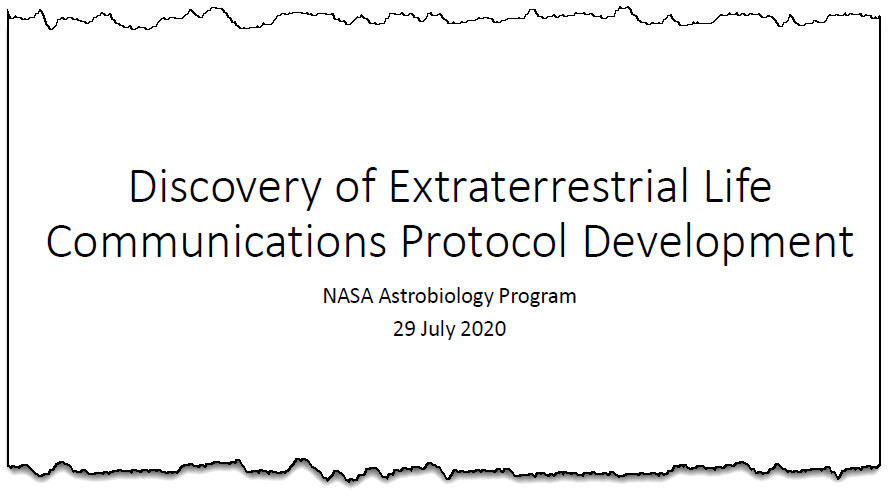
Supporting materials included in the release show that NASA’s work on extraterrestrial discovery communications extends back several years. A presentation titled “Discovery of Extraterrestrial Life Communications Protocol Development,” dated July 29, 2020, outlines foundational considerations for such a scenario.
That document emphasizes that any discovery could vary significantly in nature:
“Factors about the detection/discovery may occur along a spectrum: Location: near (in our Solar System) far (exoplanets) Organism: microbial humanoid Biosignature: chemical/molecular ‘traditional’ fossil”
It also highlights the dual challenge of scientific validation and public communication, stating:
“Differences in socioeconomics, race, gender, education level, culture, faith, etc.”
“Ensure all have accurate information and support to make meaning of it”
“Cultivate a culture of celebration vs. fear”
The opening line of this section places immediate emphasis on how unevenly a discovery of extraterrestrial life could be received across society. By explicitly listing “differences in socioeconomics, race, gender, education level, culture, faith, etc.,” the document acknowledges that public interpretation would not be uniform, but shaped by deeply rooted social and cultural frameworks. The guidance that follows reinforces NASA’s role not simply as a source of scientific data, but as a communicator responsible for ensuring that “all have accurate information and support to make meaning of it,” coupled with an intentional effort to “cultivate a culture of celebration vs. fear.”
Taken together, this section reflects a deliberate focus on managing societal reaction as much as conveying scientific findings, with the underlying premise that public response itself would be a critical component of any confirmed discovery.
Defined Role for NASA in a Discovery Scenario
The documents outline how NASA views its role in the event of such a discovery, emphasizing information dissemination and public engagement.
According to the presentation:
“The provision of accurate scientific information in an equitable way”
“Access to scientific expertise”
“Encouragement of healthy conversation and dialogue”
The agency also describes itself as playing a broader societal role:
“Facilitators in a co-creative, meaning-making process across diverse communities”
Redactions Limit Visibility Into Final Protocol
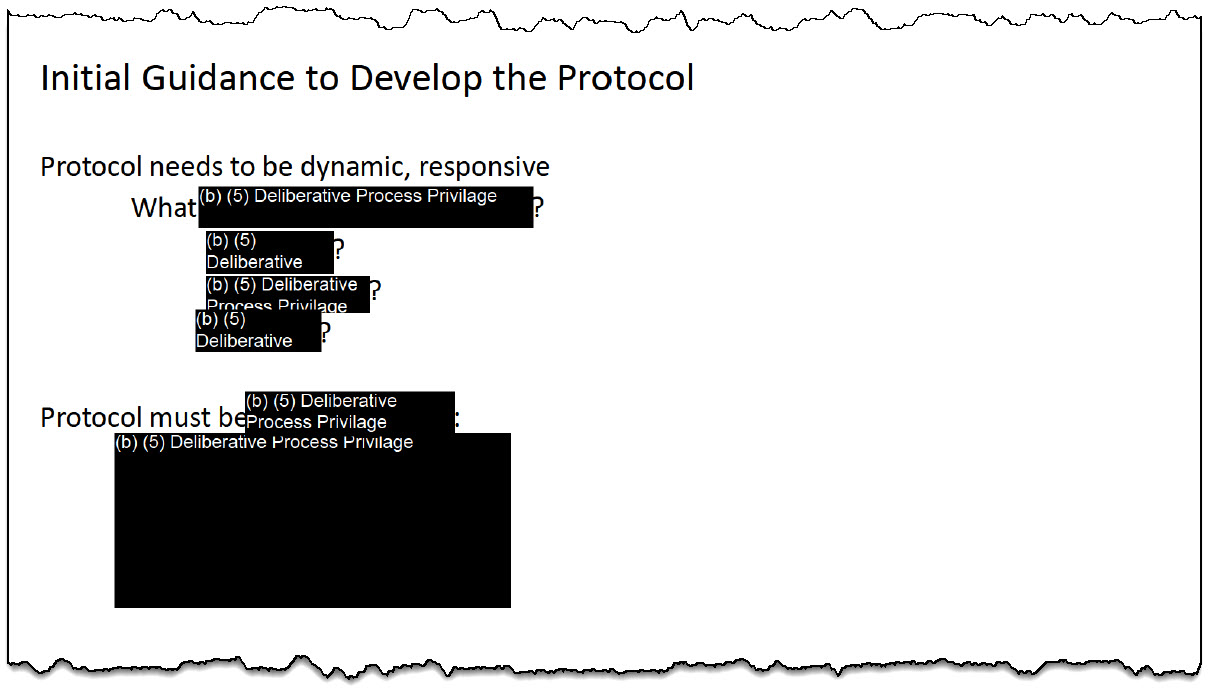
Portions of the material remain withheld under FOIA Exemption 5. NASA states this exemption applies to “draft documents, analyses, recommendations and/or opinions expressed by employees,” which are part of internal deliberations.
A slide labeled “Initial Guidance to Develop the Protocol” contains multiple redactions, obscuring specific recommendations and elements of the proposed communications approach.
Timing Relative to UAP Activity and Public Interest
The June 2025 meeting occurred after a period of sustained public and governmental focus on unidentified anomalous phenomena. In 2023, NASA released the findings of its independent UAP study team, which examined how the agency could contribute to understanding unidentified objects observed in air and space. That study concluded prior to the timeframe of the 2025 communications planning documented in this release.
The records released through this FOIA request do not reference UAP, nor do they connect the communications planning effort to any specific UAP investigation or conclusion.
However, the timing places the renewed discussion within a broader environment of increased attention to anomalous phenomena, congressional hearings, and ongoing public speculation about the possibility of future disclosures related to non-human intelligence. It should also be noted that Dr. Grinspoon was a member of NASA’s UAP study effort.
What the Documents Establish
The records confirm that NASA personnel revisited and actively discussed how to communicate a confirmed discovery of extraterrestrial life as recently as June 2025, building on earlier work conducted within the NASA Astrobiology Program.
The documents do not indicate that any such discovery has occurred, nor do they outline a finalized or approved communications protocol. Significant portions of the deliberative process remain redacted, and no operational plan is fully disclosed.
The Black Vault has filed an appeal fighting the (b)(5) redactions which completely shield the “Initial Guidance to Develop the Protocol” slide. Those results will be posted, when available.
###
Document Archive
 26-00374-F-HQ Release Package [17 Pages, 1.4MB]
 Loading...
 Reload document
 Open in new tab


