
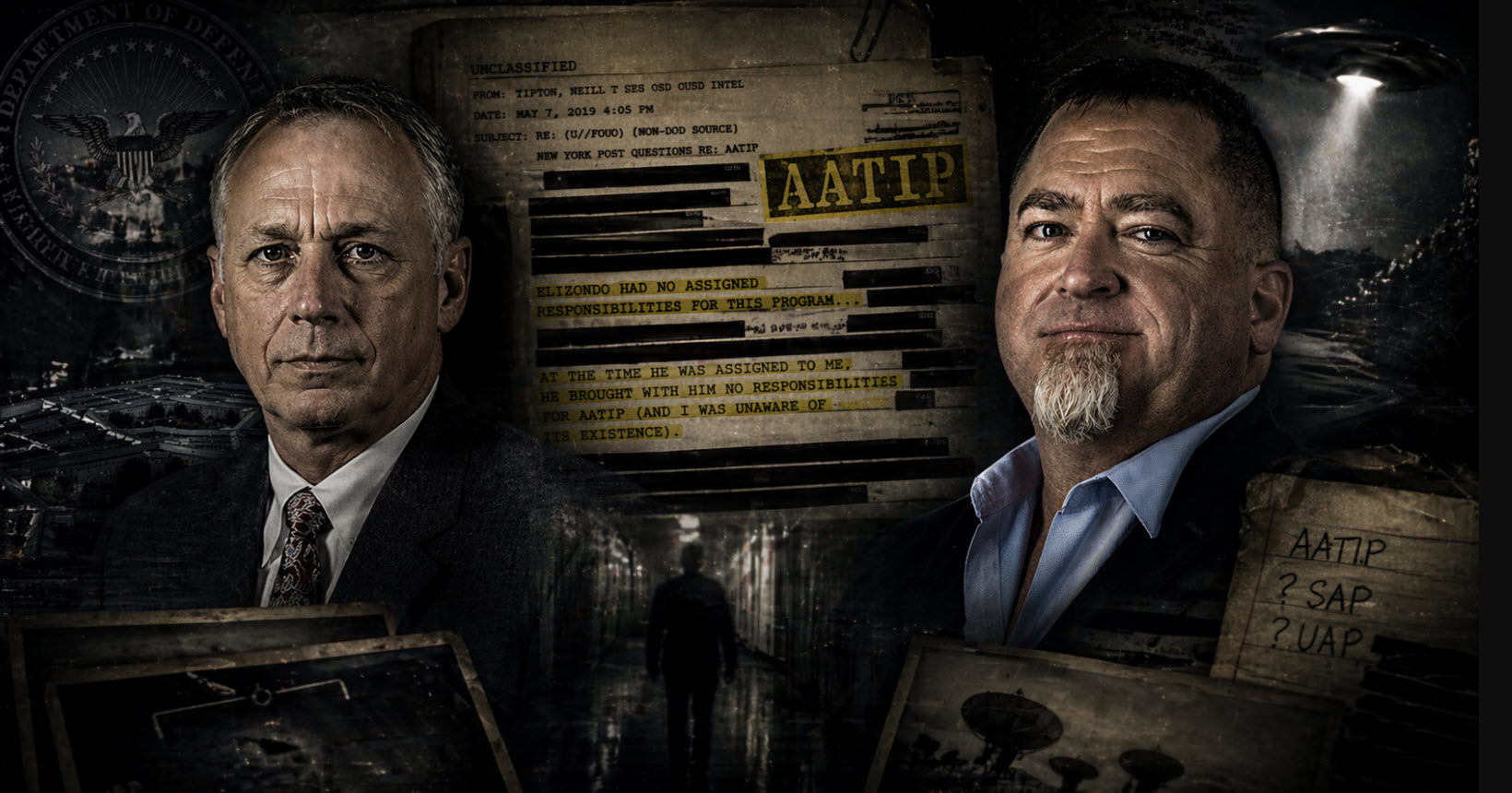


A newly released series of Pentagon emails from May 2019 reveals an internal contradiction at the center of the Department of Defense’s narrative on the Advanced Aerospace Threat Identification Program (AATIP) and Luis Elizondo.
At the center of the records is a May 7, 2019, email from senior Pentagon official Neill Tipton, former Director of Defense Intelligence for Collection and Special Programs, which states in clear terms that Elizondo “had no assigned responsibilities” related to AATIP during his time under Tipton within the Office of the Secretary of Defense (OSD).
Yet the same batch of emails, along with previously released records published by The Black Vault as released via the Freedom of Information Act (FOIA), shows Tipton was directly communicating with Elizondo about AATIP, reviewing a memo to assume responsibilities tied to it, and participating in internal discussions about how the Department should respond to inquiries on the subject.
The newly uncovered email chain also shows that Tipton’s statement did not stand uncontested internally. Instead, it prompted immediate concern among Pentagon officials about contradictions, prior statements, and the need to keep messaging consistent.
Tipton’s Core Statement
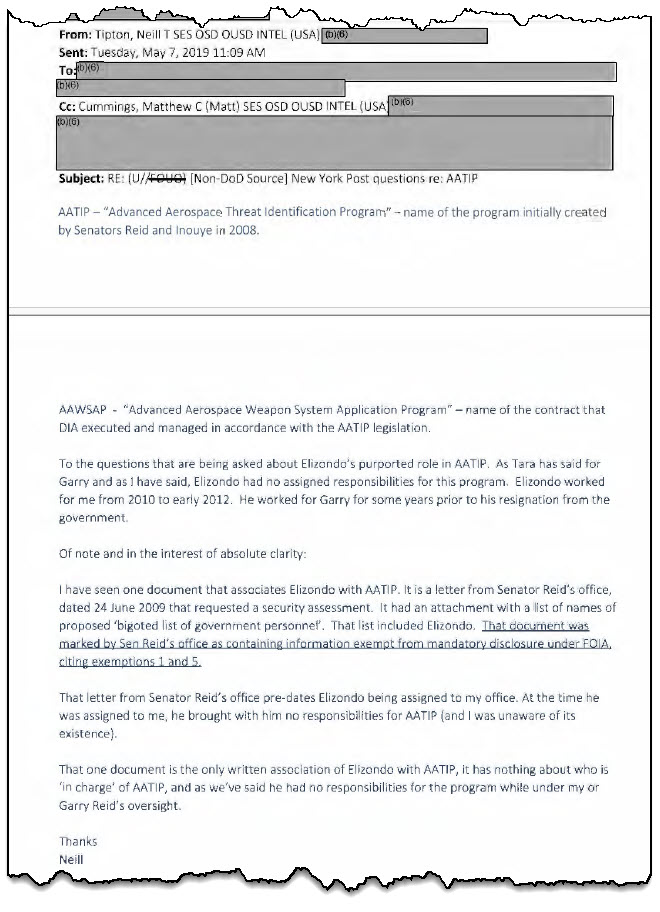
In the May 7, 2019, email, Tipton wrote:
“Elizondo had no assigned responsibilities for this program… Elizondo worked for me from 2010 to early 2012.”
He added:
“At the time he was assigned to me, he brought with him no responsibilities for AATIP (and I was unaware of its existence).”
The language is precise and limited in scope, focusing specifically on Elizondo’s time under Tipton within OSD.
Immediate Internal Reaction
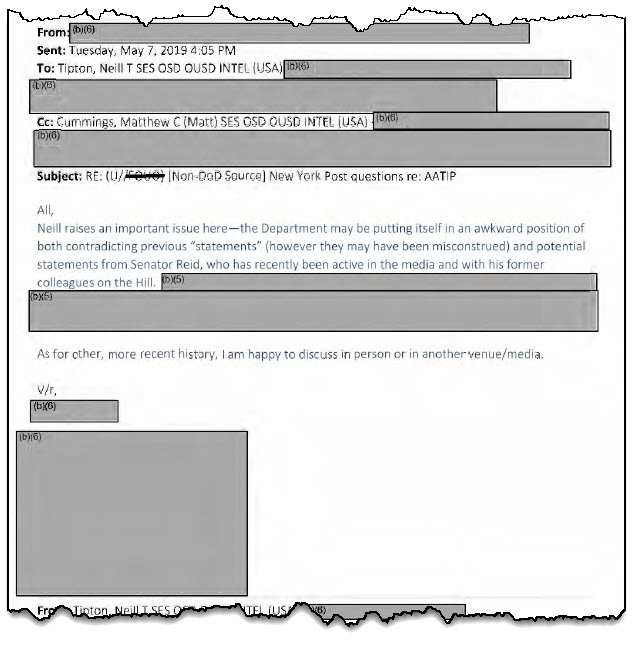
A follow-up email sent later that day by an individuals name that was redacted reflects concern about how the statement could be interpreted:
“Neill raises an important issue here—the Department may be putting itself in an awkward position of both contradicting previous ‘statements’ (however they may have been misconstrued) and potential statements from Senator Reid…”
The message continues:
“As for other, more recent history, I am happy to discuss in person or in another venue/media.”
This indicates that additional context existed but was not being fully revealed in the written response. It also suggests that further discussion was being moved to another setting, outside the documented email exchange, which would limit what is preserved in the official record and subject to a future FOIA disclosure.
Defining the Scope of the Pentagon’s Answer
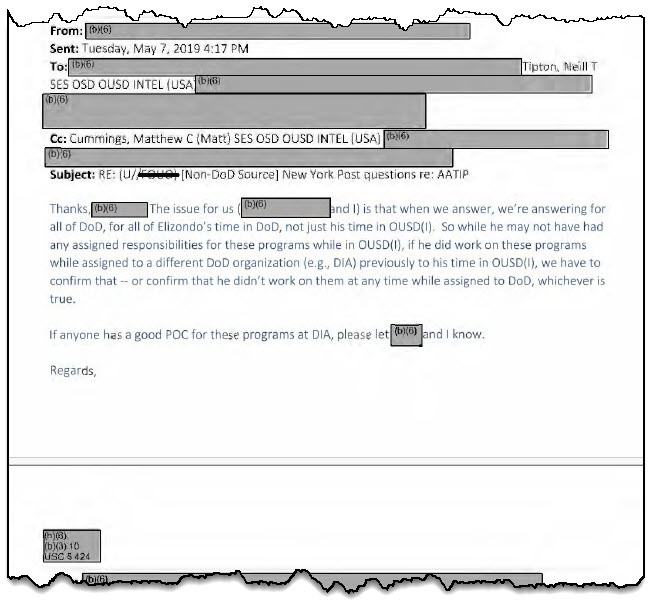
Another email in the chain further clarifies the Department’s internal reasoning:
“The issue for us… is that when we answer, we’re answering for all of DoD, for all of Elizondo’s time in DoD, not just his time in OUSD(I).”
It continues:
“So while he may not have had any assigned responsibilities for these programs while in OUSD(I), if he did work on these programs while assigned to a different DoD organization… we have to confirm that—or confirm that he didn’t work on them at any time while assigned to DoD, whichever is true.”
This internal discussion highlights why the Pentagon’s statement was narrowly framed. It addressed only a specific period and organizational context, rather than Elizondo’s entire time within the Department of Defense. What remains unclear is why the broader context was not included, particularly given the existence of other documented exchanges. Whether additional information influenced how the statement was constructed is not addressed in the available records.
Messaging Coordination
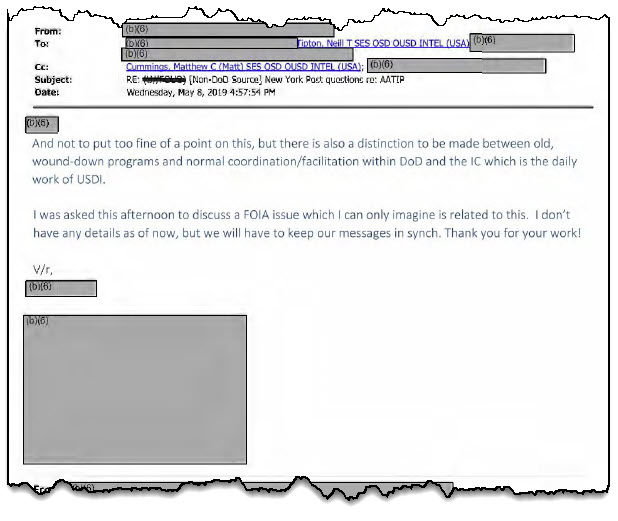
By May 8, 2019, the email chain shows awareness that the issue extended beyond a single response:
“I was asked this afternoon to discuss a FOIA issue which I can only imagine is related to this… we will have to keep our messages in synch.”
That same email introduces an important distinction:
“There is also a distinction to be made between old, wound-down programs and normal coordination/facilitation within DoD and the IC…”
This suggests that internally, officials were grappling with how to define AATIP itself, Elizondo’s role, if any, and how to respond to the public in a unified, synchronized, way.
Documented Exchanges With Elizondo
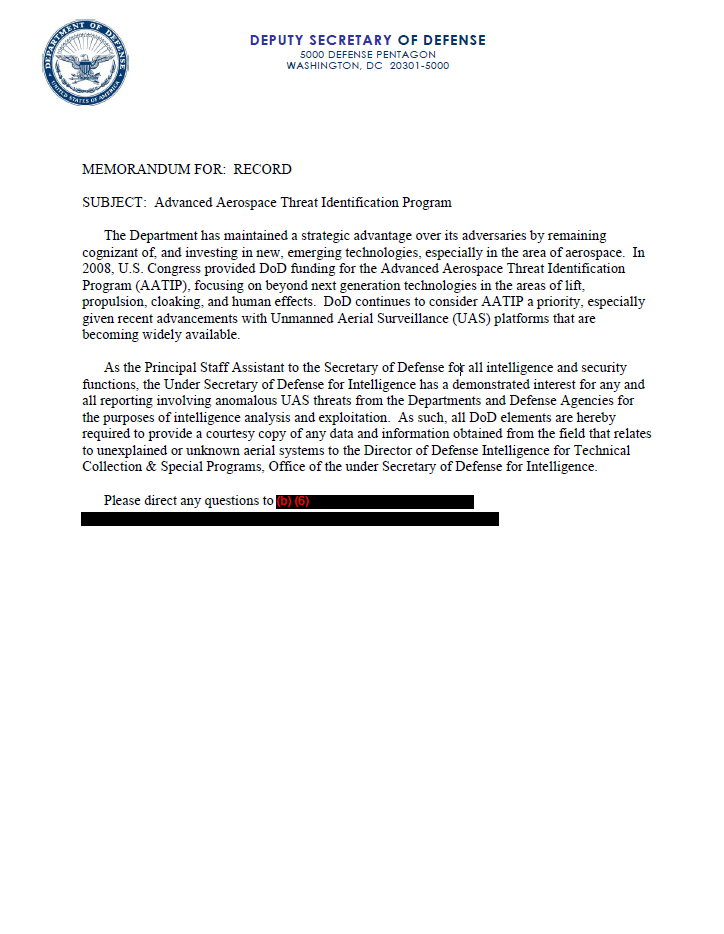
The significance of these internal discussions becomes clearer when compared to previously released records obtained by The Black Vault.
In a September 25, 2017, email, Elizondo wrote to Tipton:
“Per SECDEF’s Front Office guidance to you and me, I took the liberty of drafting a memo… that helps you better assume the new responsibilities for AATIP.”
Tipton responded days later:
“Getting spun back up. Will read and get thoughts back today or tomorrow…”
These exchanges show that Tipton and Elizondo were in direct communication about AATIP, including a draft memorandum outlining responsibilities.
Those exchanges are not referenced in Tipton’s May 7, 2019, email.
The omission is notable because it shows that Tipton was, at minimum, aware of AATIP discussions and had been directly engaged in communications about it.
It should also be noted that efforts by The Black Vault to confirm direct communication between Neill Tipton and Luis Elizondo regarding AATIP responsibilities were neither immediate nor straightforward. The process began with FOIA case 21-F-0964, filed on May 5, 2021, which specifically sought emails between the two officials containing terms such as “AATIP,” “UAP,” and related keywords. Despite the targeted nature of the request, the Department of Defense responded on December 14, 2021, stating that “no records” were found. This response stood in direct conflict with prior research and information indicating that such communications did, in fact, exist.
In response, The Black Vault filed an appeal within one day, citing a specific known email dated September 25, 2017, in which Elizondo contacted Tipton and referenced AATIP directly. That appeal argued that “this fact alone should have yielded at least one responsive document,” and challenged the adequacy of the search conducted. The appeal was ultimately granted in February 2022, forcing the case to be remanded for further processing. However, even after the appeal was approved, procedural issues persisted, including the Department of Defense failing to acknowledge the reopened case until August 2023, which it later stated had been “overlooked.”
When records were eventually produced under the remanded case (21-FR-0964), they confirmed that responsive communications did exist. However, even within those records, key details were initially obscured. In a related FOIA production (case 21-F-1154), portions of the same email chain had previously been released with critical language redacted, including the specific reference to “AATIP” in the context of transferring responsibilities. Only after continued pressure and the appeal process did the unredacted version reveal that Elizondo had written to Tipton that he had drafted a memo “that helps [Tipton] better assume the new responsibilities for AATIP.” This progression from “no records,” to partially redacted records, to eventual disclosure… demonstrates the extent to which confirming even basic facts about these exchanges required sustained effort and formal challenge through the FOIA process.
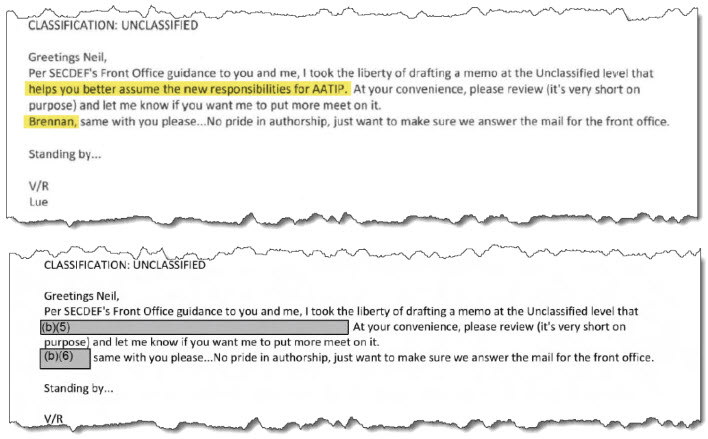
This does not establish that Elizondo formally led AATIP. It also does not confirm the exact structure or status of the program within the Department of Defense.
However, it does demonstrate that AATIP was being discussed between Tipton and Elizondo, including a transfer of responsibilities, which was not reflected in the 2019 internal conversation that led to the public statement. Tipton emphasized that he was “unaware of AATIP’s existence,” a statement tied to an earlier period when Elizondo worked under him. Yet documented emails from 2017 show Tipton was later engaged in direct discussions about AATIP, raising questions about why that context was not included in his 2019 account.
Speculation on What Was Left Unsaid
It is not explained in the documents why this context was omitted. If AATIP was considered an informal effort, a limited initiative, or a responsibility outside formal assignment structures, that context could have been articulated within the public statement to provide greater clarity.
Similarly, if AATIP was viewed as a minor or secondary activity, that distinction could have been conveyed using established Pentagon terminology, as well.
However, the absence of any reference to documented exchanges between Tipton and Elizondo adds to the existing uncertainty and raises additional questions that are not addressed in the available records, nor is any of it addressed in any official statements by the Pentagon.
Statement From Luis Elizondo
Luis Elizondo, in a statement provided to The Black Vault for this article, disputes Tipton’s characterization and asserts that the documentary record reflects a different reality.
Elizondo stated:
“There exists several emails and documents that illustrate as a matter of fact that Neill not only knew about my involvement in AATIP, but that he had agreed to replace me and assume my responsibilities.
It’s disappointing to see senior leaders outwardly lie to their chain of command to save their own butts, but given Neill’s new role at the time, and the massive witch hunt Garry Reid had initiated to tear me down and erase me, I understand why Neil wrote what he did. But it still does not make it right.
There are numerous witnesses that also briefed Neil WITH ME present. I think this email by Neill proves once and for all how they attempted to change the narrative. However, I sure wish someone would ask him the same question under oath. I guarantee to you his statement would not be the same if he knows the consequences for lying.
This is yet another example of the tremendously unjust efforts by my former leadership to try and cover their butts while throwing me to the wolves. I am relieved that people are now seeing the truth for what it really is.
AATIP was real, I was the senior ranking official, and since my departure the Pentagon has tried every way to change the narrative. It’s shameful but I am not the last bit surprised; business as usual I guess…and they wonder why our citizens have lost all faith and confidence at the Pentagon. If Hegseth were to read this, I sure hope he would fire some people.”
These claims are presented as Elizondo’s position and are not independently and/or fully verified within the scope of the released documents. Elizondo’s comments are published here, in full, and unedited.
Neill Tipton did not respond to a request for comment.
A Record Still Taking Shape, Nearly 10 Years Later
The May 2019 email chain does not resolve the longstanding questions surrounding AATIP or Elizondo’s role. It does not confirm that Elizondo led a formal program, nor does it define the full scope or structure of AATIP.
What it does show is that Pentagon officials were actively discussing how to respond, how to align messaging, and how to avoid potential contradictions.
It also shows that known communications between key individuals were not reflected in at least one official internal explanation that led to the DoD’s publish statements about Elizondo and AATIP.
Whether that omission reflects incomplete knowledge, narrow framing, or other factors is not addressed in the available record, thus far.
As additional documents continue to emerge, the historical record surrounding AATIP and the roles of those involved remains incomplete and continues to evolve.
The Black Vault has numerous outstanding FOIA requests on this specific issue, many of which have been pending for more than six years, which may yield additional records that further clarify these unresolved questions.
The full batch of 400+ pages of records containing the above email thread is currently under appeal, as The Black Vault is challenging the extensive redactions in key portions of the conversations. The outcome of that appeal will be reported when available.
###
Document Archive
 20-F-0163 Full Release Package [418 Pages, 17MB]
 Loading...
 Reload document
 Open in new tab


